GAZA STRIP — Barely 48 hours after U.S. President Donald Trump announced a "historic breakthrough" for the complete disarmament of Hamas, fresh violence on the ground has threatened to derail the fragile diplomatic roadmap. Israeli military strikes in the Gaza Strip have killed at least five Palestinians, underscoring the deep chasm between high-level diplomatic texts and the harsh realities on the battlefield.
The latest flare-up serves as an immediate, bloody test for the newly unveiled U.S.-led peace framework.
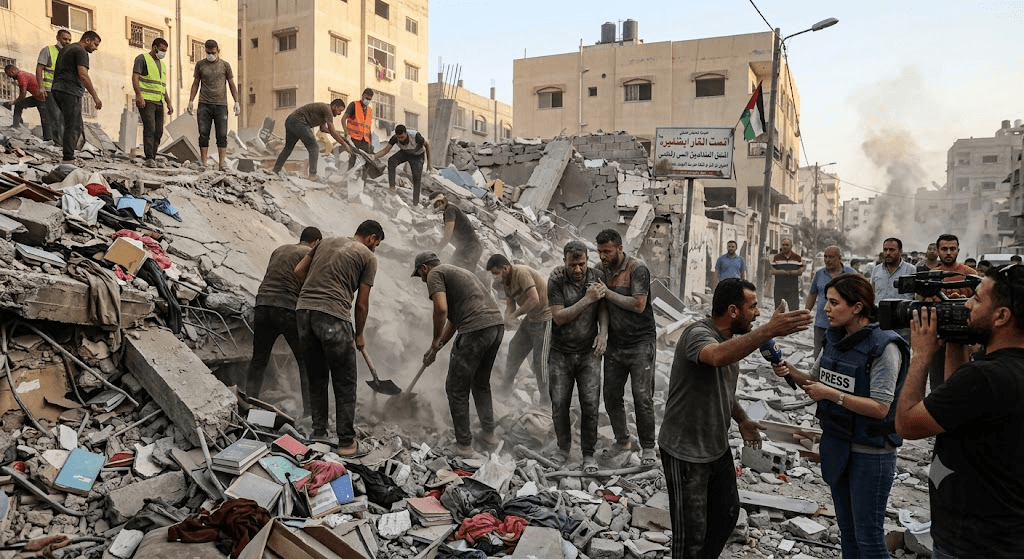
According to local officials, Israeli forces conducted targeted operations in the enclave, resulting in five casualties. The Israel Defense Forces (IDF) has maintained that their operations target active security threats, previously noting the targeting of commanders and weapons smugglers.
However, the timing of the strikes could not be more volatile. It comes directly on the heels of President Trump's announcement on Truth Social that the U.S.-led "Board of Peace"—with mediation from Egypt, Qatar, and Türkiye—had secured a phased agreement for the total disarmament of Hamas and other armed factions in Gaza.
For residents in Gaza, the ongoing military activity shatters any immediate hope that the newly minted deal would bring an instant halt to the violence.
The diplomatic breakthrough announced on July 31 outlines an intricate, phased process aimed at stabilizing the region. Under the terms of the agreement, Hamas and other armed factions are required to systematically surrender their heavy weaponry to the National Committee for the Administration of Gaza (NCAG), which serves as a transitional body composed of Palestinian technocrats.
In response to these verified disarmament milestones, Israeli forces are expected to execute a phased withdrawal from the Gaza Strip. To ensure long-term stability and secure the territory during this transition, an International Stabilization Force (ISF) will deploy to work directly alongside a newly established Palestinian police force.
Despite Hamas negotiators tentatively accepting the draft roadmap, the order of operations remains a massive structural flaw. Hamas maintains that a total cessation of Israeli hostilities and initial military withdrawal must happen first. Conversely, Israeli officials have reiterated that complete demilitarization is an absolute prerequisite before any troop withdrawals begin.
While Washington celebrates the roadmap as a monument to deal making, the political atmosphere in Israel is markedly skeptical. Prime Minister Benjamin Netanyahu has yet to formally endorse the agreement, face-to-face with intense pressure from his right-wing coalition partners. National Security Minister Itamar Ben Gvir openly slammed the text, warning it would simply allow "Hamas to organize for the next massacre."
With political analysts pointing out that neither side trusts the other to take the first step, the Board of Peace's 14-day window to finalize a concrete implementation timetable looks incredibly narrow.
The U.S. administration hopes that international pressure will eventually force both sides to comply. But as smoke rises from the latest strike zones in Gaza, the immediate danger is that tactical military engagements will shatter the diplomatic track before it even formally begins.
For the millions caught in the crossfire, the theoretical promise of a phased peace plan remains entirely eclipsed by the deadly reality of ongoing warfare.
Published by Banx Network. This article is part of the Banx decentralized media programme, powered by the BXE token on the XRP Ledger.