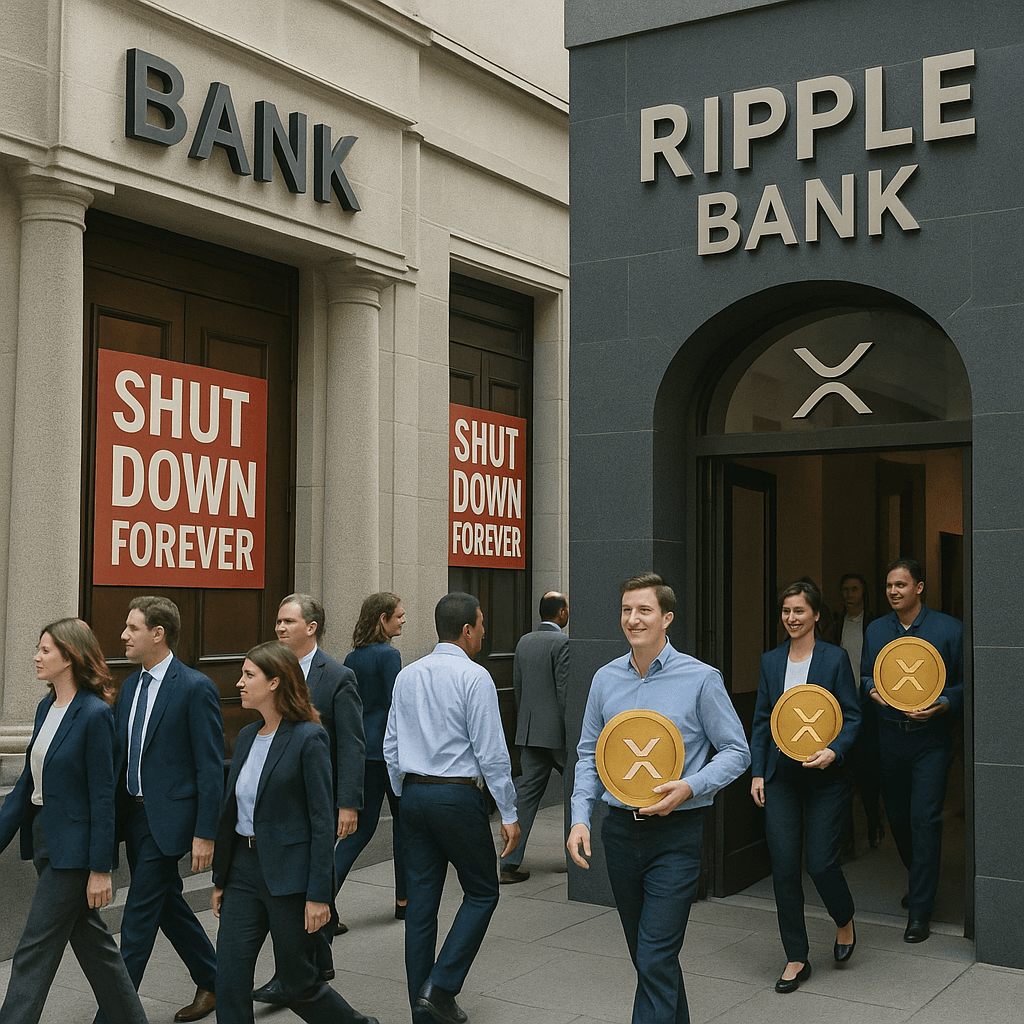
The global financial landscape is shifting at unprecedented speed. Data shows that over 3,000 U.S. bank branches have closed in 2025 alone, according to FDIC and industry filings, marking one of the steepest annual declines in modern history. Rising digital adoption, cost pressures, and the growing influence of blockchain-based finance are driving institutions to consolidate physical operations.
At the same time, Ripple is awaiting approval for its U.S. national trust bank license, expected to be finalized before year-end. If granted, Ripple Bank would become one of the first blockchain-native institutions recognized under U.S. federal banking law. The license would allow Ripple to directly integrate XRP into regulated financial flows — opening doors for cross-border settlements, tokenized assets, and institutional custody services.
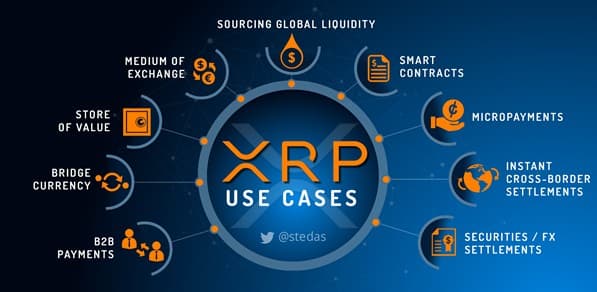
Ripple’s Strategic Play: XRP as a Global Settlement Currency
Ripple’s vision goes beyond retail banking. By combining a bank charter with its existing payments network, Ripple aims to position XRP as the backbone of international settlement, reducing reliance on SWIFT and fiat intermediaries. Analysts have pointed out that Ripple’s push coincides with a surge in tokenization partnerships — from DBS Bank and Franklin Templeton’s money-market tokenization pilot to broader central bank digital currency (CBDC) experiments.
Privacy and compliance remain critical hurdles. Ripple CEO Brad Garlinghouse recently highlighted the need for a privacy layer that protects institutional flows while remaining regulator-friendly. Such upgrades, once live, could accelerate XRP adoption by banks wary of exposing transaction details on public ledgers.
Where BXE Token Fits In
Parallel to Ripple’s developments, the BXE Token has emerged as the utility backbone of the XRP Ledger’s expansion. Unlike XRP, which focuses on settlement, BXE powers institutional tokenization programs and decentralized media directly on XRPL.
Institutional Onboarding: Since the August 2025 launch of BanxChange’s institutional tokenization program, every company that creates an asset on XRPL triggers a burn of 1,000–10,000 BXE tokens, directly reducing supply.
Decentralized Media: In September, BanxChange launched a decentralized journalism program that pays authors in real time on-chain. Over 300 articles have been published to date, with 10 million BXE allocated to fund contributors, and 100 BXE burned per approved article.
The token’s fixed supply of 500 million makes these burns significant. And with the November 14th centralized exchange listing of BXE set to coincide with a 10 million token burn, investors are watching for a potential “supply shock” that could amplify its valuation.
Convergence: Banks Decline, Blockchain Rises
The juxtaposition is stark: while thousands of physical bank branches shutter, Ripple prepares to open a fully digital, blockchain-native bank. And at the heart of XRPL’s institutional and media expansion sits BXE Token, anchoring utility in both trillion-dollar industries — banking and media.
For many, this signals more than just fintech disruption. It points to a structural re-alignment of global finance, where blockchain tokens like XRP and BXE are positioned not as speculative side-bets, but as the infrastructure of tomorrow’s economy.
⚡ Upcoming Milestone: November 14, 2025 — BXE Token centralized exchange listing and 10 million token burn event
Published by Banx Network. This article is part of the Banx decentralized media programme, powered by the BXE token on the XRP Ledger.