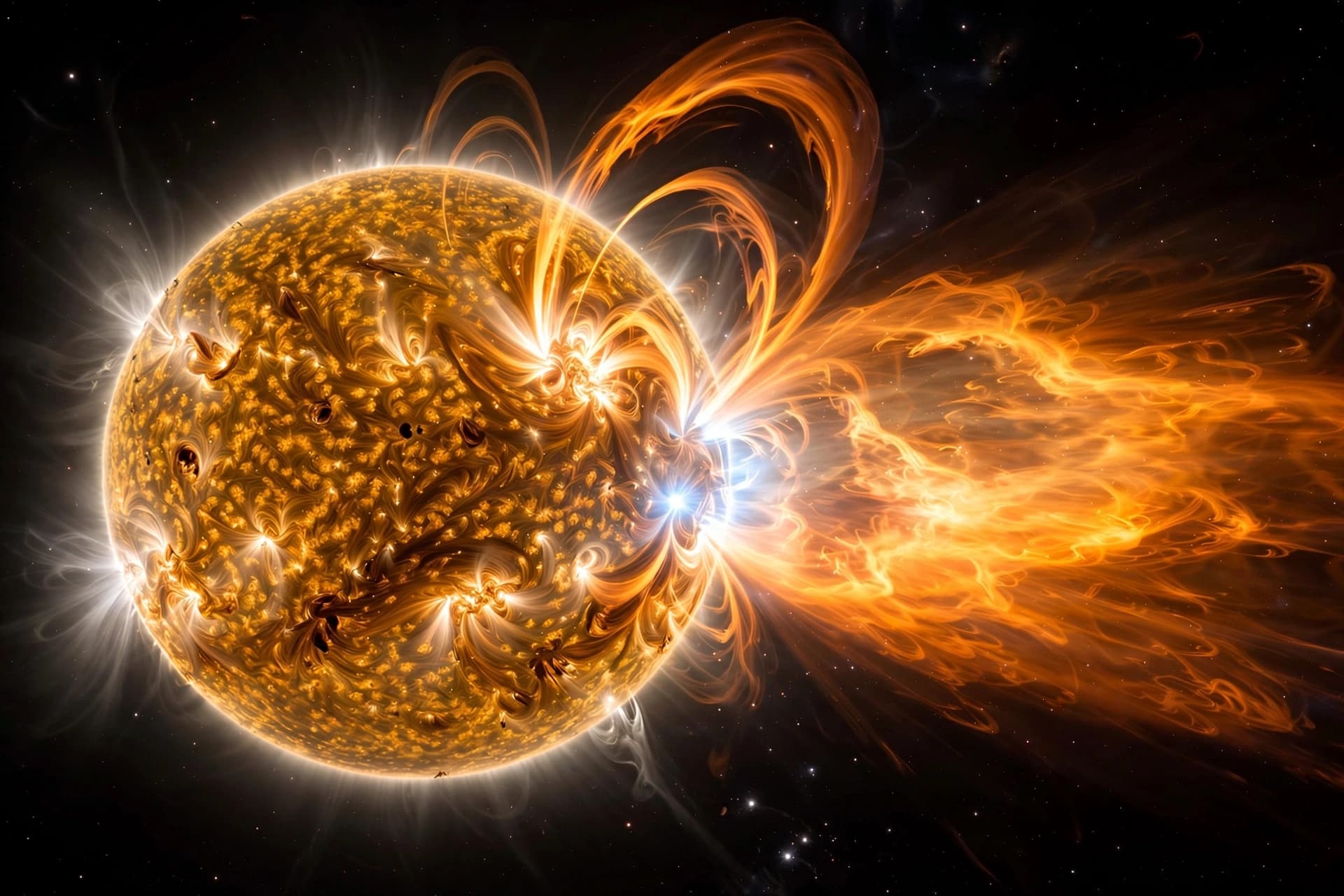
The Sun, our steady and reliable source of light and life, is often perceived as a benign neighbor in the cosmos. However, recent research suggests that this calm demeanor may be deceptive. A new study indicates that our star is capable of producing "superflares"—massive eruptions of energy far more powerful than anything recorded in modern history. While such events are rare, occurring perhaps once every century, their potential impact on our technology-dependent society is profound.
The findings, led by researchers at the Max Planck Institute for Solar System Research, analyzed data from thousands of sun-like stars observed by the Kepler space telescope. They found that superflares, which release up to 1,000 times more energy than typical solar flares, occur on about one percent of sun-like stars. Given that our Sun shares key characteristics with these stars, it is statistically likely that it too possesses the magnetic machinery necessary to generate such extreme events.
Historically, the most powerful solar storm recorded was the Carrington Event of 1859, which disrupted telegraph systems and caused auroras visible near the equator. A superflare would be significantly more intense, potentially damaging satellites, disrupting power grids, and interfering with global communications. In today’s interconnected world, the consequences could be catastrophic, affecting everything from GPS navigation to financial transactions.
The study emphasizes that while the probability of a superflare is low, it is not zero. The Sun’s magnetic activity follows an 11-year cycle, with periods of increased storminess. We are currently approaching the peak of Solar Cycle 25, which has already shown higher-than-average activity. While this does not guarantee a superflare, it serves as a reminder of the Sun’s dynamic and unpredictable nature.
Preparing for such an event requires international cooperation and robust infrastructure. Scientists are working to improve space weather forecasting, using satellites to monitor solar activity in real time. Early warnings could allow operators to shut down vulnerable systems, minimizing damage. However, long-term resilience will require hardening power grids and developing backup systems for critical services.
For the public, the news may seem alarming, but it is important to maintain perspective. Superflares are rare, and the Sun has been stable for billions of years. The risk is manageable with proper preparation and awareness. Understanding the Sun’s capabilities allows us to take proactive steps rather than living in fear. It is a call for vigilance, not panic.
Moreover, studying superflares on other stars helps us understand the broader context of stellar evolution. It reveals that our Sun is not unique in its potential for violence, but part of a larger family of variable stars. This knowledge enriches our understanding of the cosmos and our place within it, highlighting the delicate balance that makes life on Earth possible.
In the end, the possibility of superflares is a testament to the power of our star. It reminds us that while the Sun gives life, it also holds the potential for disruption. By respecting this power and preparing for its extremes, we can ensure that our civilization remains resilient in the face of cosmic uncertainty.
AI Image Disclaimer: The visual aids included here are AI-generated illustrations of solar activity and space weather concepts, not actual photographs of the Sun or specific satellite data.
Sources: Max Planck Institute for Solar System Research Universe Today Live Science
Published by Banx Network. This article is part of the Banx decentralized media programme, powered by the BXE token on the XRP Ledger.