There is a particular reassurance in the phrase "performed as expected"—words that sound mundane until you remember what was expected. The Orion capsule's heat shield was asked to endure a reentry at speeds approaching 48,000 kilometers per hour, with external temperatures exceeding 4,000 degrees Fahrenheit, and to keep four astronauts inside at a comfortable room temperature. That it did so, and that NASA has now confirmed it, is a quiet triumph of engineering over the inferno.
NASA's rigorous analysis of the Artemis II heat shield has confirmed that the thermal protection system performed as predicted during the crew's return from the Moon, according to a statement released this week . The spacecraft reached a maximum velocity of 39 times the speed of sound—roughly 48,000 kilometers per hour—and experienced external temperatures exceeding 4,000 degrees Fahrenheit at its peak, while the cabin remained in the mid-70s Fahrenheit . The mission was the first time astronauts flew aboard Orion.
The heat shield's performance was not a foregone conclusion. During the uncrewed Artemis I mission in 2022, the shield sustained more damage than NASA had anticipated, with small cracks and charred material breaking off. An intense two-year investigation followed, and NASA made a key decision: it did not physically modify the shield for Artemis II. Instead, it changed the reentry trajectory, shortening the maximum downrange distance the spacecraft could fly between atmospheric entry and splashdown. Analysis had shown that limiting this distance would reduce the time the shield spent in the temperature range where the Artemis I phenomenon occurred .
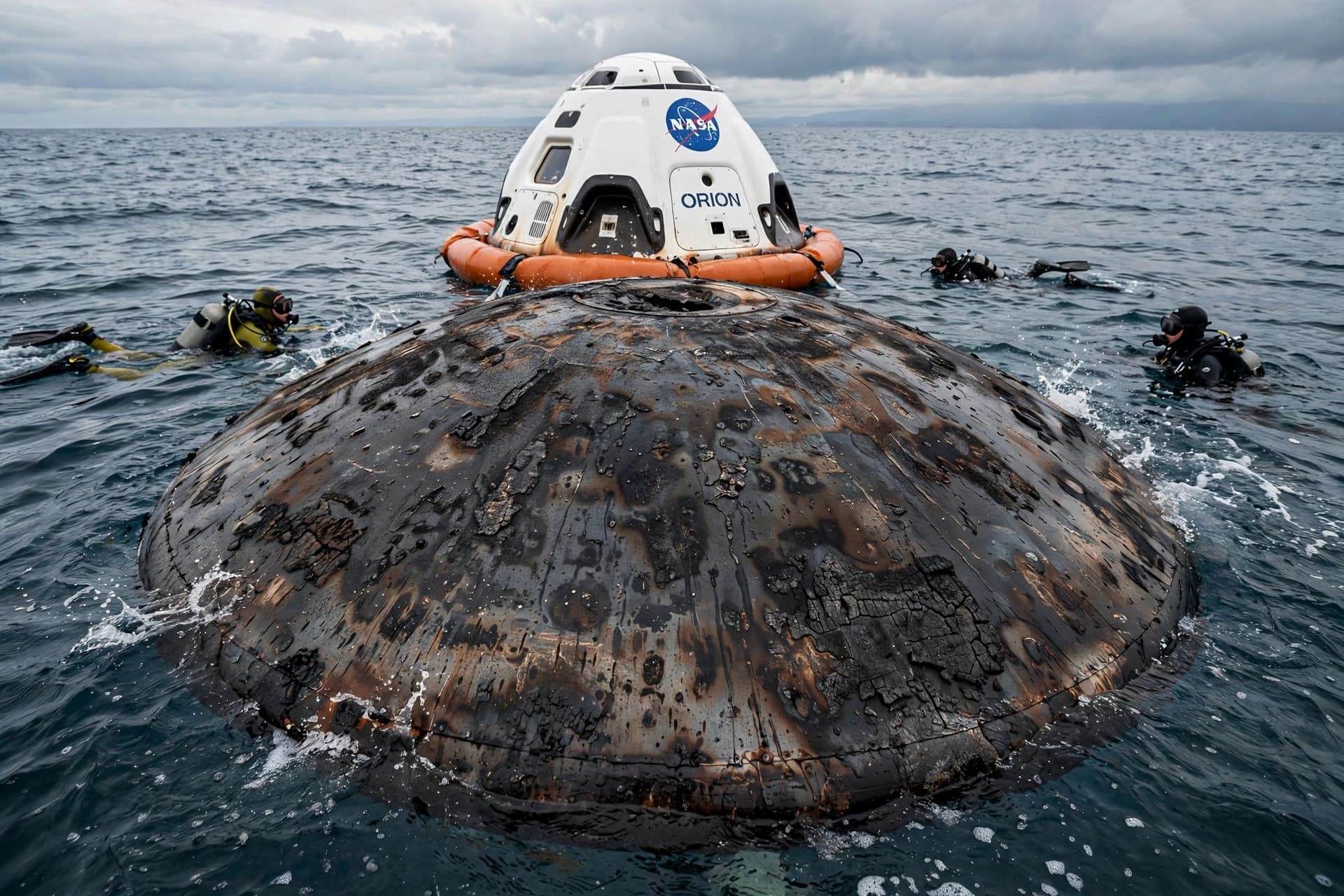
The modification worked. Engineers found only nine spots of char loss on the Artemis II heat shield dish, compared to 103 during Artemis I—a reduction by a factor of ten . The 186 blocks of Avcoat, the ablative material that protects the crew, functioned as intended. The backshell, made up of 1,300 ceramic tiles, showed no signs of overheating, and features designed to seal and protect windows, vents, and thrusters met expectations .
The precision of the reentry was also notable. Orion entered the atmosphere within only 192 feet of its targeted entry interface and splashed down just 0.59 miles from the predicted landing site off the coast of San Diego . The spacecraft's aerodynamic and aerothermal performance, including the heat shield and backshell, was in line with engineering predictions based on pre-flight analyses and ground testing.
What the technical language does not fully capture is the human stakes. The heat shield is the only barrier between the crew and complete destruction during reentry. When Artemis II commander Reid Wiseman described the experience, he said, "We came in fast, and we came in hot" . He and pilot Victor Glover reported seeing brief moments of char loss during the descent, but the shield held. NASA Administrator Jared Isaacman, speaking after the mission, was direct: "No chunks missing. The heat shield performed as expected, and I'm thrilled, because now we're done with this thing" .
The confirmation clears a critical hurdle for the Artemis program. The heat shield's performance on Artemis II validates the trajectory modifications and the design, providing the confidence needed for Artemis III and the planned return of humans to the lunar surface. Engineers are continuing to analyze samples extracted from the heat shield, comparing post-flight laser scans to pre-flight measurements, but the core question—whether Orion can bring astronauts home safely from the Moon—has been answered.
The capsule will fly again. The shield will face the same fire. And the phrase "performed as expected" will carry, for those who understand what it means, the weight of a quiet miracle.
AI Image Disclaimer: This article includes AI-generated imagery created for illustrative purposes only.
Sources: NASA, NDTV, Autoevolution, Kompas.com
Published by Banx Network. This article is part of the Banx decentralized media programme, powered by the BXE token on the XRP Ledger.