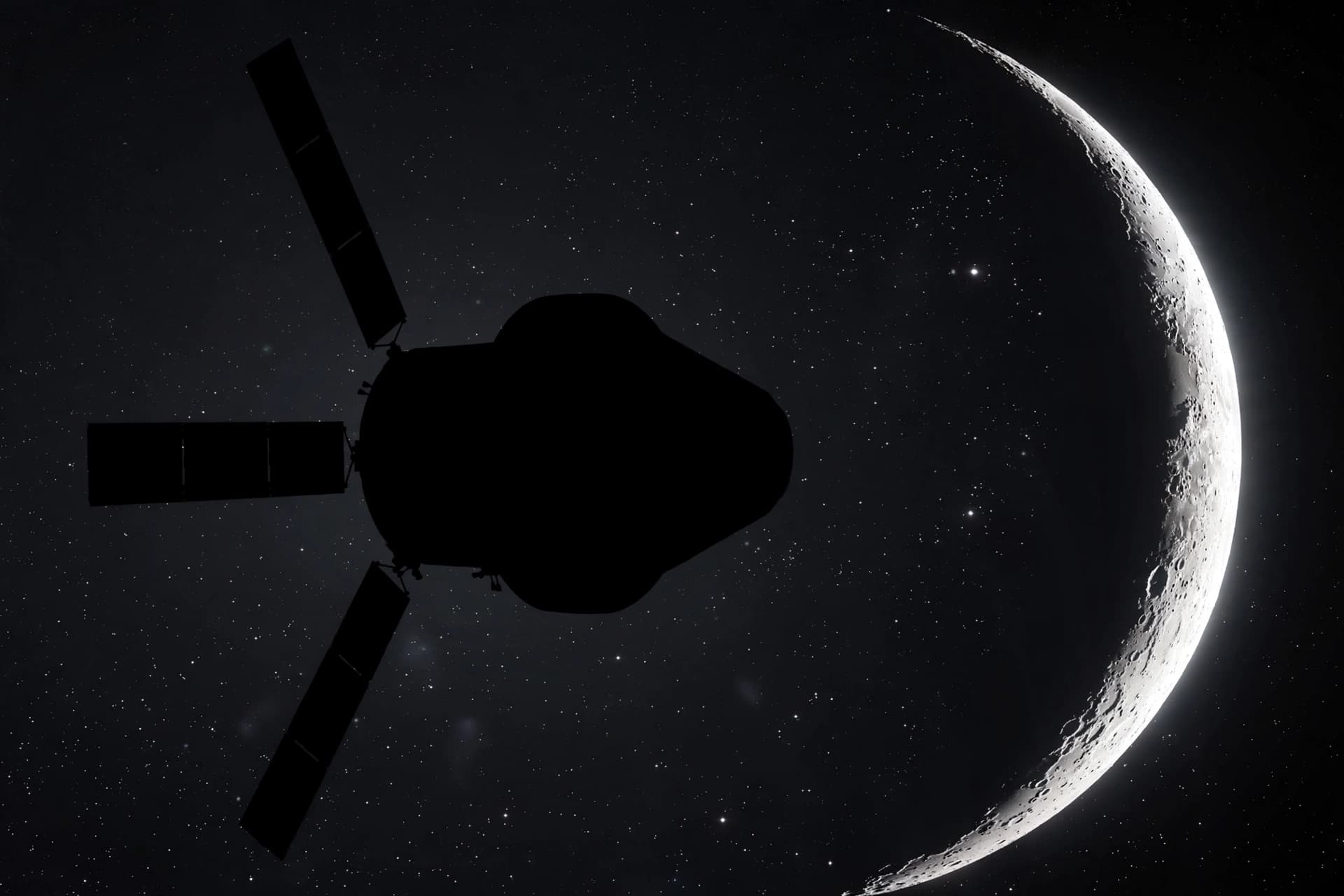
In April 2026, the Artemis II mission carried four astronauts farther from Earth than any humans had traveled in over fifty years. Their vessel, the Orion spacecraft, was tasked with proving its capability to sustain life and operate safely in the harsh environment of deep space. As the crew circled the Moon and returned home, they did more than just break distance records; they validated a new era of human exploration, demonstrating that Orion is ready to serve as the bridge between low-Earth orbit and the lunar surface.
The mission’s primary objective was to test Orion’s life support systems, navigation, and communication capabilities during a prolonged journey beyond the protection of Earth’s magnetosphere. For ten days, astronauts Reid Wiseman, Victor Glover, Christina Koch, and Jeremy Hansen monitored the spacecraft’s performance, conducting a series of checks and experiments. The results were overwhelmingly positive, with all major systems functioning within expected parameters. This success provides NASA with the confidence needed to proceed with Artemis III, which aims to land humans on the Moon.
One of the most critical tests involved the spacecraft’s heat shield, which protects the crew during re-entry into Earth’s atmosphere at speeds exceeding 25,000 miles per hour. During Artemis I, an uncrewed test flight, some unexpected charring was observed on the shield. For Artemis II, engineers had made adjustments, and the crew’s safe return confirmed that these modifications were effective. The heat shield held firm, ensuring that the capsule remained intact and the interior temperature stable during the fiery descent.
Beyond technical systems, the mission also focused on human factors. Living in the confined space of Orion for ten days required careful management of resources and morale. The crew reported that the habitat was comfortable and functional, with adequate sleeping quarters and workspaces. They conducted medical experiments to study the effects of deep space radiation and microgravity on the human body, gathering data that will be crucial for future long-duration missions to Mars.
The trajectory of Artemis II took the spacecraft on a free-return path around the Moon, reaching a maximum distance of over 250,000 miles from Earth. This maneuver tested Orion’s propulsion and navigation systems in real-time, allowing ground controllers to verify their ability to guide the ship accurately. The precision of the flyby demonstrated the robustness of the guidance software and the reliability of the Space Launch System (SLS) rocket that propelled them into space.
Communication delays, inherent in deep space travel, were also managed successfully. As the distance increased, the time lag for signals grew, requiring the crew to operate with greater autonomy. This experience is invaluable for preparing astronauts for future missions where real-time support from Earth will not be possible. The team’s ability to troubleshoot and adapt highlighted the importance of training and psychological resilience in space exploration.
The success of Artemis II marks a pivotal moment in the history of spaceflight. It proves that the United States has the capability to return humans to the lunar vicinity and lays the groundwork for sustainable presence on the Moon. The data collected during this mission will inform the design of future spacecraft and habitats, ensuring that they are safe and efficient for explorers.
Artemis II has delivered on its promise, proving that Orion is capable of handling the rigors of deep space. The mission’s success is a testament to the dedication of thousands of engineers, scientists, and astronauts who worked to make it happen. As NASA looks toward Artemis III and beyond, the lessons learned from this journey will guide the next steps in humanity’s return to the Moon and eventual voyage to Mars.
AI Image Disclaimer: The visuals in this article are AI-generated illustrations intended to depict the Orion spacecraft and lunar flyby concepts, not actual photographs from the Artemis II mission.
Sources: NASA, Space.com, Wikipedia, USA Today
Published by Banx Network. This article is part of the Banx decentralized media programme, powered by the BXE token on the XRP Ledger.