There are creatures that seem to belong more to myth than to the ordinary catalog of living things, and the lion's mane jellyfish is one of them. To encounter one at night, in the black water of the Salish Sea, is to be reminded that the ocean still holds shapes and scales that resist easy description. Underwater videographer John Roney did not see the animal first. He saw a single tentacle, trailing overhead like a thread let down from some unseen ceiling, stretching beyond the reach of his light.
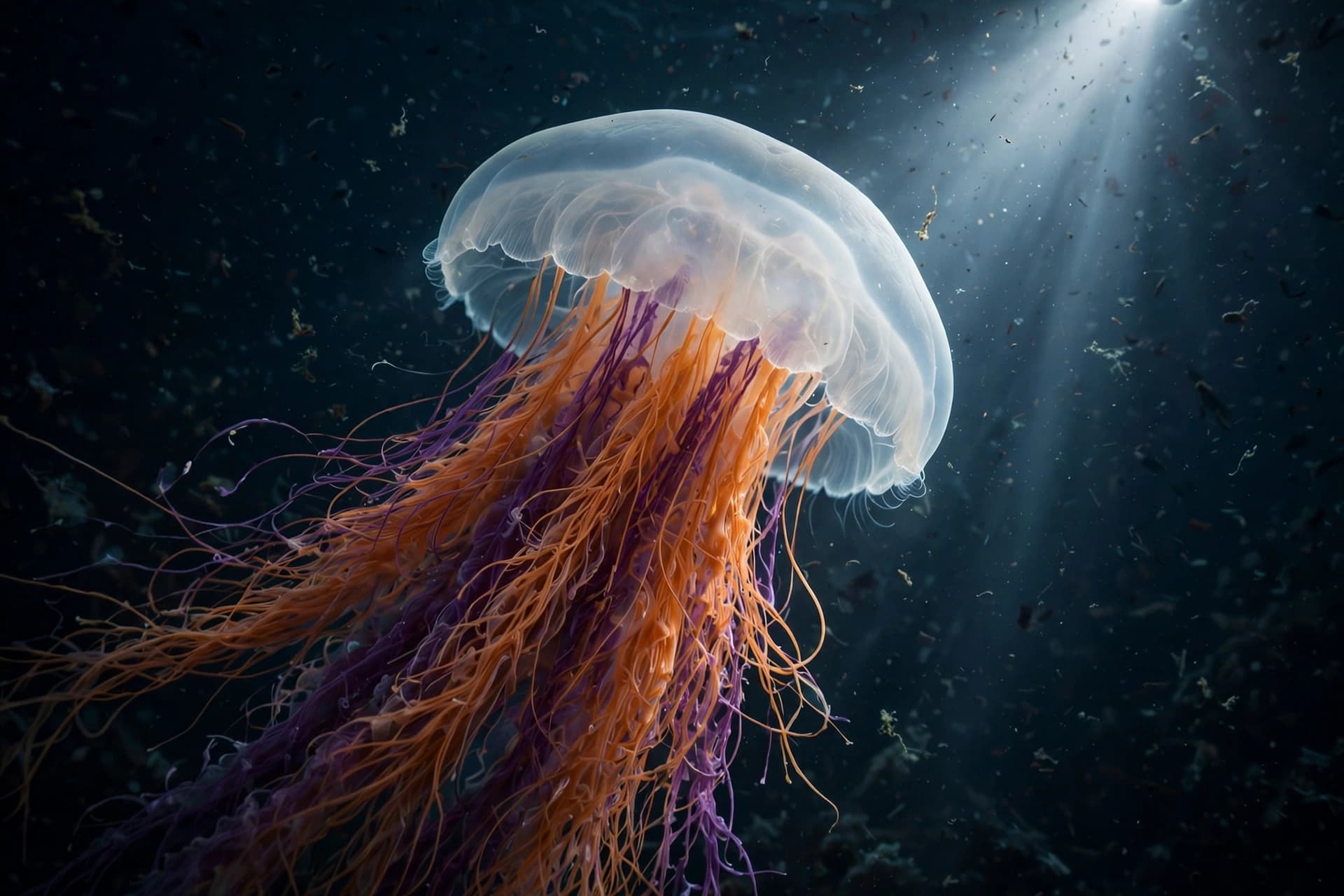
Roney followed that thread through the darkness for more than a minute before the creature itself came into view: a lion's mane jellyfish of extraordinary size, pulsing slowly through water flecked with marine snow . The footage he captured, shared publicly later, shows a pale, translucent bell drifting above a dense cluster of tentacles colored in deep orange, purple, and crimson. It is a hypnotic sight, and a slightly unsettling one, given what those tentacles are capable of.
The lion's mane jellyfish, Cyanea capillata, holds a legitimate claim to the title of heaviest known jellyfish. The largest recorded specimen had a bell diameter of roughly seven feet and tentacles extending up to 120 feet, according to measurements cited by the Smithsonian and Guinness World Records . Weight is difficult to establish with precision—weighing a jellyfish of that size is not a practical exercise—but estimates place the maximum at over one metric ton. Much of that mass is tentacle, a sprawling net of stinging tissue designed to ensnare fish, zooplankton, and other jellyfish.
The Salish Sea, where Roney was diving, is a marginal sea of the Pacific Ocean between British Columbia and Washington State. Its cold, nutrient-rich waters are known for supporting large marine life, and the lion's mane jellyfish is a seasonal presence there . The species tends to grow larger in colder waters, a phenomenon sometimes called polar gigantism, though the precise reasons for this pattern are still a subject of study. The animal Roney filmed was not measured, but the length of tentacle he followed before finding the bell suggests a specimen of considerable size.
Roney's footage has circulated widely, and much of the commentary has focused on the creature's beauty. The colors are indeed striking—the tentacles carry pigments that range from warm orange to deep violet, and against the black water they appear almost luminous. But Roney himself offered a caution in his account of the dive: this is not a jellyfish one should touch . The stings are moderately painful to humans, and for someone with sensitivities or an allergic response, they could be more serious.
There is a literary footnote to this animal that is worth mentioning, not because it changes the science but because it illustrates how fear and wonder often travel together. Sir Arthur Conan Doyle, in a Sherlock Holmes story, imagined a lion's mane jellyfish as a mysterious killer. The fictional portrayal was exaggerated, but it stuck in the cultural memory. The real animal is not a murderer of men, but it is a highly effective predator of the small creatures it feeds upon, and its stinging cells are not decorative.
What the footage offers, beyond spectacle, is a reminder of how much of the ocean remains unfamiliar. The lion's mane is not a rare species, but encounters of this kind—a diver, a night, a creature of that size emerging from the dark—are not everyday events. Most people will never see one alive, and even those who spend their lives on the water may go years without crossing paths with a specimen of this magnitude. The video is a window, briefly opened.
For now, the jellyfish continues its slow drift through the Salish Sea, trailing its long and stinging threads behind it. It is heavy, and old in its lineage, and entirely indifferent to the attention. The diver who found it followed a tentacle into the dark and came back with an image that will linger in the minds of those who watch it. That is a kind of encounter, even at a distance, and it asks for nothing more than our attention.
Image note: The visual elements accompanying this article were created using artificial intelligence and are not actual photographs from the dive.
Sources: BBC Wildlife Magazine, Gizmodo, Smithsonian National Museum of Natural History, Guinness World Records
Published by Banx Network. This article is part of the Banx decentralized media programme, powered by the BXE token on the XRP Ledger.