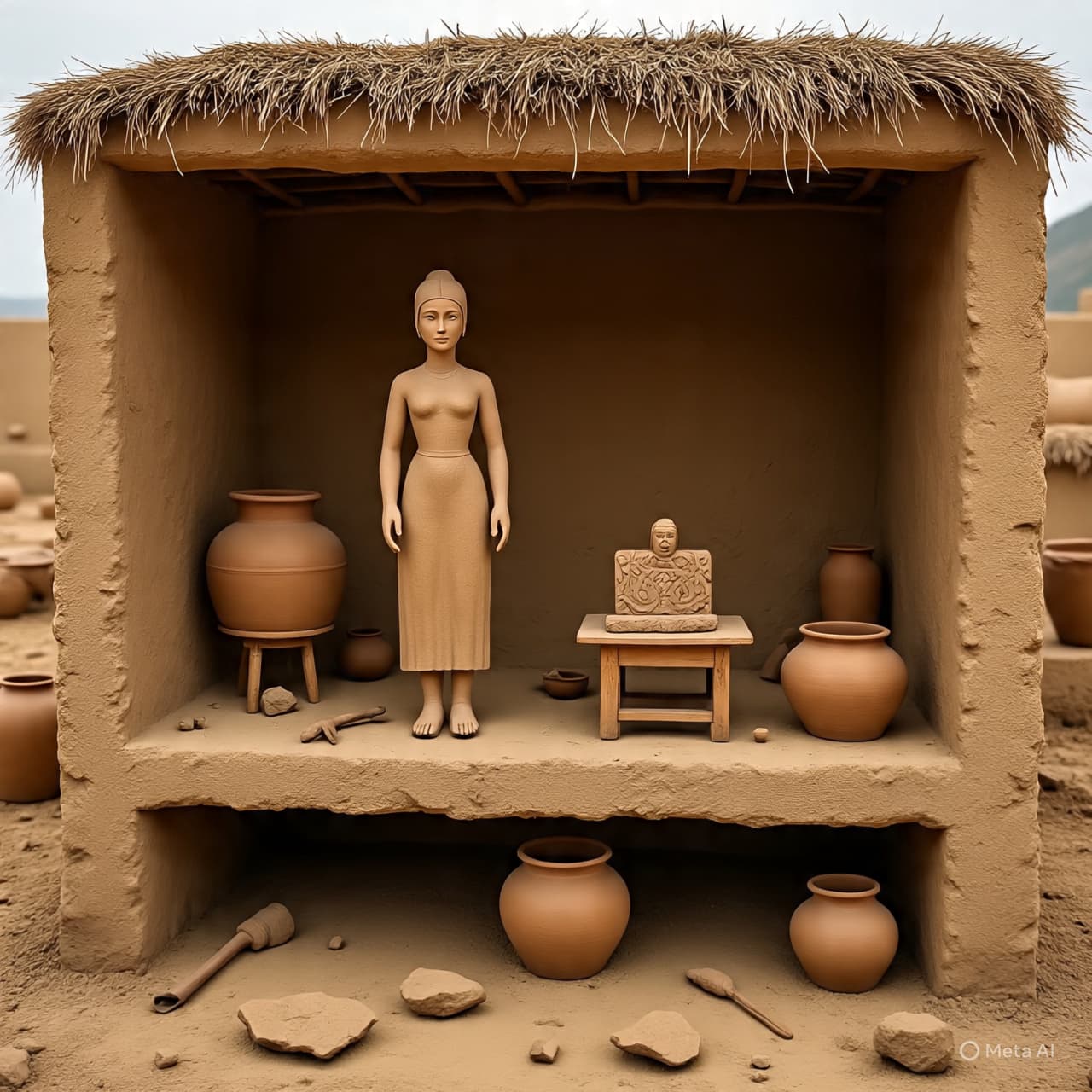
In the soft light of early morning, when the shadows of trees stretch toward quiet horizons and the wind whispers through the grass, one might imagine a voice from deep antiquity stirring in the dust. Many thousands of years ago long before cities, before written words, before the promise of tomorrow’s certainty there was a place where people built homes as earnest shelters against the unpredictable world. At Tumba Madžari, near the gentle plains of what is now North Macedonia, they shaped mud, wood, and straw into simple square houses. And in one of those homes, they placed something that would echo across millennia: a figurine of a woman whose form embraces both the hearth and the home she watches over.
This artifact, known today to archaeologists and visitors alike as the Great Mother, stands at just under 40 centimeters tall and combines the lines of the feminine figure with a cubed lower half that seems to reflect the very walls of the dwelling where she was found. Excavated first in 1981 from a Neolithic settlement used between roughly 5800 and 5200 B.C., this terracotta sculpture suggests that the lives of Stone Age people were not only shaped by daily toil but also by deep symbolic worlds. In the gentle curve of her shoulders and the simple geometry at her base, archaeologists see not just form, but function: an icon designed to safeguard family, fertility, and the collective peace of hearth and household.
Surrounded by ceramic pots, hearth-built ovens, and tools of daily life, the figurine seems to emerge from her house as if rising with the dawn her gaze fixed inward, where fires simmered and stories were told. Scholars draw connections between such representations and broader Neolithic spiritual or cultural practices, in which life’s mysteries birth, growth, warmth, and protection were woven into tangible forms. Unlike other female figurines found across prehistoric Europe and the Near East, the Great Mother at Tumba Madžari appears as a symbiotic blend of woman and structure, reminding us gently that home was not just a place of shelter, but an axis of shared belief and daily ritual.
Walking among the reconstructions of those ancient dwellings today, one can almost feel the echo of life stirred in the clay hands molded by necessity, eyes shaped by hope, bodies standing where heartbeats once pulsed. In each artifact unearthed cups, amphorae, tools, and fragments of grain storage there lies the quiet testament of human aspiration: to nourish, to protect, to belong. The Great Mother, rising from her house, is a poignant reminder that even in eras we can barely imagine, people found ways to give shape to their stories, to give voice to their wishes for continuity and care.
As archaeologists continue to uncover fresh fragments of this extraordinary site, the clay figure invites reflection on how early communities understood shelter not merely as architecture but as a sacred embrace. It whispers to us across the archaeological layers, encouraging us to consider how our own homes carry meaning far beyond bricks and beams. In the hushed corridors of that Neolithic neighborhood, the Great Mother stands still not in sharp judgment, but in quiet continuity with the lives that once animated her world.
AI Image Disclaimer *Visuals are created with AI tools and are not real photographs.*
Sources:
Live Science Explanders MIA (Macedonian Information Agency) HAEMUS (research/heritage non-profit) World History Encyclopedia
Published by Banx Network. This article is part of the Banx decentralized media programme, powered by the BXE token on the XRP Ledger.