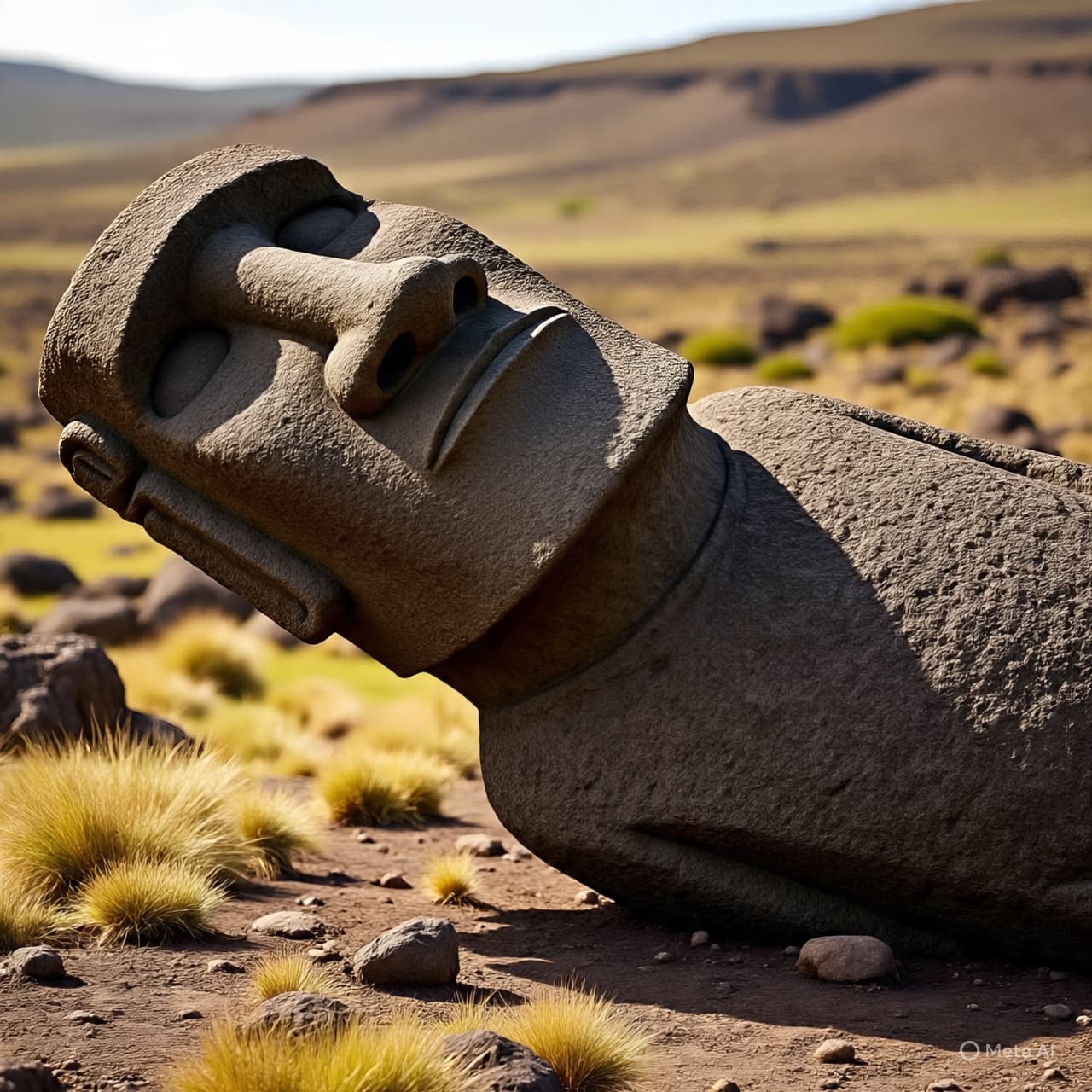
They stand with faces weathered by salt and centuries, their silence echoing louder than the waves that break upon Rapa Nui’s shore. The moai of Easter Island — those immense, solemn sentinels — have always seemed beyond the grasp of explanation. Were they rolled? Dragged? Lifted by hands unseen? For generations, people turned to myth when physics felt too small. And yet, sometimes the truth walks quietly beside us, hidden in simplicity.
A team of archaeologists decided to listen differently — not to the legends of the sky, but to the shape of the earth and the stones themselves. They noticed the clues hidden in plain sight: the bases of the statues were not flat, but curved like the soles of feet; the roads they once traveled were gently concave, as if designed to cradle motion. The statues leaned slightly forward, poised, balanced — ready to move if only one knew how to ask.
So they built one — a faithful replica weighing 4.35 tons — and gathered eighteen pairs of hands to wake it. They tied ropes around its head and shoulders, and with careful rhythm began to pull, first one side, then the other, like rocking a child to sleep. The moai swayed, found its balance, and then, astonishingly, took a step. Slowly, in a steady zigzag, it walked one hundred meters in forty minutes — upright, graceful, alive.
This experiment was not just a feat of strength but a rediscovery of understanding. The movement was effortless compared to dragging or rolling, the energy spent less than one might imagine for moving stone. Each tug, each counter-pull, made the statue sway in its own slow dance — a dance guided by gravity, design, and human cooperation.
The evidence aligns like the stones themselves: the statues’ shape, the roads’ curvature, the oral histories that said the moai once “walked.” Even the scars found on fallen figures match the kind of wear that upright rocking would create. What once seemed mythic now feels human again — not alien miracles, but the quiet genius of islanders who turned limitation into invention.
In a world quick to seek spectacle, the lesson of the moai feels like a whisper from the past: that progress is sometimes rhythmic, not rushed; that strength lies in coordination more than in force; that wonder is often born of balance.
The scientists behind the study — led by Carl Lipo of Binghamton University and Terry Hunt of the University of Arizona — have brought this elegant explanation into view. Their work adds a credible, physical foundation to the long-debated question of how Rapa Nui’s people transported their monumental sculptures, showing that ingenuity, not mystery, carried the island’s giants home.
AI Image Disclaimer: “Visuals are created with AI tools and are not real photographs.”
Sources: Binghamton University, Archaeology Magazine, Phys org, ScienceDaily, National Geographic
Published by Banx Network. This article is part of the Banx decentralized media programme, powered by the BXE token on the XRP Ledger.