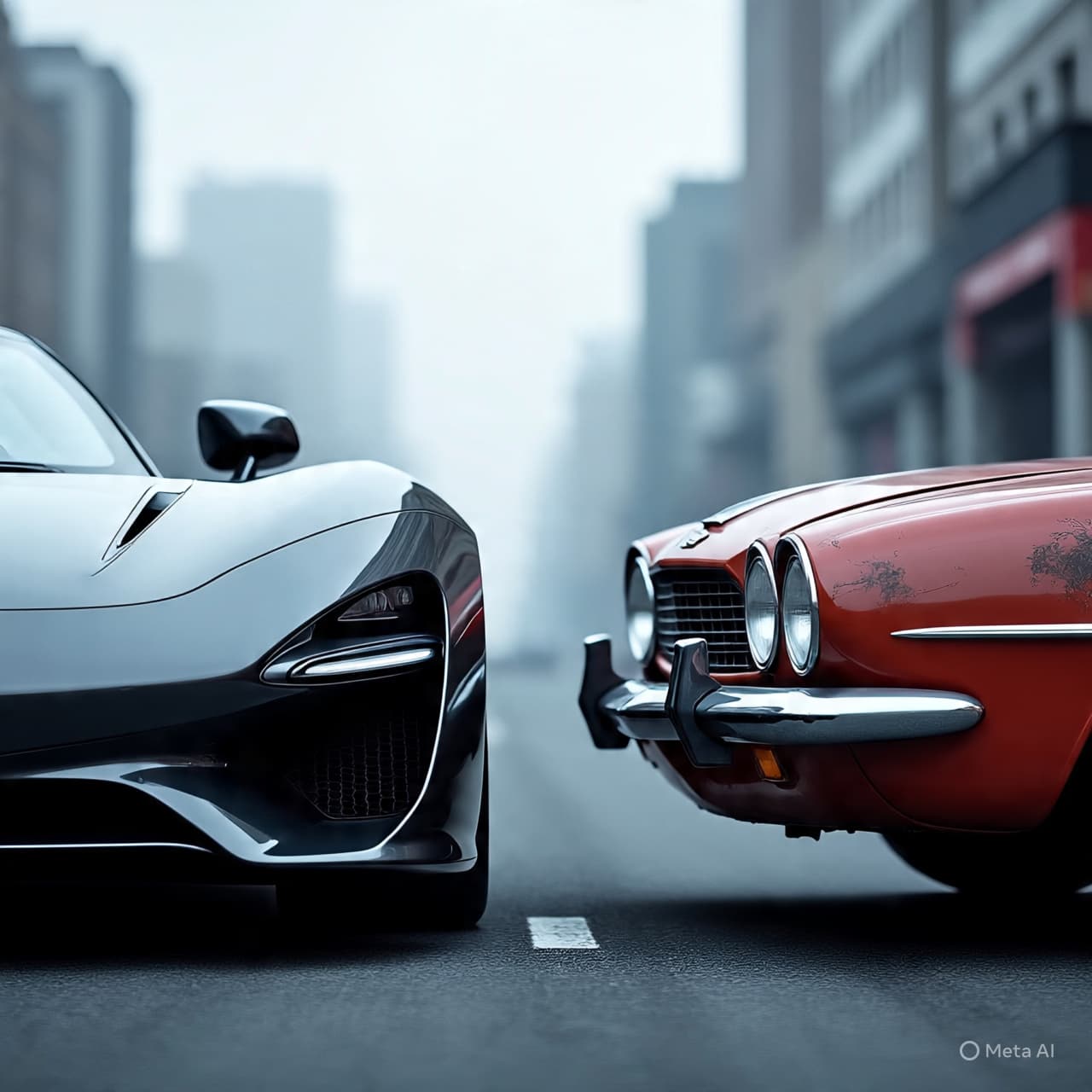
There is a certain poetry in motion—how air parts gently around a well-shaped machine, how speed becomes not a struggle but a quiet agreement between form and force. Yet, not every car was born to glide through the wind like a whisper. Some arrived with edges that resisted, shapes that challenged, and silhouettes that seemed to argue with the very air around them.
Aerodynamics, often invisible yet profoundly influential, has long shaped the evolution of the automobile. But in certain moments across history, design took a different path—prioritizing character, utility, or sheer boldness over the smooth persuasion of airflow. The result is a fascinating gallery of vehicles that, while memorable, were anything but friendly to the wind.
A car that looks as though it was abruptly cut short, the AMC Gremlin carried a distinctive truncated rear that disrupted airflow dramatically. Its charm was undeniable, but its aerodynamic profile was far from graceful.
With its unusual “double-deck” front and bulbous proportions, the Multipla prioritized interior space over airflow. Its shape created turbulence rather than harmony, making it one of the most unconventional designs ever produced.
Angular, fragmented, and unapologetically bold, the Aztek became infamous for its aesthetics. Its design language, full of sharp lines and abrupt transitions, worked against aerodynamic efficiency.
Built for rugged terrain rather than highways, the Wrangler’s boxy frame, flat windshield, and exposed hinges create significant drag. Its purpose, however, was never to slip quietly through the air.
Massive and imposing, the H2 embraced a military-inspired form that prioritized presence over performance. Its blunt surfaces resist airflow at nearly every angle.
Resembling a rolling cube, the Scion xB was a celebration of simplicity and utility. Aerodynamically, however, it offered little compromise to the wind.
Designed for durability in harsh environments, the Niva features a straightforward, angular shape that reflects its utilitarian roots more than any aerodynamic consideration.
Compact yet unapologetically square, the Jimny carries the spirit of classic off-roaders. Its upright stance and flat surfaces create notable drag, but also undeniable personality.
Though softer in form than others on this list, the 2CV’s high roofline and narrow body were designed for practicality and comfort rather than slicing through air efficiently.
With its asymmetrical rear and box-like silhouette, the Cube embraced uniqueness over efficiency. Airflow, in this case, was almost an afterthought.
In the quiet conversation between design and physics, these cars chose to speak in their own dialect. They remind us that not every vehicle must chase perfection in efficiency—some exist to challenge expectations, to prioritize identity, or to serve a purpose beyond speed.
As automotive technology continues to refine the art of aerodynamics, these machines remain as echoes of a different philosophy. They may not glide effortlessly through the wind, but they carry something just as enduring: character.
AI Image Disclaimer Visuals are created with AI tools and are not real photographs.
Source Check Top Gear Car and Driver MotorTrend Road & Track Autocar
Published by Banx Network. This article is part of the Banx decentralized media programme, powered by the BXE token on the XRP Ledger.