Key Highlights
- Incident:North Korea accuses South Korea of fabricating a landmine explosion.
- Casualties:The blast injured three South Korean soldiers in September.
- Diplomatic Tensions:The exchange highlights rising tensions along the DMZ.
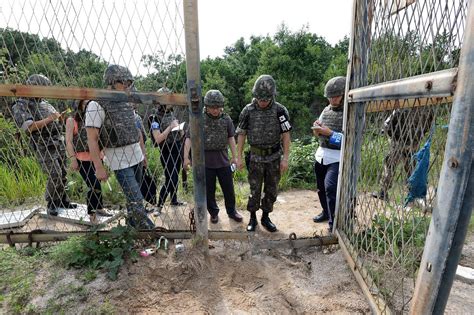
North Korea has formally accused South Korea of fabricating the circumstances surrounding a landmine explosion that injured three South Korean soldiers in September. In a letter sent to the United Nations Security Council, Pyongyang claimed that Seoul is using the incident as a pretext to obstruct its ongoing border fortification efforts. This accusation marks a significant escalation in the already tense relations between the two Koreas.
The landmine blast occurred in the heavily fortified Demilitarized Zone (DMZ), an area that has been a flashpoint for military tensions since the Korean War. South Korean officials have attributed the explosion to North Korean mines, asserting that the North has not only failed to take responsibility but has also refused to engage in dialogue regarding the safety of the border area. In response to the incident, South Korea has called for an apology from Pyongyang and has urged the North to remove any remaining landmines from the DMZ.
This diplomatic spat comes at a time when tensions are already high on the Korean Peninsula. South Korea has proposed military talks aimed at clarifying the border situation and restoring communication channels that have been largely severed in recent years. However, North Korea's response to these overtures has been dismissive, further complicating the potential for dialogue.
The letter sent to the UN Security Council not only criticizes South Korea's handling of the landmine incident but also reflects North Korea's broader strategy of framing its military actions as defensive measures against perceived aggression from the South. This narrative is part of a long-standing pattern in North Korean rhetoric, which often portrays the regime as a victim of external pressures.
As the situation develops, the international community is closely monitoring the exchanges between the two Koreas. The UN Security Council has historically played a role in mediating tensions on the peninsula, but its effectiveness has been questioned in recent years. The ongoing military posturing and lack of communication raise concerns about the potential for miscalculations that could lead to further conflict.
In summary, the landmine incident and the subsequent accusations highlight the fragile state of inter-Korean relations. With both sides entrenched in their positions, the path to de-escalation remains uncertain. The international community, particularly the United States and China, may need to intervene to facilitate dialogue and prevent further escalation of tensions in the region.
Published by Banx Network. This article is part of the Banx decentralized media programme, powered by the BXE token on the XRP Ledger.