There is a particular heaviness that settles over a community after violence touches a place of worship. A funeral, already a gathering of grief, became something else entirely when gunmen opened fire at a Greek Orthodox church in Karak, southern Jordan, last week. Nine people were killed, more than two dozen wounded, and a nation known for its relative stability found itself confronting a question it had hoped to avoid.
In the early hours of Monday morning, Jordanian security forces provided part of an answer. Acting on intelligence, commandos surrounded an abandoned house in Karak where three suspects were hiding. When the men refused to surrender and opened fire, the security forces responded in kind, wounding and disarming all three before taking them into custody . No security personnel were injured in the operation .
The attack itself took place on Friday during a funeral at St. George's Greek Orthodox Church in the village of Hmoud. CCTV footage verified by the BBC showed three men approaching the church with guns and firing on the mourners. A witness described the assault lasting roughly fifteen minutes, with people taking cover, cradling the dead, and fleeing as the gunmen escaped in a pickup truck, firing as they went . The dead included several doctors, their names read aloud at a funeral led by the Greek Orthodox Patriarch of Jerusalem, Theophilos III, who condemned the attack as a "vile, cowardly, and bloody act" .
Karak is home to a sizable Christian community in the Muslim-majority kingdom, and the targeting of a church during a funeral has stirred particular anguish. King Abdullah II praised the security forces for pursuing the suspects "to the very end," writing on social media that "no proponent of dark ideologies that divide Jordanians will be tolerated" . Interior Minister Mazen al-Faraya said authorities would hold to account anyone involved and were "examining every factor that leads youth toward extremism" .
No group has yet claimed responsibility for the attack. The suspects have not been publicly identified, and their motives remain under investigation. The predawn raid in Karak was described by state media as a swift response to an act that had shocked a country unaccustomed to sectarian violence of this kind . Jordan has long positioned itself as a stabilizing force in a turbulent region, and the attack has raised uncomfortable questions about the reach of extremism within its own borders.
For the families of the nine victims, the arrests offer a measure of accountability but not resolution. The wounded continue to recover. The church in Hmoud, where mourners had gathered to bury one person and instead found themselves fleeing for their lives, remains a scene of trauma. The Patriarch's visit to the injured on Sunday, and his leadership of the funeral for eight of the victims, offered a ritual of grief that no arrest can replace .
Jordanian officials have promised a thorough investigation and have vowed to confront the ideologies that led to the attack. The three men in custody are the first step in a legal process that will unfold over months. What remains to be seen is whether the violence was an isolated act or a sign of something deeper—a question that will shape how Jordan understands itself in the aftermath of a Friday afternoon that turned a funeral into a killing field.
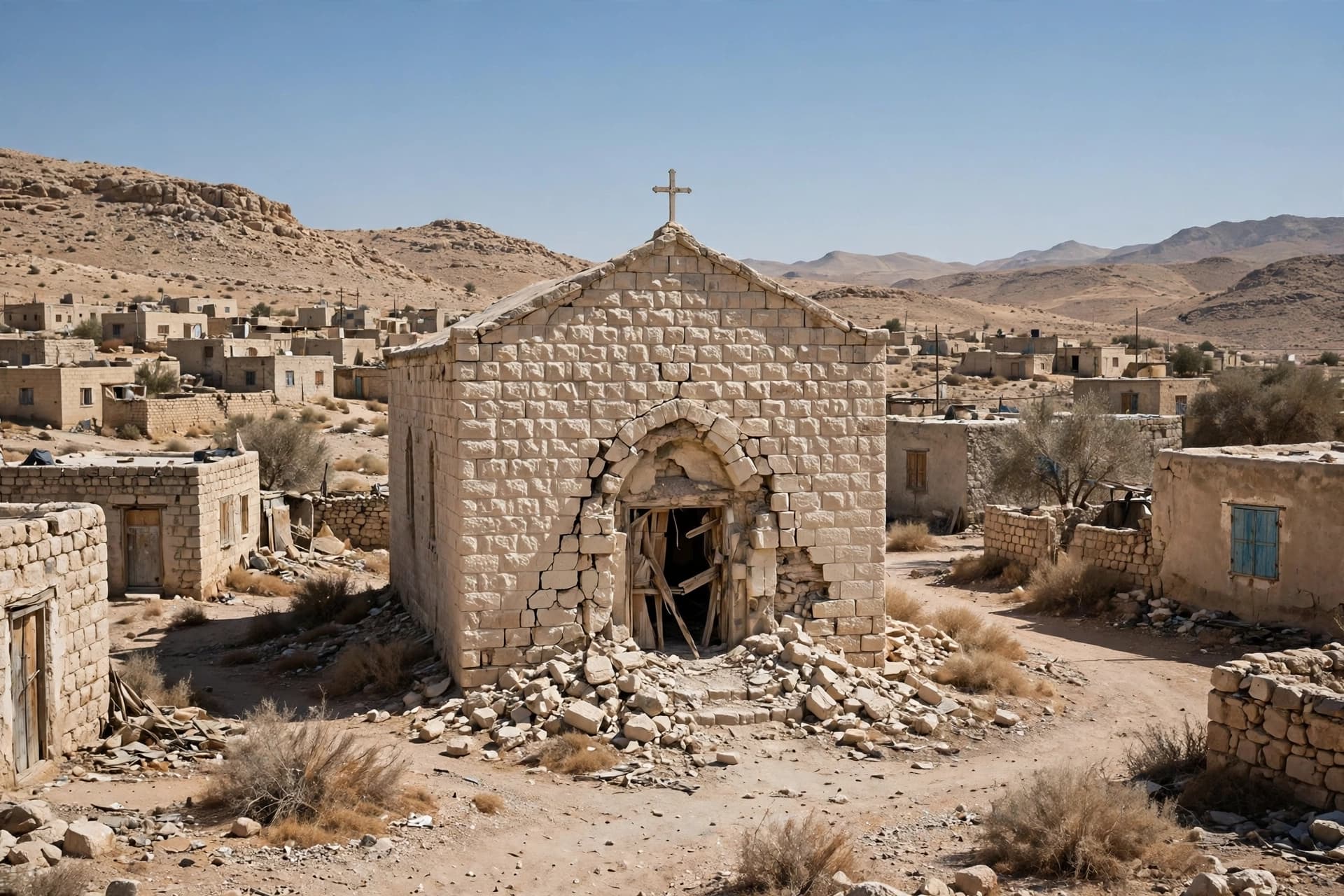
Image note: The visual accompanying this article is an AI-generated illustration and does not depict actual events, individuals, or the church.
Sources: The New York Times, AP News, BBC, Petra
Published by Banx Network. This article is part of the Banx decentralized media programme, powered by the BXE token on the XRP Ledger.