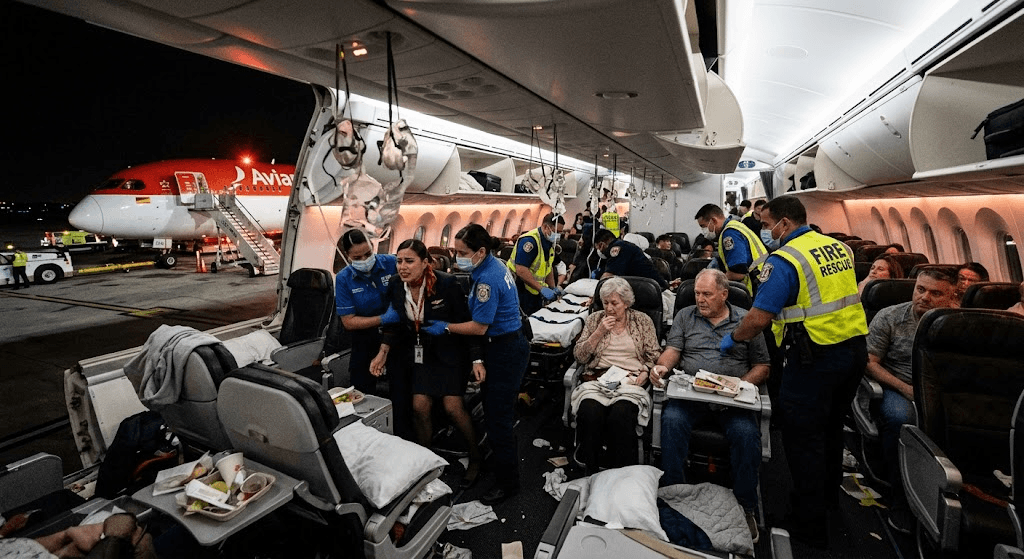
MIAMI, FLORIDA — An overnight red-eye flight turned into a scene of panic and destruction after Avianca Flight 042 encountered unexpected severe turbulence while en route from Medellín, Colombia, to New York City’s John F. Kennedy International Airport (JFK). The violent mid-air jolt forced the flight crew to declare an emergency and execute an immediate precautionary landing at Miami International Airport (MIA).
The flight was cruising smoothly when the aircraft was struck by intense, sudden atmospheric instability. Unbuckled passengers and flight crew members were tossed about the cabin as items dislodged from overhead bins, scattering personal belongings, trash, and service equipment across the aisles.
Eye-witnesses aboard described a feeling of freefall that lasted several terrifying seconds before pilots managed to stabilize the aircraft and initiate a diversion protocol to the nearest major airport. The aircraft touched down safely at Miami International Airport around 3:30 AM local time, where Miami-Dade Fire Rescue and airport emergency services were already waiting on the tarmac.
Medical personnel boarded the aircraft immediately to triage affected passengers and crew. At least eight individuals—including three cabin crew members and five passengers—were transported to local medical facilities, including Jackson Memorial Hospital, for evaluation and treatment of neck, back, and soft-tissue injuries.
"Upon arrival, Avianca's team and airport medical services activated the appropriate protocols to provide immediate care to three cabin crew members and six affected passengers."— Avianca Airlines Official Statement
Following medical clearances and safety inspections, the remaining passengers were accommodated on a re-scheduled leg departing for New York later that morning. Aviation authorities routinely reiterate that while clear-air turbulence can be difficult to predict with weather radar, keeping seatbelts fastened whenever seated remains the single most effective safety measure for airline passengers.
Incidents of severe turbulence have drawn increased scrutiny from aviation safety regulators and climate scientists in recent years. Atmospheric researchers note that shifting global wind patterns and intensified jet streams are contributing to a rising frequency of severe clear-air turbulence along heavily traveled international flight corridors. In response, major airlines are increasingly investing in advanced predictive turbulence detection software and updating in-flight safety protocols to minimize risk and protect passengers during unexpected atmospheric shifts.
Published by Banx Network. This article is part of the Banx decentralized media programme, powered by the BXE token on the XRP Ledger.