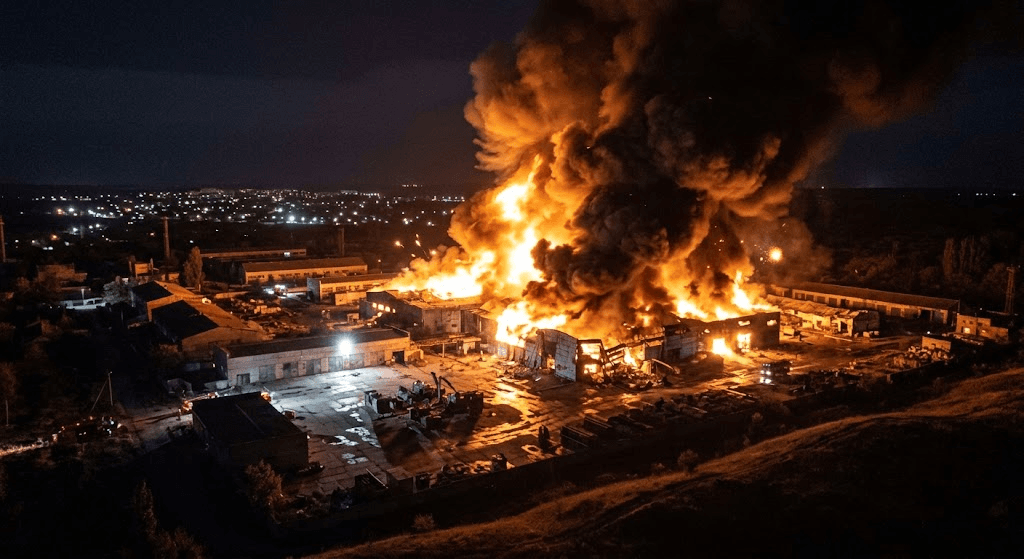
LUHANSK OBLAST, UKRAINE — A series of precision strikes triggered a massive fire at a major Russian military supply base and troop staging area in occupied Luhansk Oblast. The overnight barrage ignited multiple large-scale blazes across the facility, illuminating the night sky and causing heavy damage to critical Russian logistics infrastructure situated well behind the front lines.
Local reports and satellite thermal detection data confirmed that three separate fire hotspots rapidly converged into a widespread inferno near Khrustalnyi in occupied Luhansk. The targeted facility—a former motor depot long utilized by Russian forces as a central staging hub for personnel, ammunition, and transport vehicles—was severely compromised during the assault.
Residents across the region reported secondary detonations as fuel supplies and stockpiled munitions caught fire following the initial strike.
The strike is part of a broader, sustained campaign targeting vulnerable military hubs and supply arteries in occupied territories. By striking logistics depots and troop quarters deep within Russian-controlled zones, defensive forces continue to disrupt the flow of fuel, ammunition, and fresh personnel needed to sustain offensive operations along the active eastern front.
Local monitoring channels noted that emergency crews inside the occupied territory struggled for hours to control the flames amidst ongoing secondary bursts.
"Strikes targeting key staging areas and supply depots deep behind enemy lines severely restrict the operational mobility of occupation forces. Denying safe rear-guard quarters directly undermines their frontline sustainability."— Regional Military & Intelligence Analysis Briefing
The destruction of the Luhansk staging site marks another significant blow to occupation logistics across eastern Ukraine. As precision aerial and long-range capabilities continue to reach key facilities in the rear, Russian command structures face growing difficulties securing essential supply nodes and troop staging bases away from the immediate frontline.
As occupation forces grapple with these mounting logistics challenges, military analysts anticipate that command structures will be forced to further decentralize their supply networks and relocate staging hubs farther from the front. However, shifting these vital nodes deeper into rural areas risks increasing transit times and fuel consumption, complicating ongoing supply operations across the occupied sector.
Published by Banx Network. This article is part of the Banx decentralized media programme, powered by the BXE token on the XRP Ledger.