MOSCOW — A massive wave of Ukrainian drones struck the Russian capital and its surrounding region overnight, killing at least two people and sparking a fire at a major oil refinery. Russian officials labeled the barrage an unprecedented attempt to disrupt the nation’s ongoing parliamentary elections.
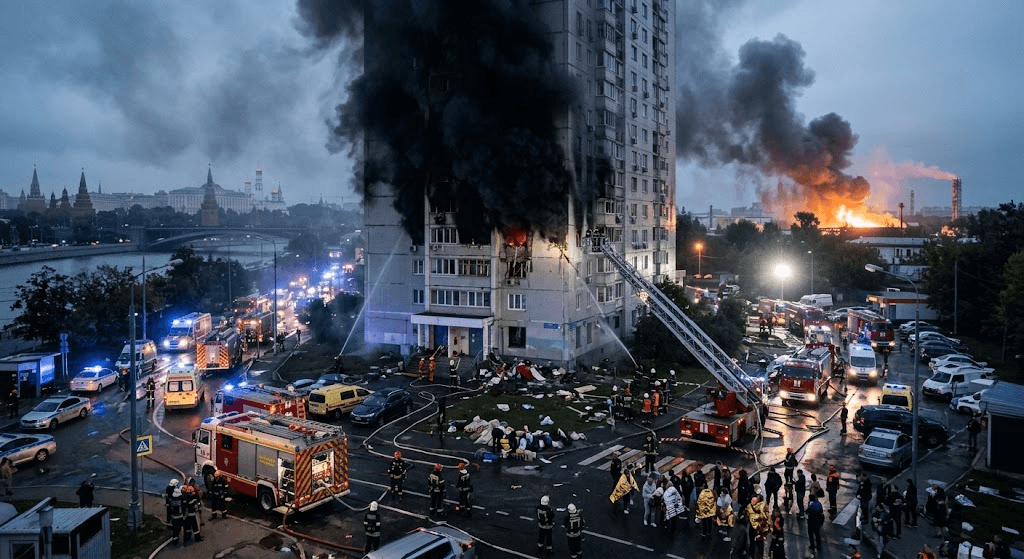
Moscow Mayor Sergei Sobyanin reported that Russian air defenses intercepted and downed over 1,600 drones across the nation, including 450 heading directly toward the capital. Despite the heavy interception rate, falling debris and direct impacts inflicted significant localized damage. Plumes of thick black smoke rose above the Moscow Oil Refinery after several drones struck the facility's grounds.
In the surrounding Moscow region, regional Governor Andrey Vorobyov confirmed two fatalities—a 44-year-old woman and an elderly man—in separate strike locations. In the Ramenskoye district, a drone hit a 21-story residential apartment building, triggering a blaze that forced emergency crews to evacuate 400 residents.
The assault represents one of the largest coordinated aerial strikes against the Russian capital since the conflict began. Ukrainian officials have not formally commented on the operation, though Kyiv has systematically intensified long-range strikes targeting Russian energy infrastructure and logistics hubs in recent months.
The overnight barrage triggered immediate grounded flights and air traffic holds across Moscow’s major aviation hubs, including Sheremetyevo, Domodedovo, and Vnukovo airports. Civil aviation authorities enacted safety protocols, diverting dozens of incoming domestic and international flights to alternate airfields in neighboring regions. The airspace restrictions created severe logistical bottlenecks throughout the morning, stranding thousands of travelers as terminal concourses filled with passengers awaiting status updates on delayed departures.
Internationally, military analysts noted that the scale of the strike signals a significant escalation in Ukraine's long-range strategic drone capabilities. By simultaneously targeting energy production assets and forcing active air defense deployments near urban centers, the operation highlighted persistent vulnerabilities in deep-rear defense networks. Analysts suggest that such coordinated multi-vector attacks are increasingly aimed at applying psychological and economic pressure on key Russian industrial corridors while complicating logistics far behind the frontline.
Published by Banx Network. This article is part of the Banx decentralized media programme, powered by the BXE token on the XRP Ledger.