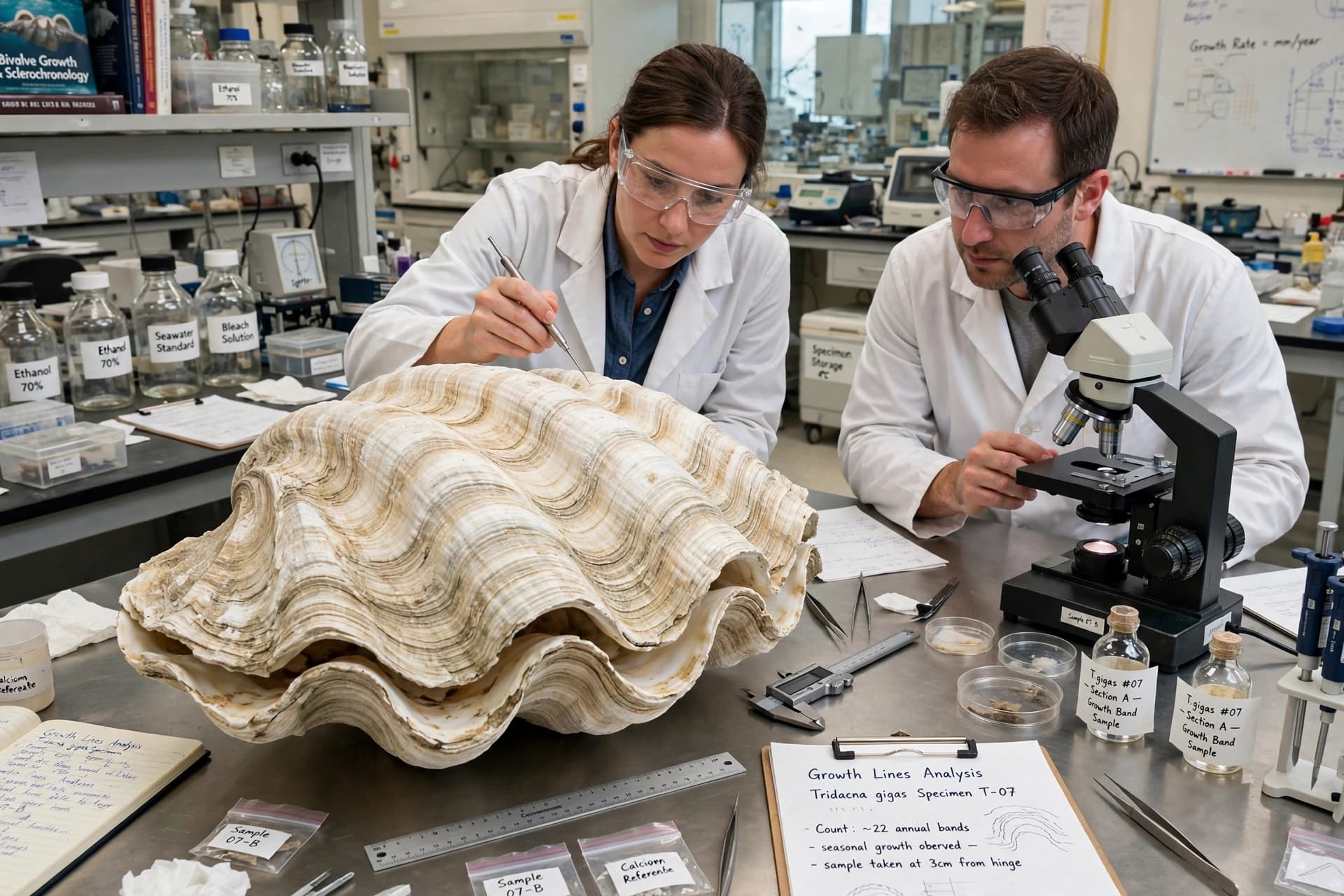
There is a particular wonder in the idea that a creature as slow and unassuming as a giant clam might be keeping a diary—a record written not in ink but in calcium carbonate, not in words but in the chemistry of its shell. For nearly thirty years, a Tridacna gigas lived in the lagoon at Jiigurru, in the northern Great Barrier Reef, adding a microscopic line of growth each day. When it died, around 1827, it left behind a shell that functioned as an archive: a month-by-month account of the reef's climate at the end of the Little Ice Age, a record that scientists have now learned to read .
The research, published in Global and Planetary Change and led by Amy Prendergast of the University of Melbourne, focused on a 58-centimeter shell collected from the lagoon. Radiocarbon dating placed the clam's life between approximately 1785 and 1827. Under a microscope, researchers counted almost 10,900 daily growth lines, confirming a lifespan of about 30 years . To extract the climate record, they drilled 784 tiny powder samples from the shell layers and measured stable oxygen and carbon isotopes. Oxygen isotopes served as a proxy for sea temperature; carbon isotopes provided clues about rainfall and seasonal wet-dry cycles .
The results, when compared with modern measurements from the same lagoon between 1995 and 2015, painted a picture of a reef that was cooler but not dramatically so. Annual average temperatures were 0.6 to 0.9 degrees Celsius cooler 225 years ago. The difference was most pronounced in summer, which was 0.9 to 1.2 degrees Celsius cooler than today. Winter temperatures, however, were almost the same .
The shell also recorded the rhythm of El Niño and La Niña. Temperature and hydroclimate data showed pronounced two- to three-year cycles consistent with these climate patterns. Near the end of the 18th century, warmer and drier El Niño-like conditions were more common. In the early 1800s, cooler and wetter La Niña-like conditions became more frequent, including the strongest such events in the reconstruction .
What makes this record particularly valuable is its rarity. Most high-resolution climate archives from before the industrial era come from the Northern Hemisphere and from high latitudes. Tropical oceans in the Southern Hemisphere are much less well documented, leaving a gap in the understanding of natural climate variability . Giant clams, which live across the tropical Indo-Pacific, can help fill that gap. Their shells grow continuously, recording daily and seasonal changes with a resolution that few other archives can match.
The research was conducted in partnership with the Walmbaar Aboriginal Corporation and Nguurruumungu Indigenous Corporation, acknowledging Jiigurru's status as a culturally significant place for the Dingaal and Ngurrumungu peoples . The shell's story does not end with its death. It continues to speak, offering a baseline against which the changes of the past century can be measured—and a reminder that the reef, for all its apparent permanence, has always been in motion.
AI Image Disclaimer: The visual elements in this article were created using AI generation tools and are intended for illustrative purposes only.
Sources: James Cook University, The Conversation, Scinexx
Published by Banx Network. This article is part of the Banx decentralized media programme, powered by the BXE token on the XRP Ledger.