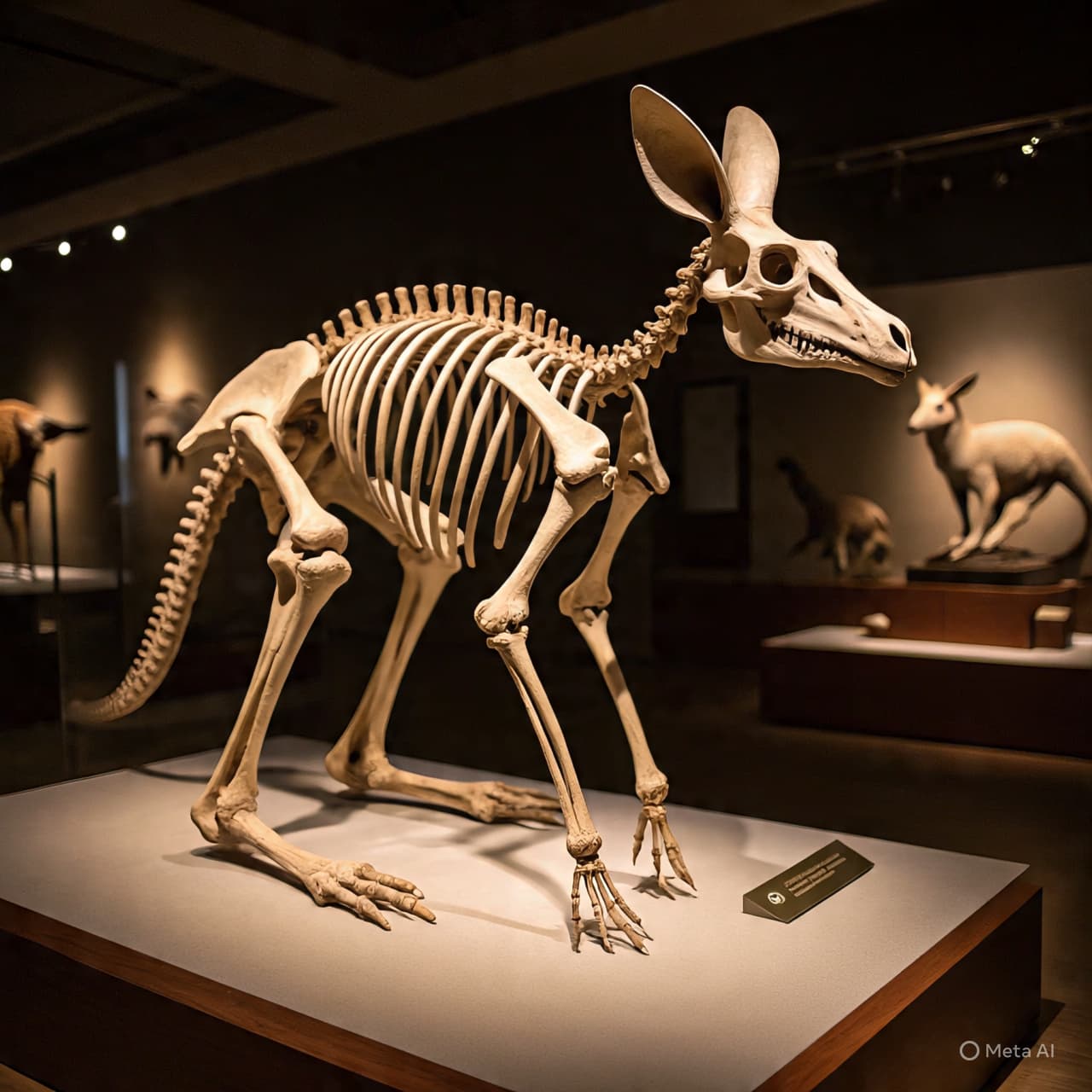
In the sunburnt expanse of ancient Australia, a shadow once moved with surprising grace. A kangaroo the size of a small car, tipping the scales at nearly 250 kilograms, may have bounded across the plains with a rhythm not unlike its modern descendants. The fossilized bones speak of bulk and power, yet hints of spring and agility suggest a creature that, against intuition, embraced the sky in its stride.
Scientists peering into the past reconstruct a world both harsh and vibrant, where enormous herbivores navigated landscapes of towering eucalyptus and sprawling grasslands. The giant kangaroo, formidable in size, also embodied the ingenuity of evolution: its skeletal structure hints at musculature capable of storing and releasing energy, allowing leaps that would have carried it far and fast. In imagining this, one sees a dance of mass and momentum, a delicate compromise between gravity and biology.
These discoveries remind us that scale is not always a constraint. Nature, it seems, finds ways to surprise, to defy the simple logic of weight and motion. The ancestor of kangaroos, once presumed slow and ponderous, emerges instead as a testament to evolutionary creativity—proof that even in immensity, grace can endure. Its story invites reflection on the hidden dynamism of life, the rhythms that have pulsed across continents long before humans charted them, and the subtle poetry embedded in the very bones of the earth.
AI Image Disclaimer Visuals are AI-generated and serve as conceptual representations.
Sources Nature; Australian Museum; Science Daily; Proceedings of the Royal Society B; Smithsonian Magazine
Published by Banx Network. This article is part of the Banx decentralized media programme, powered by the BXE token on the XRP Ledger.