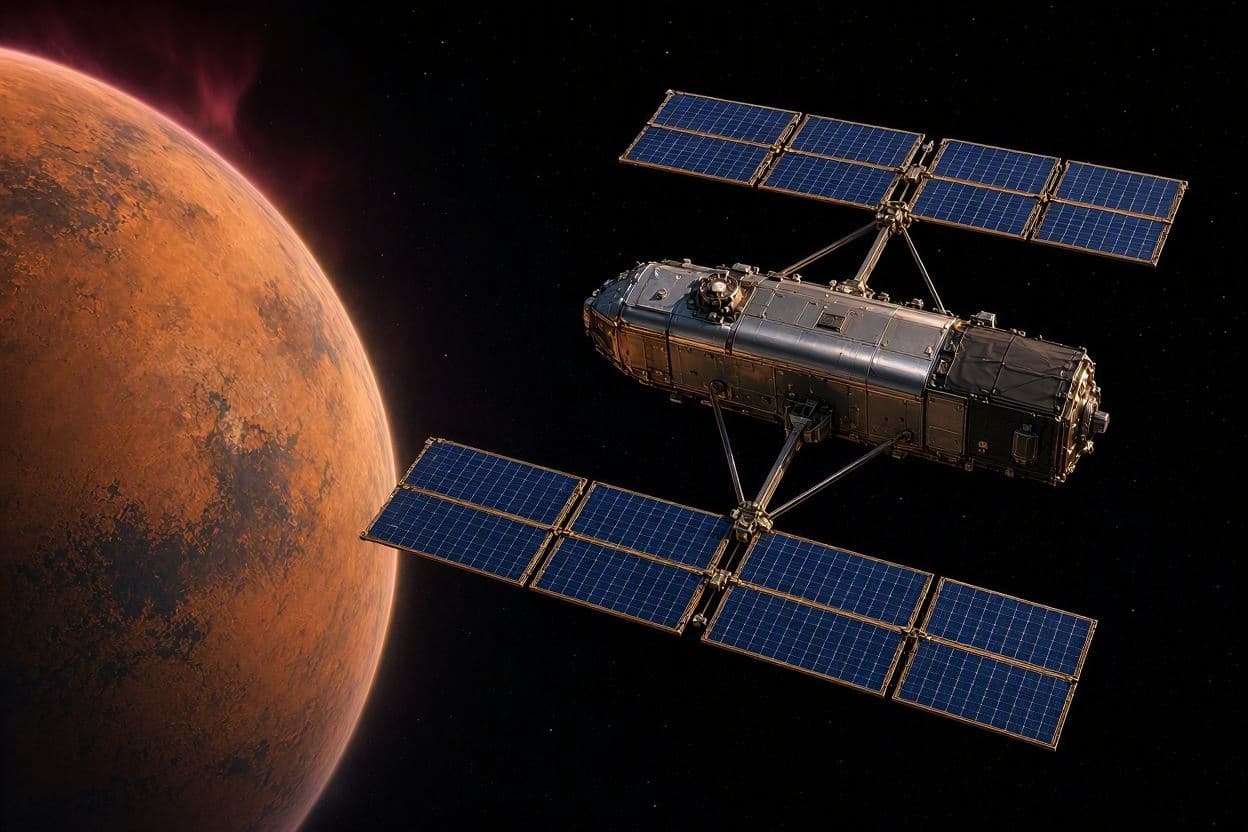
In the precise world of space exploration, where every calculation must be exact, a small error can have monumental consequences. In September 1999, NASA’s Mars Climate Orbiter vanished into the Martian atmosphere, a 125 million mission lost not to mechanical failure or external hazard, but to a simple unit conversion error. One team used English units, while another expected metric, a mismatch that silently diverted the spacecraft from its intended path.
The orbiter had traveled for nine months, covering millions of miles through the vacuum of space. As it approached Mars, ground controllers prepared for orbital insertion, a critical maneuver that would place the spacecraft in a stable orbit around the Red Planet. However, the thruster firings calculated by Lockheed Martin engineers in pound-seconds were interpreted by NASA’s Jet Propulsion Laboratory as newton-seconds. This discrepancy, though seemingly minor, accumulated over time, resulting in a significant trajectory error.
When the orbiter reached Mars, it entered the atmosphere at a much lower altitude than planned. Instead of settling into orbit, it burned up and disintegrated, ending the mission abruptly. The loss was a stark reminder of the importance of standardization and communication in complex engineering projects. It highlighted how siloed teams, even within the same organization, can operate with different assumptions that go unchecked until it is too late.
Investigations following the incident revealed that the error had been detected by software monitors but was dismissed as a minor anomaly. This oversight underscores the danger of normalizing deviations, where small irregularities are ignored rather than investigated. Had the discrepancy been addressed earlier, the mission might have been saved, or at least the loss understood before it occurred.
The Mars Climate Orbiter failure led to significant changes in NASA’s project management practices. Strict protocols for unit standardization were implemented, ensuring that all teams use the metric system exclusively. Cross-checks and independent validations became mandatory, fostering a culture of transparency and rigorous verification. These lessons have since been applied to subsequent missions, improving their reliability and success rates.
For the engineering community, the incident serves as a cautionary tale about the complexities of collaboration. It emphasizes the need for clear communication channels and shared standards, especially in multinational and multi-contractor projects. The cost of misunderstanding is high, not just in financial terms but in the loss of scientific opportunity and public trust.
Today, the story of the Mars Climate Orbiter is taught in engineering schools worldwide, illustrating the critical role of attention to detail. It reminds students that technology is only as strong as the processes that support it. By learning from past mistakes, we build a foundation for future achievements, ensuring that errors are caught before they become disasters.
In the end, the loss of the orbiter was a painful but valuable lesson. It reinforced the principle that in space, there is no room for ambiguity. Every number, every unit, and every assumption must be verified, for the stakes are nothing less than the success of human exploration.
AI Image Disclaimer: The illustrations for this article are AI-generated to represent the themes of space exploration and engineering precision, using symbolic imagery rather than depicting the actual accident or specific hardware.
Sources: NASA, JPL, Scientific American, Wikipedia
Published by Banx Network. This article is part of the Banx decentralized media programme, powered by the BXE token on the XRP Ledger.