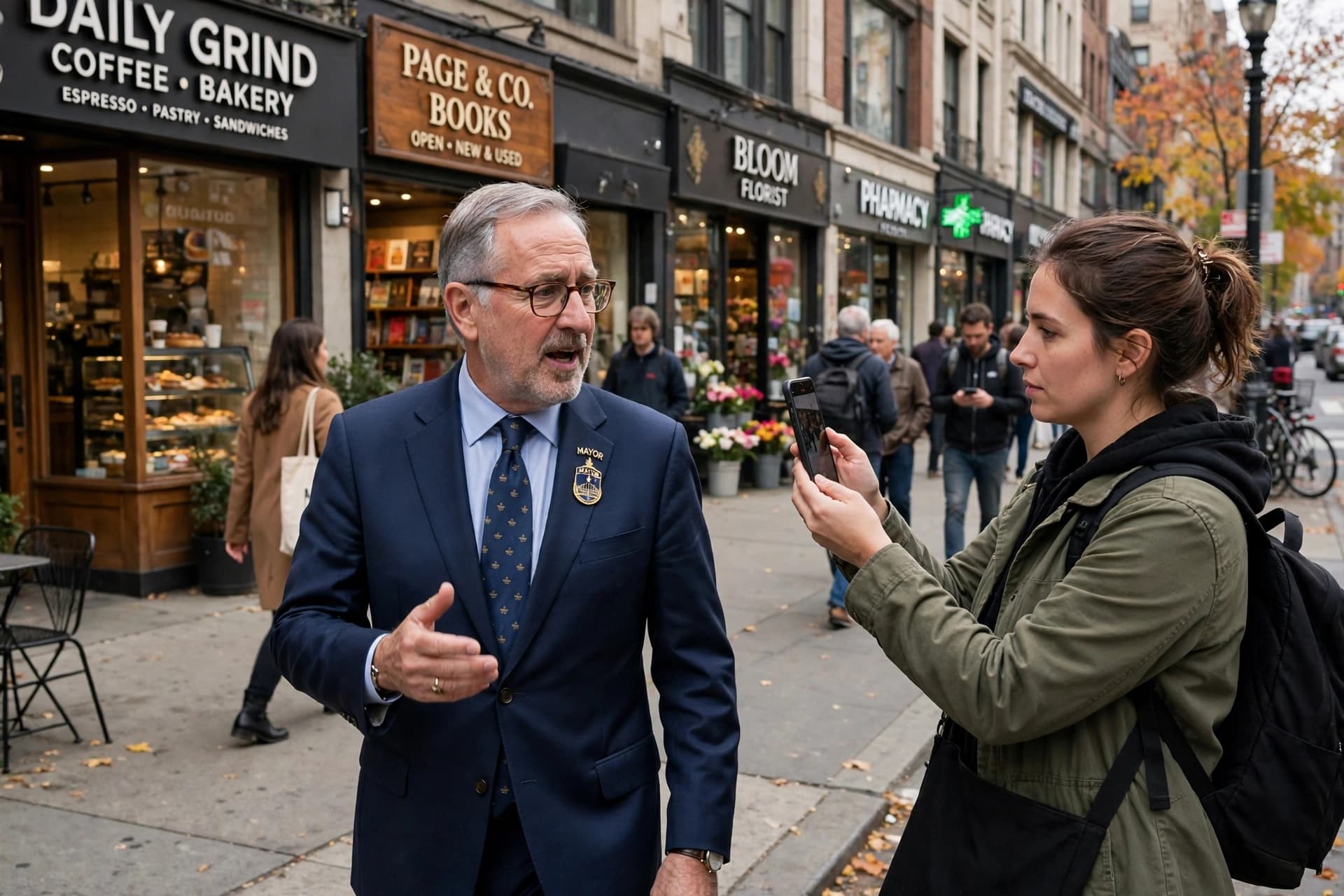
There is a particular awkwardness that descends upon a politician trying to be authentic on camera—an awkwardness made sharper by the knowledge that the authenticity is itself a performance, that the walk-and-talk is scripted, and that the person holding the phone is, in fact, a communications staffer with a shot list. Across the United States, mayors and mayoral candidates have begun filming short, vertical videos in the style popularized by New York City Mayor Zohran Mamdani, whose viral social media clips helped propel him to victory and who has continued to use the format to communicate from City Hall. The results, according to a Boston Globe survey of the trend, range from charming to cringeworthy .
The format is deceptively simple: a politician walks through a neighborhood, speaks directly to the camera, and explains a policy or a problem in under thirty seconds. It is meant to feel raw and immediate, a peek behind the curtain. But as strategists note, the videos are tricky to pull off. "They can be effective, but the person has to be genuinely likable or it doesn't work," said Aviva Bowen, a Chicago political strategist. "They're supposed to be raw and gritty and a peek behind the curtain" . When they fail, they fail visibly. A mayoral candidate in Chicago was filmed flubbing a line and having to jog backward to reset the shot. A mayor in another city was criticized for a video that felt overproduced and stilted .
The trend has produced some genuine successes. In Seattle, Katie Wilson, a nearly unknown community organizer, released a video of herself holding an $8 slice of pizza and connecting its cost to the city's housing crisis. Her campaign took off, and she was elected, unseating the incumbent. Sandeep Kaushik, a Seattle political strategist, said the videos worked because they leaned into her image as an awkward policy nerd. "They come across as really honest and authentic," he said. "They showed you who she is as a person" . In San Francisco, Mayor Daniel Lurie has used the format to announce a mountain lion sighting, promote a new Jollibee opening, and demonstrate how to clean storm drains—videos that his communications team says grew naturally from his early campaign days .
But the format carries risks. Los Angeles Mayor Karen Bass learned that lesson when a video she posted was widely mocked for striking the wrong tone. Political strategists warn that mayors must exude not just authenticity but competence, and that the line between the two is easy to cross . The videos are now spreading to governors, members of Congress, and other elected officials, each hoping to capture the elusive combination of relatability and authority that the format promises. Some will succeed. Many will cringe. The voters, scrolling past, will decide which is which.
AI Image Disclaimer: All images in this article are AI-generated and are intended for illustrative purposes only.
Sources: The Boston Globe
Published by Banx Network. This article is part of the Banx decentralized media programme, powered by the BXE token on the XRP Ledger.