There is a particular kind of memory that lives in stone—the slow, patient accumulation of chemical signatures that record not what was said or done, but what was carried in the water and absorbed by the living. For more than two centuries, a massive coral colony off West Maui has been writing such a record, and scientists have now learned to read it.
A new study led by the University of Hawai'i Sea Grant College Program, the School of Ocean and Earth Science and Technology, and the U.S. Geological Survey analyzed a 253-year-old core from a coral colony at Olowalu Reef. The core spans from approximately 1760 to 2013, capturing an extraordinary arc of human history: pre-colonial Hawaiian stewardship of the land, the rise and fall of sugarcane plantations, large-scale water diversion, and modern coastal development .
Like the rings of a tree, corals build their skeletons incrementally over time. As they grow, elements from the surrounding seawater become incorporated into their skeletons. By measuring the chemistry along the length of the Olowalu core, researchers were able to reconstruct how conditions affecting the reef changed over generations .
The findings tell a story of persistent human impact. Chemical indicators associated with sediment, nutrients, and other land-derived inputs increased by 17 to 55 percent from the eighteenth century to the late twentieth century. The largest increases occurred during the mid-1900s, coinciding with the maximum extent of Maui's sugarcane plantations. Plantation agriculture stripped hillsides of vegetation, loosened volcanic soils, and diverted freshwater, pushing more sediment and nutrients toward the reef .
The coral's growth record revealed something more troubling. Calcification rates increased by roughly 30 percent until about 1970—possibly reflecting an early nutrient subsidy—but then declined sharply, coinciding with peak sugarcane production and maximum terrestrial loading. The negative correlation between calcification and land-derived proxies suggests that the very inputs that once fertilized the reef eventually depressed its growth .
Superimposed on this long-term trend, the researchers found a rhythmic pulse in the trace element record, oscillating at frequencies that match El Niño-Southern Oscillation and Pacific Decadal Oscillation patterns. The reef's chemical record tracks not only what humans did to the land, but how climate controlled when and how much of that land-based material reached the ocean .
"What's important from this study is that some of the changes that occurred on land more than a century ago can still provide important context for what we see on reefs today," said Samuel Kekuewa, the study's lead researcher. "Understanding these legacy impacts can help us make better decisions about how we manage these areas moving forward" .
Olowalu Reef is one of Hawai'i's largest continuous reef systems and an important source of coral larvae for reefs throughout Maui Nui. The research provides the first pre-colonial to modern baseline for ridge-to-reef connectivity in Maui, demonstrating that historical land-use change has left a persistent geochemical imprint on the downstream ecosystem .
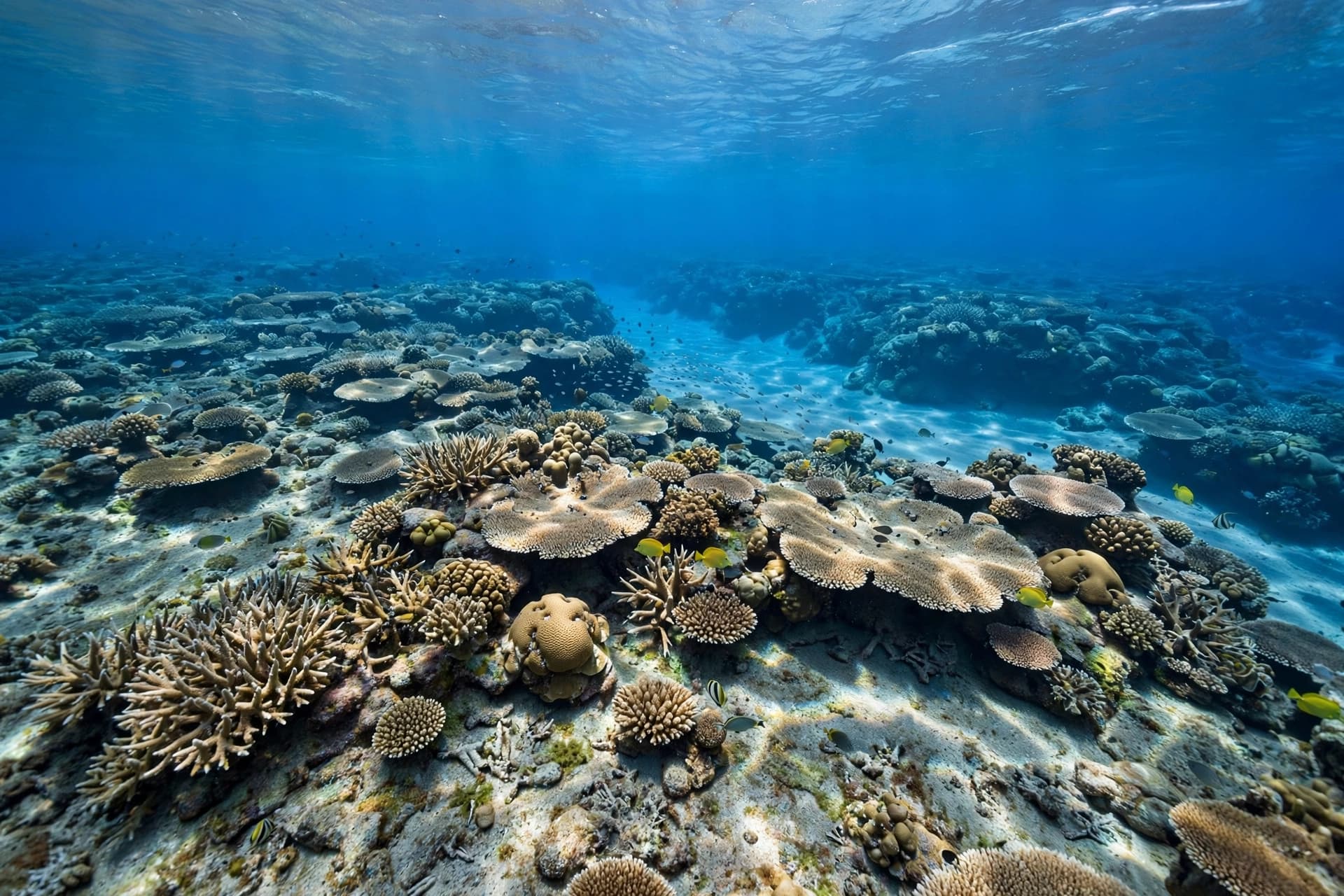
AI Image Disclaimer: Visuals in this article are AI-generated and do not depict actual specimens or events.
Sources: University of Hawai'i, U.S. Geological Survey, Coral Reefs, Scienmag
Published by Banx Network. This article is part of the Banx decentralized media programme, powered by the BXE token on the XRP Ledger.