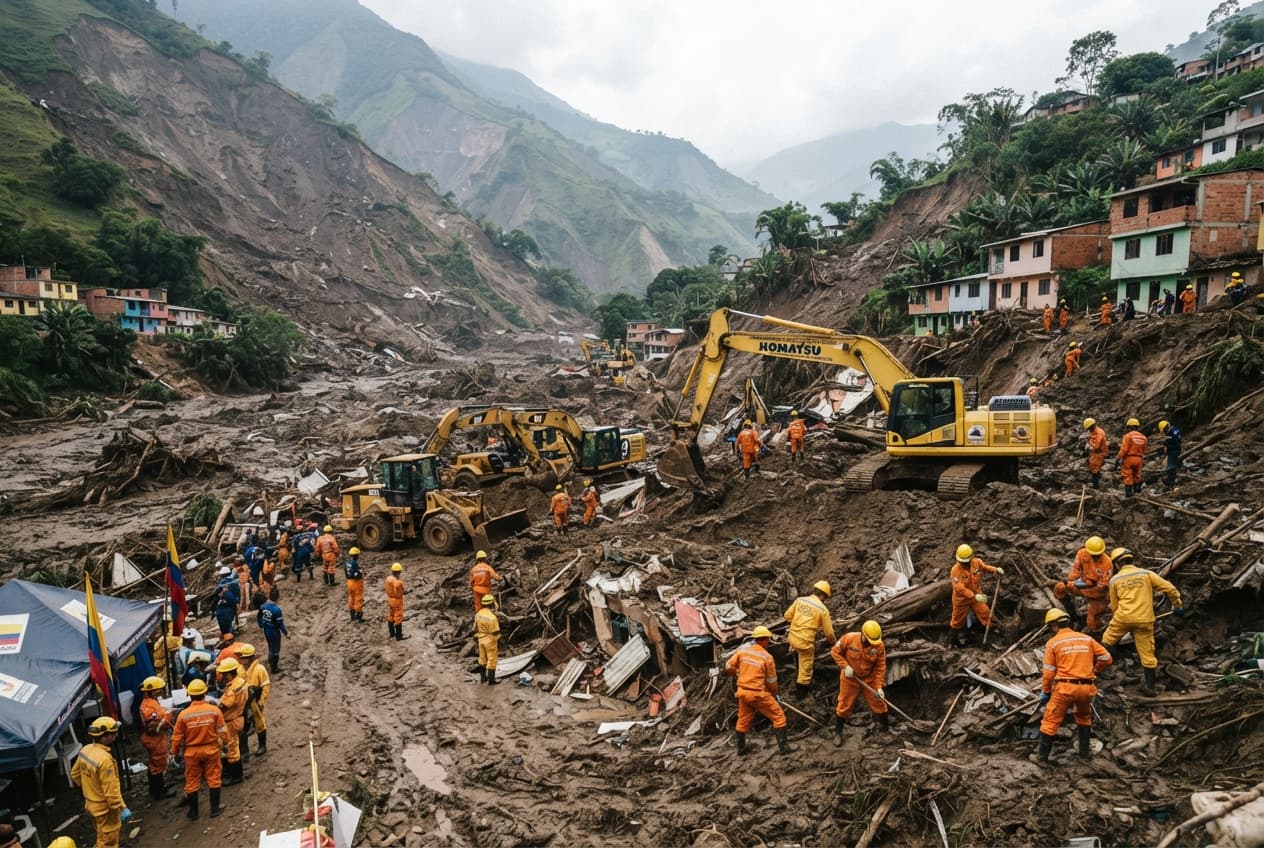
Antioquia, Colombia—Millions of tons of mud and rock detached from a saturated Andean ridge at dawn, burying a remote rural settlement in seconds. The sudden mountain collapse caught sleeping residents unaware, wiping out wooden and masonry homes clustered along the valley floor. Local authorities confirmed that communications with the isolated hamlet went dead immediately after the impact, cutting off vital distress signals.
Survivors who managed to escape the upper fringes of the slide area ran frantically toward neighboring towns to sound the alarm. Regional disaster management teams mobilized immediately, dispatching rescue units equipped with canine search squads and heavy excavation gear. Navigating the treacherous terrain proved nearly impossible as secondary landslides continuously blocked narrow mountain passes and access roads.
Paramedics set up field stations on the outer perimeter of the debris field, treating injured villagers pulled from the edge of the mudflow. Local officials stated that dozens of people remained unaccounted for beneath a dense blanket of gray earth that spanned several hundred meters. Helicopters attempted to land near the impact zone but were forced back by low cloud cover and persistent drizzle over the peaks.
Agricultural fields and livestock enclosures were entirely obliterated, erasing the primary economic livelihood of the small farming community in a single sweep. Community leaders had warned municipal authorities for months about growing structural cracks along the upper ridge following unseasonal downpours. Those warnings went unheeded due to budgetary constraints and administrative delays in executing necessary slope reinforcement projects.
Rescue workers formed human chains to pass digging tools and stretcher equipment across unstable ground while monitoring the ridge above for signs of further movement. Makeshift morgue tents were erected near the staging area as heavy equipment began unearthing the first tragic casualties from the wreckage. Grief-stricken relatives huddled together under plastic tarps, watching the slow, painstaking extraction process unfold in silence.
State governors declared an immediate departmental state of emergency to mobilize financial resources and accelerate the deployment of engineering battalions. International aid organizations offered technical assistance as civil defense agencies struggled to manage simultaneous weather-related crises across multiple departments. The disaster laid bare the severe risks faced by rural populations inhabiting steep mountain topography throughout the Andean range.
Engineers on site warned that a natural dam had formed across the local river basin, threatening downstream villages with sudden flash flooding if the barrier ruptured. Heavy pumps and tactical explosives were requested to manage the accumulating water pool before it could burst its earthen banks.
Search operations continued under the harsh glare of portable floodlights as night enveloped the narrow canyon without any definitive final casualty count.
Published by Banx Network. This article is part of the Banx decentralized media programme, powered by the BXE token on the XRP Ledger.