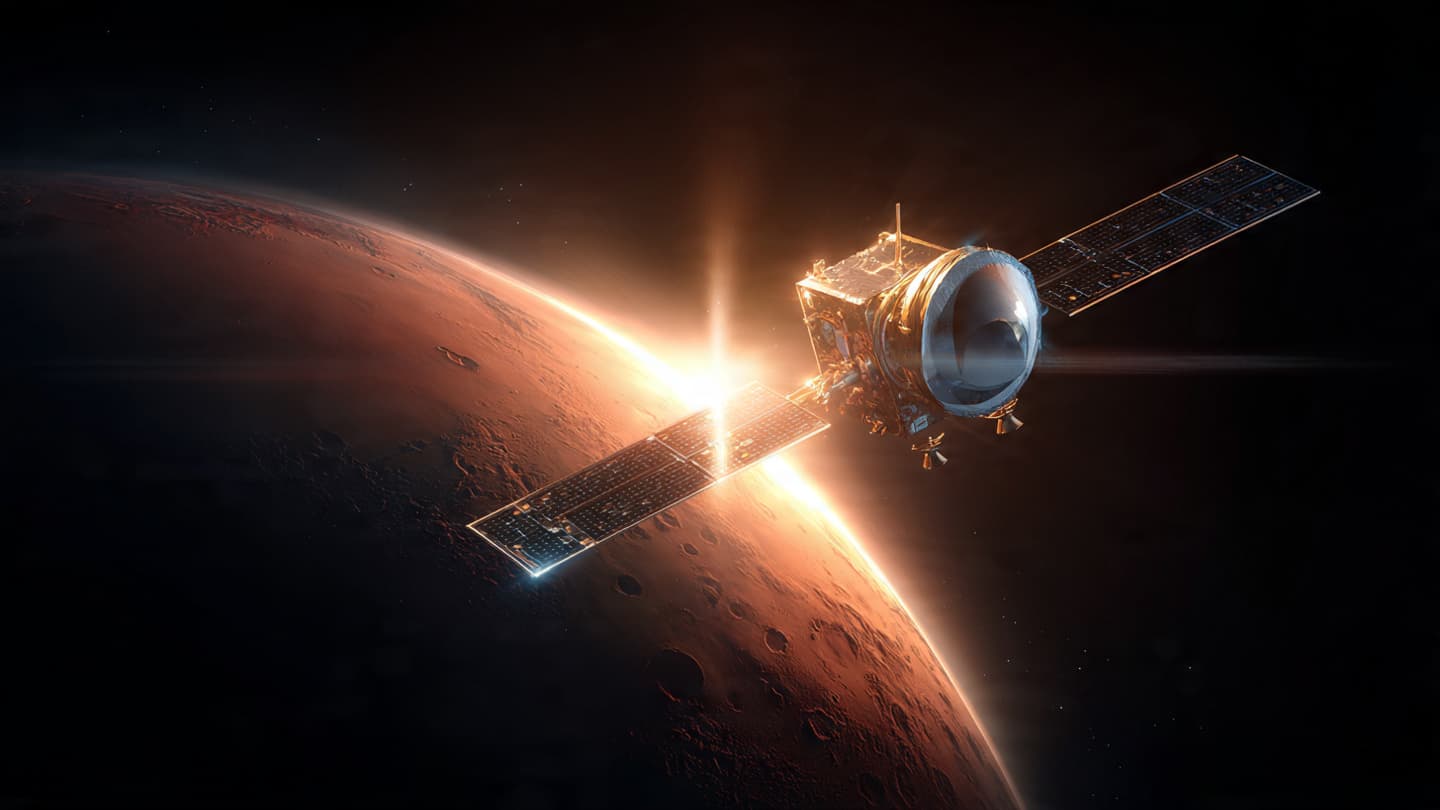
Above the rust-colored surface of Mars, the atmosphere is thin enough to feel almost absent, yet it carries a complex history written in particles and solar winds. NASA’s MAVEN spacecraft, orbiting the planet since 2014, has now identified a previously unobserved atmospheric effect, adding a new piece to the puzzle of how Mars slowly lost much of its air.
MAVEN, short for Mars Atmosphere and Volatile Evolution mission, was designed to study how the Martian atmosphere interacts with solar radiation. Over years of observation, it has tracked how solar wind strips away atmospheric particles, contributing to the planet’s transformation from a wetter ancient world to the cold desert seen today.
The newly identified atmospheric effect involves subtle changes in how energy and particles move through the upper layers of Mars’ atmosphere. While details remain within ongoing scientific analysis, the observation highlights previously unrecognized dynamics that influence atmospheric escape processes.
Scientists have long known that Mars lacks a strong global magnetic field, leaving its atmosphere vulnerable to solar particles. MAVEN’s instruments allow researchers to observe these interactions in real time, offering insights into both current atmospheric behavior and historical loss rates.
This discovery adds nuance to existing models of planetary evolution. Rather than a simple, uniform escape of atmospheric material, the data suggests more complex interactions shaped by solar activity, seasonal changes, and atmospheric composition variations.
Understanding these mechanisms is not only important for reconstructing Mars’ past but also for preparing future exploration missions. Atmospheric conditions directly affect communication, landing systems, and potential long-term human presence on the planet.
As MAVEN continues its mission, scientists expect more refinements in how Mars’ atmospheric system is understood, potentially influencing broader theories about planetary habitability across the solar system.
NASA’s MAVEN findings contribute another subtle but important layer to Mars science, reinforcing how dynamic even a thin atmosphere can be under constant solar influence.
AI Image Disclaimer: Visualizations of Mars atmospheric processes may be AI-generated for educational and illustrative purposes.
Published by Banx Network. This article is part of the Banx decentralized media programme, powered by the BXE token on the XRP Ledger.