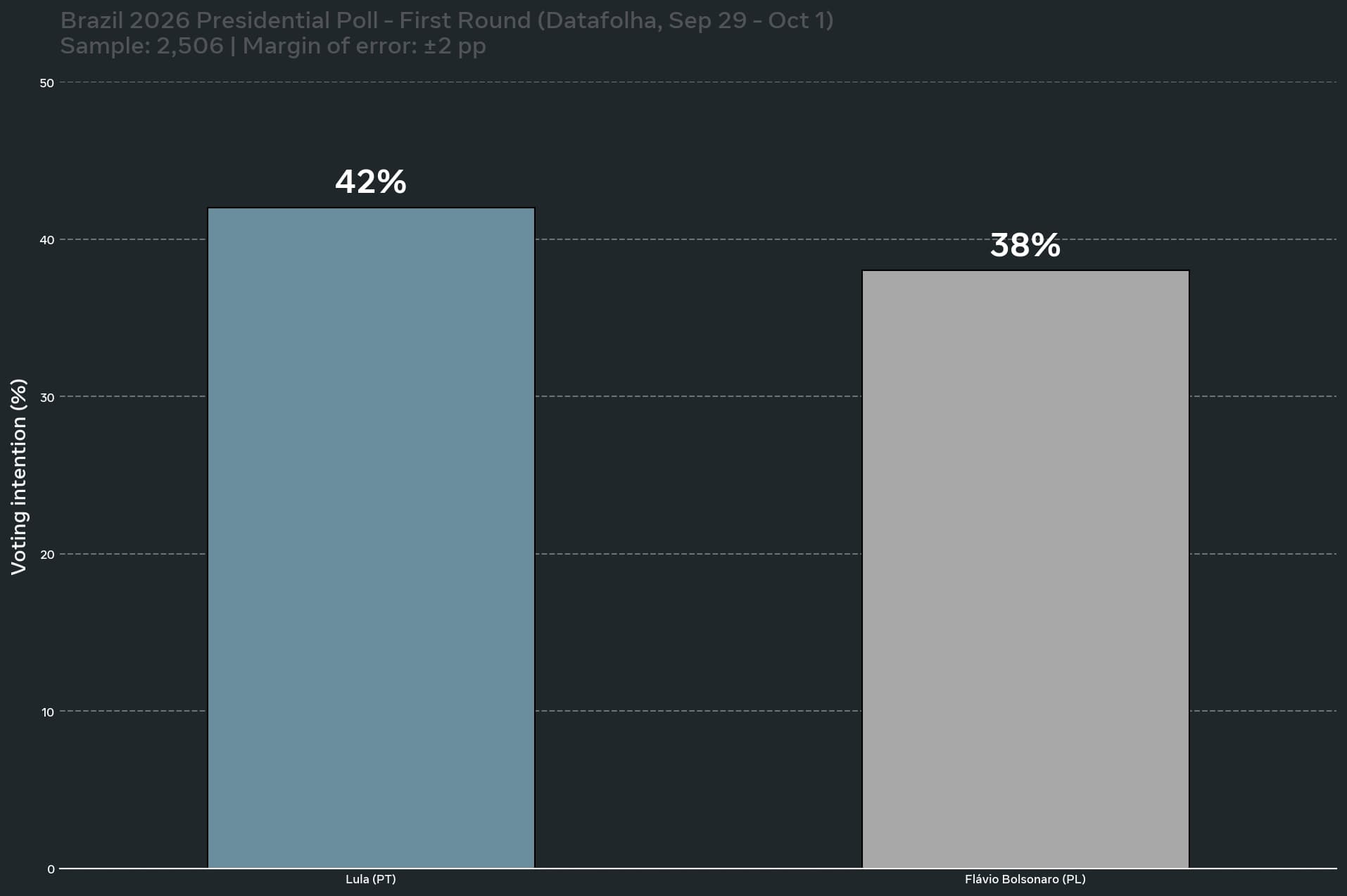
There is a particular tension that settles over a nation in the final days before an election—a tension measured not in dramatic swings but in the slow, incremental movement of numbers, the subtle recalibration of a race that had seemed settled. In Brazil, that tension has been building for weeks. On Saturday, a new CNT/MDA poll showed that President Luiz Inácio Lula da Silva's lead over Senator Flávio Bolsonaro had narrowed ahead of Sunday's first-round vote, while also pointing to a tighter contest in a likely runoff.
The numbers, as reported by Reuters, tell a story of a race that is closing. In a first-round scenario, Lula would receive 43.1 percent of voter support, followed by Bolsonaro at 38 percent. Augusto Cury registered 3.2 percent, Ronaldo Caiado 3 percent, and Renan Santos 1.5 percent. A September 15 poll had shown Lula at 40.5 percent and Bolsonaro at 30.4 percent—a lead of more than 10 points that has now shrunk to just over 5.
When projected valid votes are considered—excluding those who say they would cast blank or void ballots—the race is even tighter. Lula reaches 47.8 percent against Bolsonaro's 42.1 percent. That figure matters because of Brazil's electoral rules: if no candidate wins more than 50 percent of valid votes in the first round, the two frontrunners advance to a runoff on October 25. The poll suggests that outcome is increasingly likely, and that the runoff itself would be close. In a hypothetical second round, Lula would receive 47.3 percent compared with 43.1 percent for Bolsonaro—a margin of just over 4 points, narrower than the 7-point lead Lula held in the previous survey.
The survey, conducted by MDA, interviewed 2,007 people between September 30 and October 2, with a margin of error of 2.2 percentage points. That margin means the first-round lead is statistically significant but not commanding, and the runoff projection is within a range that could shift with turnout, last-minute developments, or the consolidation of support among the smaller candidates' voters.
Flávio Bolsonaro is the eldest son of former President Jair Bolsonaro, and his candidacy represents a continuation of the political movement his father built. Lula, who returned to the presidency after defeating Jair Bolsonaro in 2022, is seeking to extend his own political comeback. The narrowing of the race suggests that the electorate remains deeply divided, and that neither candidate has yet secured the kind of decisive advantage that would make the outcome predictable.
For now, the campaigns have one final day to make their cases. The first-round vote is scheduled for Sunday, October 4. If a runoff is required, it will be held on October 25. The poll offers a snapshot of a race in motion—a contest that has tightened, that remains unsettled, and that will be decided by voters whose choices are not yet fully known.
AI Image Disclaimer: The visual elements in this article were created using AI generation tools and are intended for illustrative purposes only.
Sources: Reuters, Miami Herald, ARY News
Published by Banx Network. This article is part of the Banx decentralized media programme, powered by the BXE token on the XRP Ledger.