
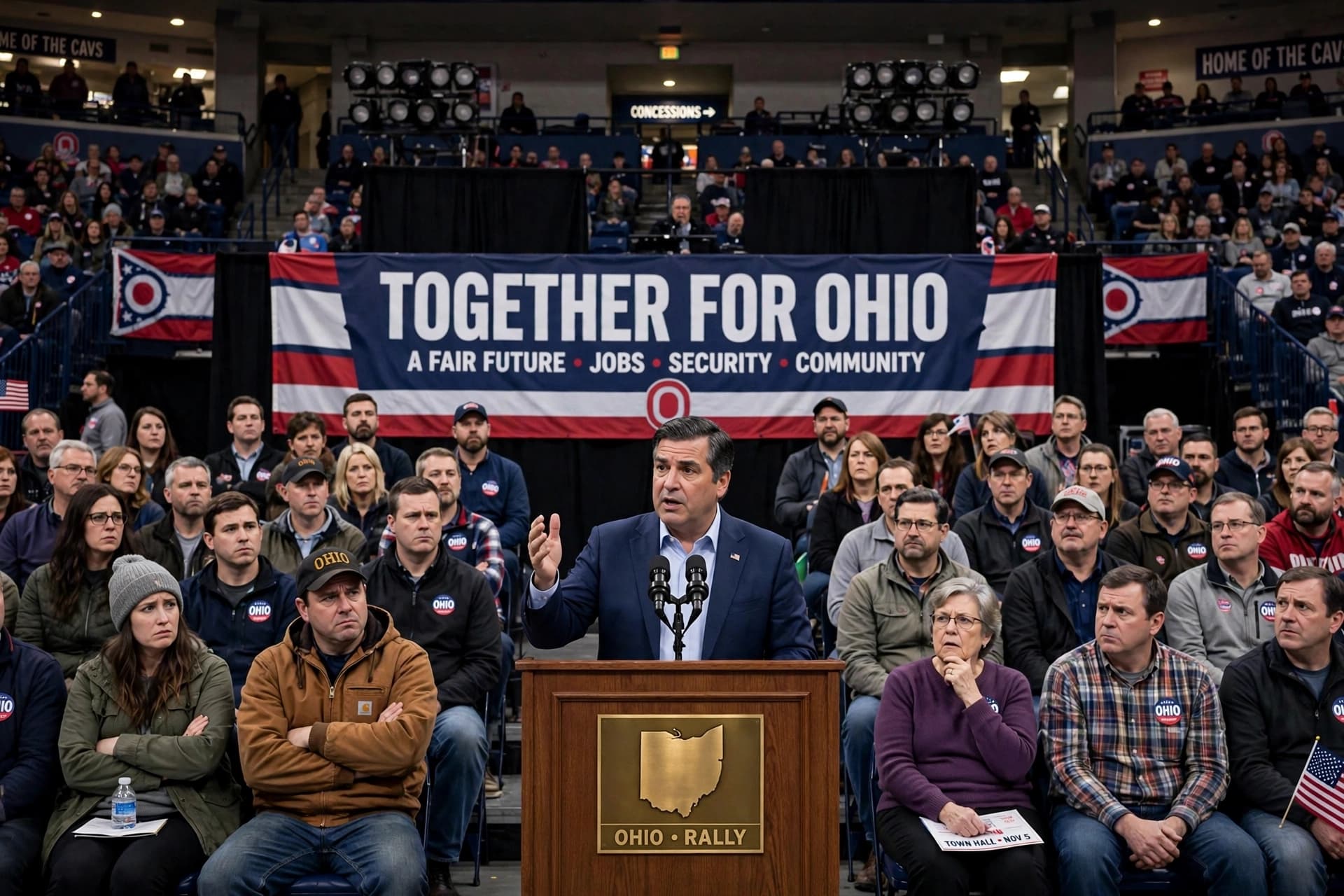
There is a particular silence that can fall over a political rally when a candidate says something the crowd did not come to hear—a silence that is not disagreement exactly, but something closer to discomfort, a recognition that the enthusiasm of the room has met its limit. On Saturday in Vandalia, Ohio, that silence arrived when President Donald Trump defended the data centers that have become a flashpoint in the state’s competitive Senate race. The crowd, which had cheered enthusiastically throughout the rally, went quiet .
“Look, there’s so much money to be made for Ohio. You can’t just turn them off. They’ll go to China,” Trump said, repeating a defense he has made before . The argument is one of economic nationalism: if the United States does not build the massive computing facilities that power artificial intelligence, China will. But the reception in Ohio suggested that the argument is not landing the way the president might hope.
Data centers have become a toxic political issue across the country, drawing bipartisan opposition in races from Texas to Pennsylvania . A September 2025 poll found the public evenly split on data center construction. By 2026, that had shifted dramatically: a Reuters/Ipsos survey found 64 percent of respondents did not think it was a good idea to build them at a rapid rate. Seventy-seven percent worried the facilities would increase their electricity rates. Only 14 percent said they would be willing to live close to one . The opposition cuts across party lines: an Annenberg survey found 61 percent of U.S. adults opposed data centers in their area, with Democrats, Republicans, and independents all expressing concern .
In Ohio, the issue is particularly acute because of Republican Senator Jon Husted, who was appointed to fill the seat vacated by Vice President JD Vance and is now running to keep it. As lieutenant governor, Husted supported tax breaks for data centers and encouraged towns to build them. Now, former Senator Sherrod Brown, his Democratic challenger, has made that record a centerpiece of his campaign. “Senator Jon Husted gave billions in tax breaks to Big Tech to make sure they would build their data centers in Ohio,” Brown wrote on X. “Now, he’s making Ohioans foot the bill” .
The Ohio race is one of the most competitive in the country, and there is likely no path to a Senate majority for Democrats without flipping it . Husted has introduced legislation that would require large power users to shoulder more of the costs associated with their electricity use, but the bill was blocked by Senate Democrats . Trump promised to sign a version of the bill “immediately within 24 hours” if Republicans retained control .
The broader political landscape suggests that data centers are becoming a defining issue of the 2026 midterms. Twenty states have enacted moratoriums or bans on construction, while seven more are advancing restrictions . The opposition is driven by concerns about electricity prices, water consumption, land use, and a broader “techlash” against the billionaires and companies driving the AI boom . For Trump, who has made American technological dominance a central theme of his presidency, the data center defense is consistent with his message. But the quiet that fell over the rally in Vandalia suggests that for many voters, the promise of jobs and economic growth is not enough to overcome the fear of higher bills and depleted resources. The president made his case. The crowd, for a moment, did not respond.
AI Image Disclaimer: The visual elements in this article were created using AI generation tools and are for illustrative purposes only.
Sources: The Canadian Press, The Hill, Brookings Institution, The National Desk, Times of India, Yonhap News
Published by Banx Network. This article is part of the Banx decentralized media programme, powered by the BXE token on the XRP Ledger.


.jpg&w=3840&q=75 "Prison Chief in Christa Pike Case Oversaw Five “Botched” Executions, Lawyers Say")