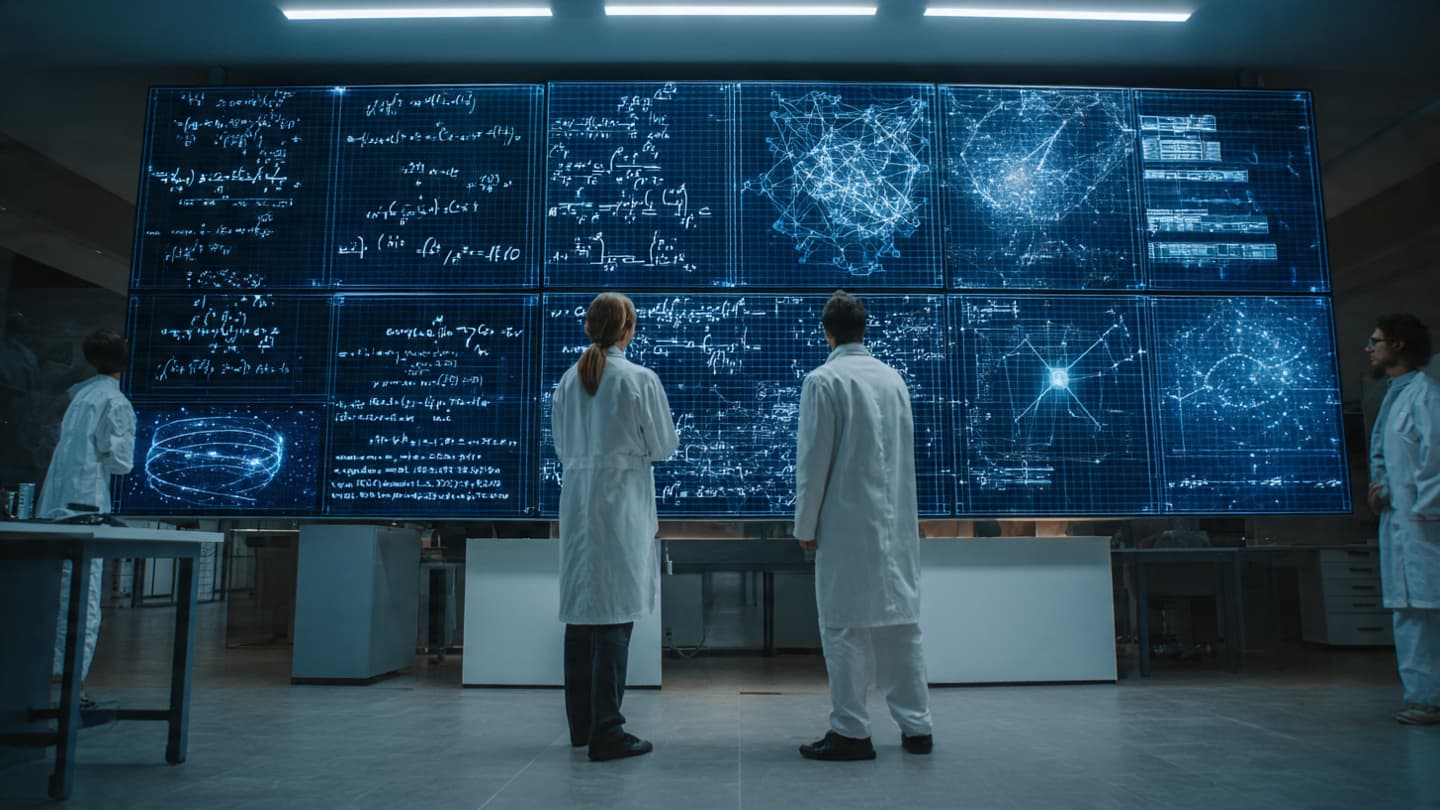
Mathematics is often described as the language of certainty, a discipline where every conclusion must be supported by careful reasoning. For centuries, mathematicians have built knowledge one proof at a time, constructing vast structures of understanding from logical foundations. A recent achievement by an artificial intelligence system known as LEAP has attracted attention because it demonstrates significant progress in one of the field's most demanding challenges: formal mathematical proof generation.
Formal proofs differ from ordinary problem-solving. Every logical step must be verified according to strict rules, leaving little room for ambiguity or interpretation. This precision makes formal mathematics an especially difficult domain for artificial intelligence systems.
Researchers behind LEAP reported that the framework achieved record-setting performance on benchmark evaluations involving mathematical proofs. The results suggest that AI systems are becoming increasingly capable of handling sophisticated reasoning tasks once considered beyond their reach.
The accomplishment reflects broader advances in machine learning and computational reasoning. Modern AI models can process enormous quantities of mathematical information, identify patterns, and explore potential solutions with remarkable speed.
Mathematicians emphasize that proof generation remains a highly specialized area. Even with significant advances, AI systems continue to operate within frameworks designed and supervised by human researchers.
Supporters of the technology see opportunities for collaboration between mathematicians and AI tools. Automated systems may help verify proofs, explore alternative approaches, and assist researchers working on complex theoretical problems.
Educational applications are also attracting interest. Advanced mathematical AI could eventually support students and researchers by providing explanations, checking logical consistency, and identifying errors within formal arguments.
At the same time, experts caution against overstating the implications. Human creativity, intuition, and conceptual understanding remain essential components of mathematical discovery. AI systems currently function best as powerful assistants rather than independent scientific thinkers.
As research continues, LEAP's achievement highlights how artificial intelligence is expanding into increasingly complex intellectual domains, opening new possibilities for collaboration between computation and human reasoning.
AI Image Disclaimer: The visual accompanying this article is AI-generated and intended as an artistic representation of advanced computational mathematics.
Source Verification Check: arXiv, IEEE Spectrum, Nature, MIT Technology Review, Association for Computing Machinery (ACM)
Published by Banx Network. This article is part of the Banx decentralized media programme, powered by the BXE token on the XRP Ledger.