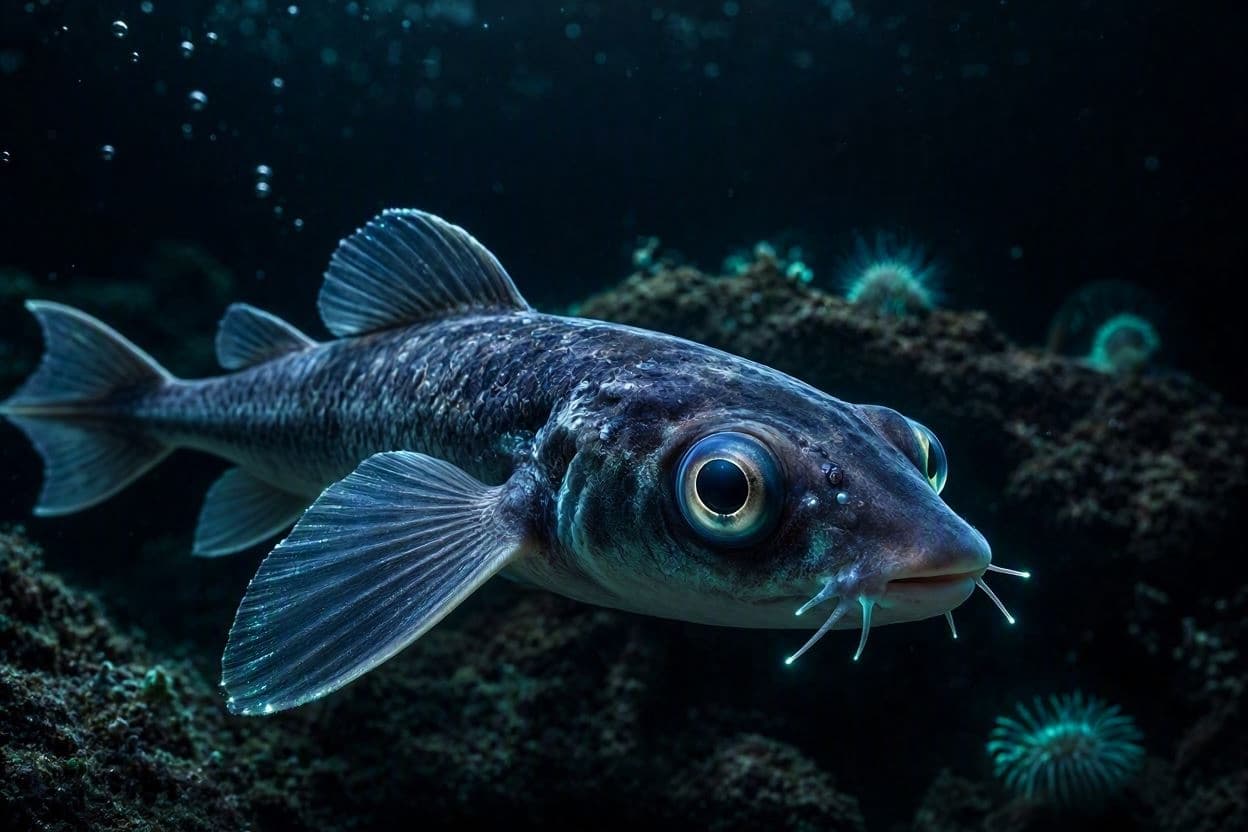
In the deep, shadowed corners of the ocean, there swim creatures that seem to have stepped out of a myth rather than a biology textbook. Chimaeras, often called ghost sharks or ratfish, are living fossils that predate the dinosaurs by over 150 million years. With their large, luminous eyes, whip-like tails, and peculiar dentition, they invite reflection on the enduring mysteries of evolutionary history. It is a moment where the ancient past swims quietly alongside the present.
These cartilaginous fish belong to the class Chondrichthyes, sharing a distant ancestry with true sharks and rays. However, their lineage diverged hundreds of millions of years ago, leading to a unique set of adaptations that have allowed them to survive multiple mass extinctions. Lineage connects life. Survival defines success.
Their appearance is a study in contrasts: a shark-like head and body paired with a long, slender tail that resembles that of a rat. This distinctive feature gives them their common name, "ratfish," and aids in their slow, graceful movement through the deep sea. Form follows function. Grace hides age.
Perhaps most intriguing are their teeth. Unlike the replaceable rows of sharp triangles found in sharks, chimaeras have tooth plates that grow continuously, much like the incisors of a rabbit. These plates are used to crush the hard shells of crustaceans and mollusks, their primary prey. Teeth tell diet. Plates crush shell.
Some species also possess a venomous spine on their dorsal fin, a defensive mechanism against potential predators. This combination of traits—ancient lineage, unique morphology, and chemical defense—makes them one of the most fascinating groups of fish in the ocean. Defense deters threat. Chemistry protects life.
Despite their eerie appearance, chimaeras are harmless to humans and spend most of their lives in the cold, dark depths of the ocean. Their elusive nature means that scientists are still discovering new species and learning more about their behavior. Depth hides secrets. Discovery reveals truth.
As we continue to explore the oceans, the chimaera serves as a reminder of the resilience of life and the vastness of time. The hope is for continued research that protects these ancient mariners and their fragile habitats. Research honors history. Protection ensures future.
Chimaeras, or ghost sharks, are ancient fish that predate dinosaurs by 150 million years. Known for their rat-like tails and rabbit-like teeth, they represent a unique evolutionary lineage. The hope is for increased understanding and conservation of these deep-sea dwellers.
AI Image Disclaimer: The visual elements accompanying this report are AI-generated interpretations designed to reflect the biological and prehistoric context of the story.
Sources: Discover Wildlife Natural History Museum BBC Earth Syfy Wire
Published by Banx Network. This article is part of the Banx decentralized media programme, powered by the BXE token on the XRP Ledger.