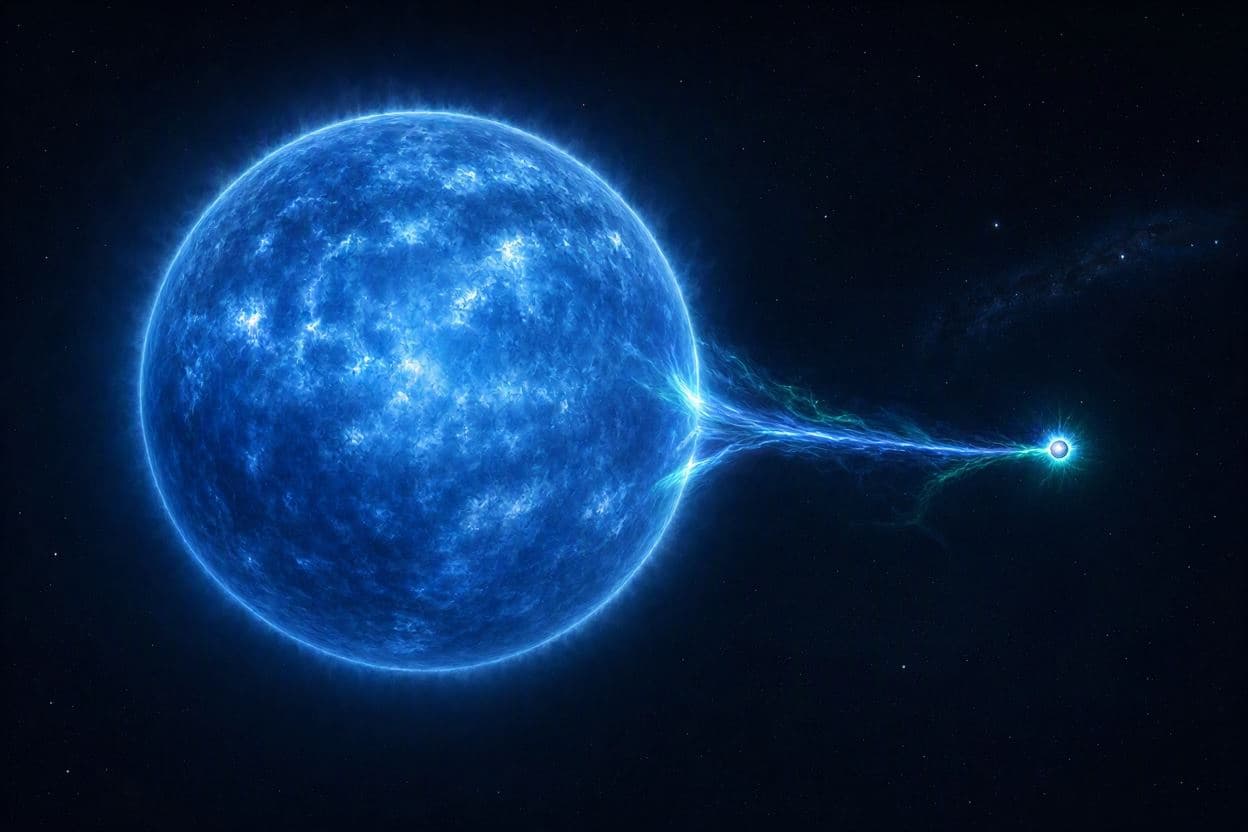
In the vast silence of the cosmos, a faint whisper has been heard. For the first time, astronomers have detected radio emissions coming directly from a planet outside our solar system. This groundbreaking discovery, led by researchers affiliated with Harvard and the Smithsonian Center for Astrophysics, opens a new window into the magnetic worlds that orbit distant stars. It is a moment that transforms exoplanets from mere points of light into dynamic, active worlds with their own atmospheric stories.
The signal originated from Beta Pictoris b, a young gas giant located approximately 64 light-years away. Unlike previous indirect detections, this observation captured the radio waves generated by the planet’s auroras. These auroras are created when charged particles interact with the planet’s magnetic field and atmosphere, a process similar to what produces the Northern Lights on Earth. The detection confirms that exoplanets can possess strong magnetic fields, a key factor in potential habitability.
The use of the Low-Frequency Array (LOFAR) telescope was crucial in this achievement. LOFAR’s sensitivity to low-frequency radio waves allowed scientists to distinguish the planet’s signal from the background noise of its host star. This technical triumph demonstrates the power of international collaboration and advanced instrumentation in pushing the boundaries of astronomical observation.
For scientists, the implications are profound. Magnetic fields protect planets from stellar radiation, helping to retain atmospheres over billions of years. By detecting these fields, researchers can better assess which exoplanets might be capable of supporting life. It adds a new layer of data to the search for habitable worlds, moving beyond size and temperature to include magnetic protection.
The discovery also provides insights into the evolution of planetary systems. Beta Pictoris b is a young planet, and its strong magnetic activity suggests that such features are prominent in the early stages of a planet’s life. Studying these young worlds helps astronomers understand how planets like Jupiter and Saturn developed their own magnetic environments.
Public interest in the search for extraterrestrial life often focuses on signals from intelligent civilizations. However, this detection is a natural phenomenon, a reminder that the universe is filled with complex physical processes. It underscores the importance of distinguishing between natural and artificial signals in the ongoing quest to understand our place in the cosmos.
The team’s findings have been published in peer-reviewed journals, inviting further study and verification. As more telescopes come online, such as the Square Kilometre Array, the ability to detect similar signals will improve. This could lead to a new era of exoplanet magnetometry, where magnetic fields become a standard parameter in planetary characterization.
The detection of radio signals from Beta Pictoris b marks a significant milestone in astronomy. It transforms our understanding of exoplanets, revealing them as active, magnetic worlds. As we continue to listen to the cosmos, each new signal brings us closer to understanding the diversity and complexity of the universe.
AI Image Disclaimer: Visuals in this article are AI-generated conceptualizations of exoplanet auroras and radio wave detection, not actual images of Beta Pictoris b.
Sources: ScienceAlert Wired The Independent Newsweek
Published by Banx Network. This article is part of the Banx decentralized media programme, powered by the BXE token on the XRP Ledger.