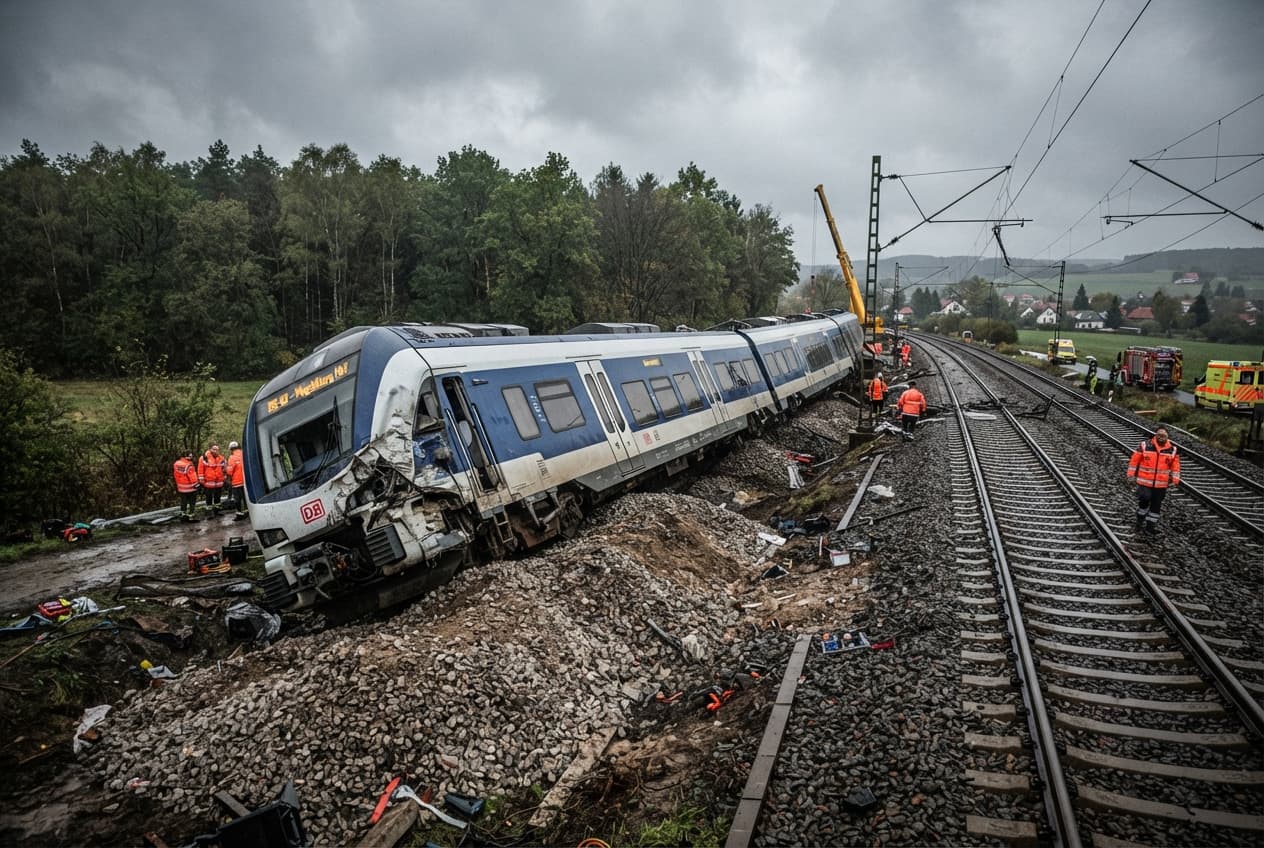
London, United Kingdom—A packed morning commuter train veered off the tracks just outside a major railway station on Wednesday, leaving one person dead and twelve others injured. The passenger service was traveling at moderate speed when the rear carriages suddenly buckled and slammed into an adjacent concrete embankment. Loud grinding noises echoed across the residential neighborhood as emergency brakes automatically engaged throughout the train.
British Transport Police and local fire brigades declared a major incident within minutes of the initial distress calls. Paramedics triaged injured passengers on the grassy slope beside the tracks while rescue teams used hydraulic equipment to free trapped travelers. Hospital helicopters landed on nearby playing fields to airlift the most critical casualties to specialized trauma centers.
Witnesses inside the carriage described luggage flying overhead as the floor violently tilted sideways during the abrupt derailment. Passengers smashed windows to escape the smoking wreckage before emergency ladders could be positioned against the doors. Rail operators immediately suspended all incoming and outgoing services along the key commuter corridor, stranding tens of thousands of travelers.
Transport secretary officials arrived at the site by early afternoon to assess the structural damage inflicted on the twisted rails. Investigators from the Rail Accident Investigation Branch began combing through electronic signal logs and mechanical track switches. Preliminary inspections suggested a localized track bed failure might have triggered the sudden wheel misalignment.
Commuters faced severe chaos across alternative bus routes and underground connections as replacement transit networks struggled to cope. Queues outside nearby underground stations wrapped around city blocks under an increasingly overcast sky. Transport executives warned that line clearances and safety checks would likely halt normal services for multiple consecutive days.
Local residents rushed toward the embankments with bottled water and blankets to assist walking wounded passengers awaiting transport buses. Council workers established a temporary reception center at a nearby community hall to provide psychological support and shelter. Railway union representatives expressed deep concern over aging infrastructure maintenance budgets following the disaster.
Engineers began deploying heavy lifting cranes to stabilize the overturned carriages before attempting to hoist them back onto flatbed cars. Power lines running parallel to the damaged track section remained deactivated to ensure the safety of recovery personnel. Specialized cleanup crews worked diligently to clear spilled oil and shattered glass from the rail ballast.
The identity of the fatality was withheld pending formal coroner verification and family notification procedures. Medical officials confirmed that several of the hospitalized passengers remain in guarded condition with severe orthopedic injuries. The operational inquiry into the exact root cause of the structural failure remains ongoing.
Published by Banx Network. This article is part of the Banx decentralized media programme, powered by the BXE token on the XRP Ledger.