There are places in the solar system where light does not simply shine — it shimmers, it bends, it performs quietly against vast and silent skies. Uranus, tilted on its side and drifting in distant blue stillness, has long kept its secrets beneath layers of cold haze. Yet even there, in a realm so far from the Sun’s warmth, curtains of light flicker and fade. And now, for the first time, those lights have been mapped in three dimensions.
Using the remarkable sensitivity of the , scientists have created the first 3D map of auroras on . The achievement marks a significant step forward in understanding one of the solar system’s most enigmatic planets — and researchers are openly expressing their excitement.
Auroras are not unique to Earth. They appear when charged particles, often carried by solar winds, collide with a planet’s magnetic field and atmosphere, releasing light. On our own world, these displays paint polar skies with shifting greens and purples. But Uranus is different. Its magnetic field is oddly tilted and offset from its rotational axis, creating auroral patterns that are far less predictable.
Previous observations, including those from the , had detected auroral activity on Uranus, but only in limited detail. What Webb has now provided is depth — a layered view that allows scientists to see not just where the auroras glow, but how they extend and move within the planet’s upper atmosphere.
The new 3D mapping was made possible through Webb’s advanced infrared instruments, which can detect subtle emissions from ionized hydrogen molecules. These emissions act like faint signatures in the dark, tracing the interaction between the solar wind and Uranus’ magnetosphere. By observing these signatures over time and from multiple perspectives, researchers reconstructed the auroras’ structure in three dimensions.
The results are already reshaping assumptions. Scientists report that Uranus’ auroras appear more dynamic and complex than previously understood. Rather than simple rings around the magnetic poles, the lights can shift in response to solar activity, expanding and contracting in ways that reflect the planet’s unusual magnetic geometry.
This breakthrough also offers clues about the inner workings of Uranus itself. Because auroras are influenced by a planet’s magnetic field, studying their shape and motion can help researchers refine models of what lies beneath the cloud tops — perhaps even shedding light on the composition and behavior of the planet’s interior layers.
For planetary scientists, the excitement is rooted in rarity. Uranus has only been visited once by a spacecraft — in 1986 — and even that encounter was brief. Remote observations are therefore essential. Webb’s ability to capture such detailed infrared data from billions of miles away demonstrates how modern astronomy can revisit distant worlds with renewed clarity.
There is also a broader implication. Understanding auroras across different planets allows scientists to compare magnetic environments throughout the solar system. These comparisons inform not only planetary science but also the study of exoplanets, where magnetic fields may influence atmospheric retention and even habitability.
For now, the central development is clear: the James Webb Space Telescope has successfully mapped Uranus’ auroras in 3D for the first time. Scientists say the findings deepen knowledge of the planet’s magnetic field and atmospheric dynamics, opening new avenues for future study of the outer solar system.
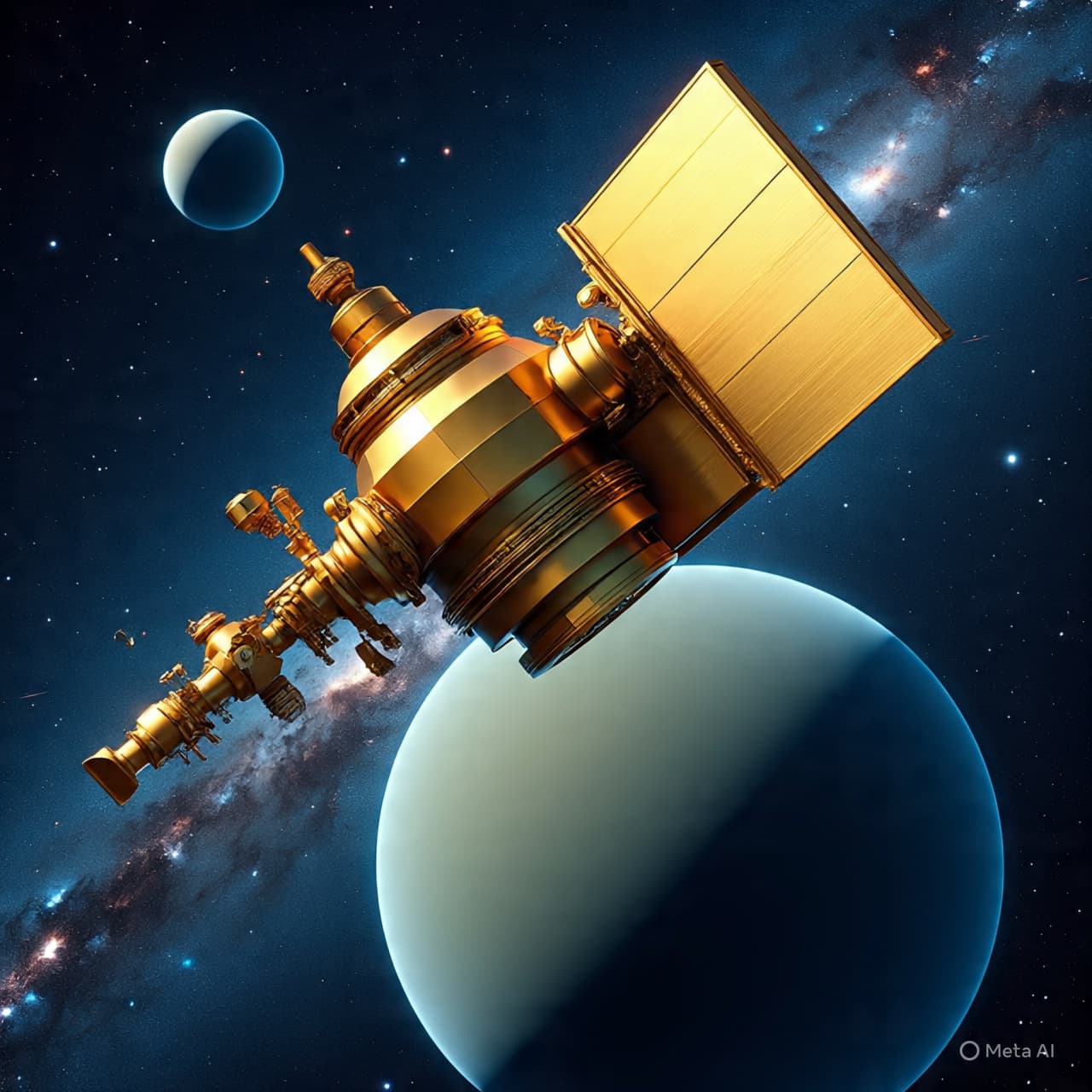
AI IMAGE DISCLAIMER Visuals are created with AI tools and are not real photographs.
Sources: NASA Reuters BBC News Space.com The Guardian
Published by Banx Network. This article is part of the Banx decentralized media programme, powered by the BXE token on the XRP Ledger.