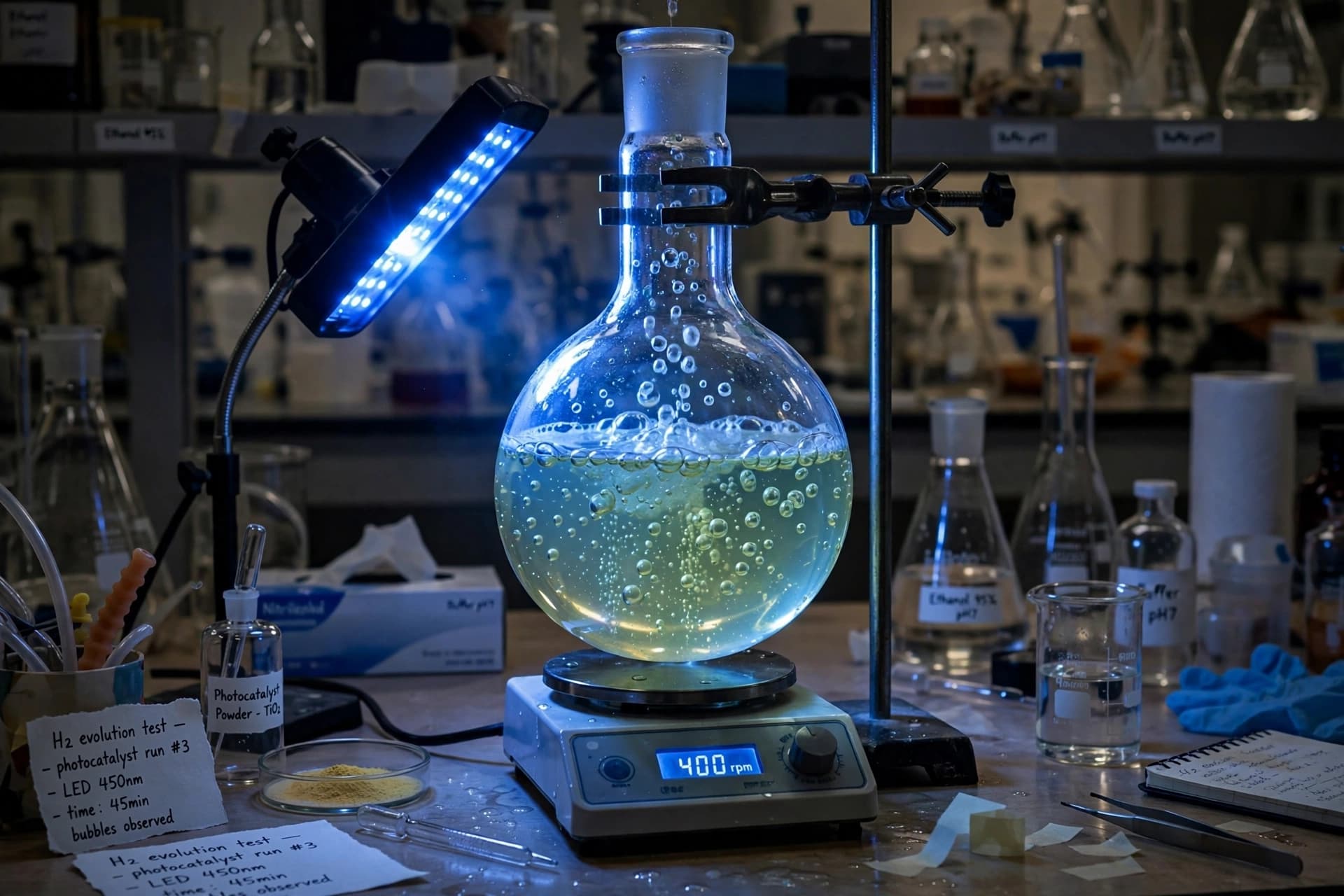
There is a particular elegance in a chemical reaction that uses the most unruly of ingredients—the hydrogen atoms that chemists have long struggled to control—and turns them into useful tools. For decades, synthetic chemists have sought ways to harness the reactivity of hydrogen atoms to build complex molecules, but the reactions have been difficult to tame. Now, a new light-driven method may offer a solution. Researchers have developed a technique that uses light to activate hydrogen atoms and directs them to specific sites on a molecule, enabling chemical transformations that were previously impractical.
The method, published in Nature, uses a photocatalyst—a molecule that absorbs light and transfers energy to a substrate—to generate hydrogen atoms from a simple, abundant source. These hydrogen atoms are then added to specific positions on unsaturated carbon-carbon bonds, forming new carbon-hydrogen bonds with high selectivity. The key to the technique is the photocatalyst's ability to control where the hydrogen atom goes, preventing it from reacting at unintended sites. This level of precision is what makes the method useful for synthesis, allowing chemists to build molecules with the exact structure they intend.
The challenge that the new method addresses is fundamental to organic chemistry. Hydrogen atoms are the smallest and most abundant atoms in organic molecules, and they are also the most reactive. This reactivity makes them useful for forming bonds, but it also makes them difficult to control. In traditional methods, hydrogen atoms often react at multiple sites, producing a mixture of products that must be separated—a process that is time-consuming and wasteful. The light-driven method avoids this problem by activating the hydrogen in a controlled way, allowing it to be delivered to a single target site.
The researchers demonstrated the technique on a range of substrates, including complex molecules with multiple functional groups. The reactions proceeded with high yields and excellent selectivity, meaning that the desired product was formed almost exclusively. The method is also compatible with a wide range of functional groups, which is important for practical applications in pharmaceutical and materials chemistry.
The implications for drug discovery and materials science are significant. Many pharmaceuticals are complex molecules that require precise control over their structure, and the ability to add hydrogen atoms selectively opens new routes for their synthesis. The method could also be used to modify existing molecules, adding hydrogen at specific positions to change their properties. For now, the research is at the proof-of-concept stage, but the principles it establishes could lead to new, more efficient ways of making the molecules that society depends on.
AI Image Disclaimer: The visual elements in this article were created using AI generation tools and are intended for illustrative purposes only.
Sources: Nature, EurekAlert!, Chemistry World
Published by Banx Network. This article is part of the Banx decentralized media programme, powered by the BXE token on the XRP Ledger.

.jpg&w=3840&q=75 "September 2026 Was the Second-Warmest on Record, With Global Temperatures Above 1.5°C for a Second Month")