There are moments in spaceflight when the roar of engines and the hush of re-entry converge into a single breath of promise. On the afternoon of November 13, 2025, from the launch pads of Cape Canaveral, the New Glenn rocket ascended in bright Florida skies — and, remarkably, returned home.
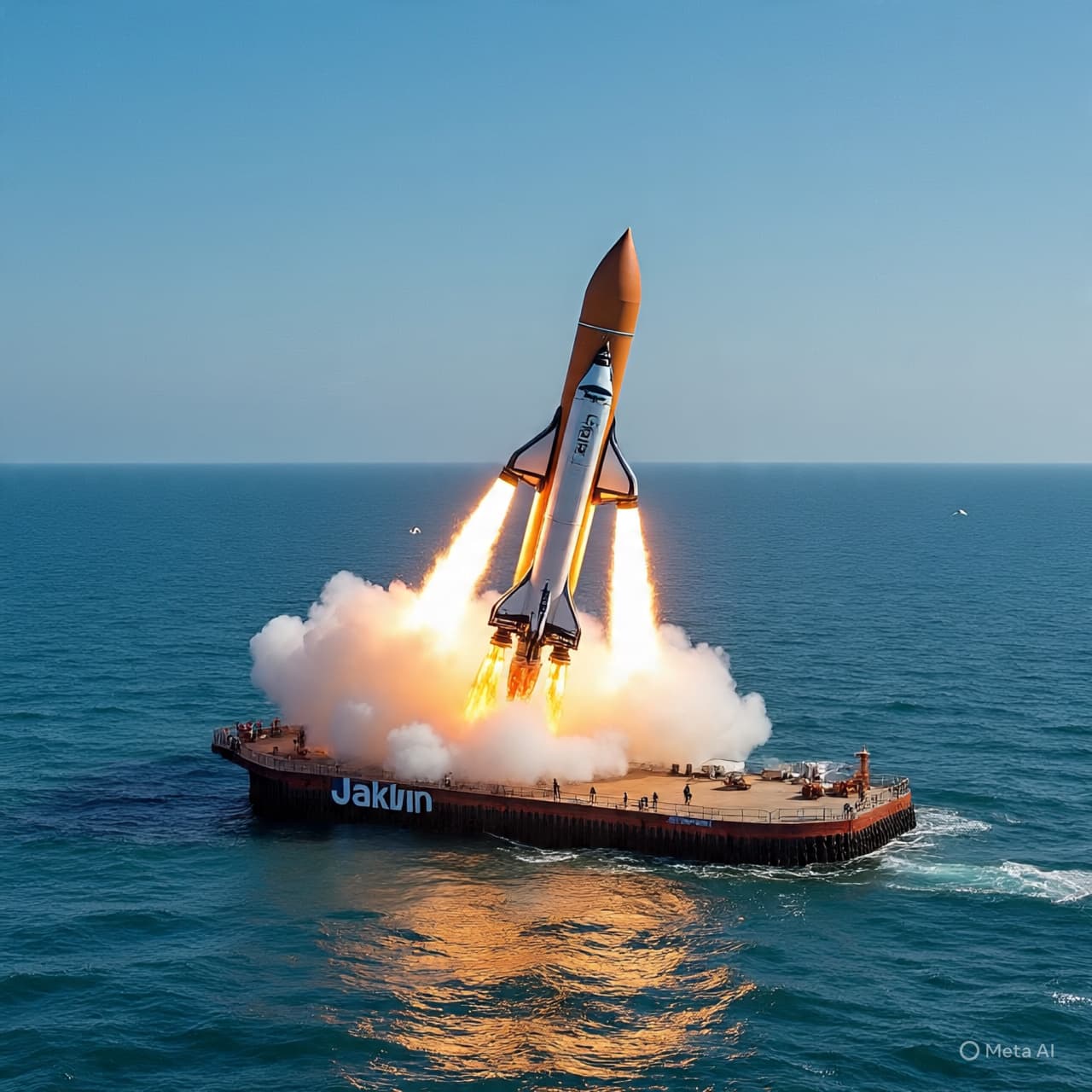
The mission carried weight in more ways than one. It delivered twin Mars-bound spacecraft — part of NASA’s EscaPADE (Escape and Plasma Acceleration and Dynamics Explorers) mission — into orbit, destined to study Mars’s magnetic field and solar wind interactions. At the same time, its first-stage booster — affectionately named “Never Tell Me the Odds” — made the company’s first successful ocean-barge landing, aboard the platform “Jacklyn” in the Atlantic.
For Blue Origin, this mission is more than a demonstration flight; it marks a strategic shift. The heavy-lift New Glenn, designed to carry large payloads and support future lunar missions, has until now been awaiting proof of both performance and reusability. Earlier this year its debut flight succeeded in launch but failed in booster recovery.
Now, with booster landing achieved and a NASA science payload aboard, the company crosses a threshold. The twin spacecraft “Blue” and “Gold” will travel toward Mars, first loitering at a distant Lagrange point, then heading into Mars orbit in 2027 to study how the planet loses atmosphere under the duress of solar winds.
It is also a sign of intensifying competition in the commercial-orbital launch market. Until now, SpaceX has been the de facto leader in reusable orbital launch vehicles, booster landings, and large-scale commercial missions. New Glenn’s success signals that Blue Origin may be closing the gap — or at least widening the field of competition.
Beyond the spectacle, the landing itself matters: reusability is one of the key levers in lowering the cost of access to space. A booster that can return and be reused — rather than discarded — changes the economics of launch. Blue Origin will now turn its focus to demonstrating refurbishment and relaunch capability for the recovered first stage.
Yet this success does not obviate the challenge ahead. The path to routine heavy-lift, reusable launch remains complex: booster recovery is one step; multiple flights, rapid turnaround, robustness of refurbishment, and cost-efficiency remain to be proven. Moreover, placing a payload on Mars is an achievement, but long-duration science missions still carry risk.
In this moment, though, the industry paused to watch: a rocket rose, delivered valuable science, and its first stage returned home safely. The rhythm of flight and return has been validated — and for Blue Origin, that brings fresh momentum.
AI Image Disclaimer: Illustrations were produced with AI and serve as conceptual depictions.
Sources: Associated Press, Reuters, Washington Post, TechCrunch, Deseret News
Published by Banx Network. This article is part of the Banx decentralized media programme, powered by the BXE token on the XRP Ledger.