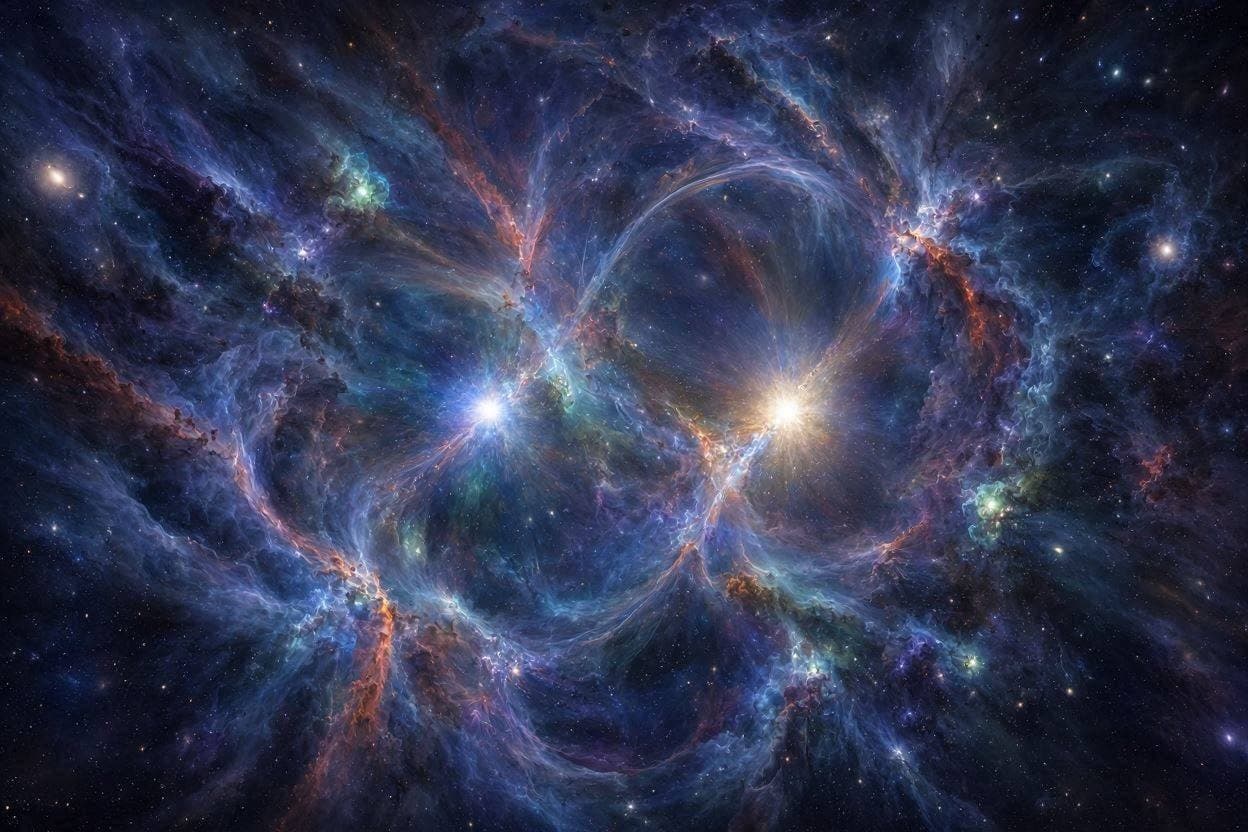
In the deep void of space, quasars shine as beacons of immense energy, powered by supermassive black holes devouring matter. They are regions of extreme violence and radiation, where one might expect complex molecules to be torn apart. Yet, astronomers have detected hydrocarbons—organic compounds essential for life as we know it—surprisingly close to a pair of interacting quasars. This finding challenges our understanding of cosmic chemistry, suggesting that the building blocks of life can persist even in the most hostile environments imaginable.
Body: The discovery was made using the James Webb Space Telescope (JWST), which observed a rare system of two quasars in the process of merging. Typically, the intense ultraviolet radiation from quasars destroys complex molecules in their vicinity. However, the JWST detected spectral signatures of polycyclic aromatic hydrocarbons (PAHs) within the dusty torus surrounding the black holes. These molecules, composed of carbon and hydrogen, are considered precursors to more complex organic structures.
The presence of hydrocarbons so close to such energetic sources suggests that they are shielded by dense clouds of dust and gas. These protective cocoons allow the molecules to survive despite the harsh radiation field. This shielding effect is crucial for the formation of stars and planets, as it preserves the chemical ingredients necessary for planetary systems to develop. It indicates that the universe is more chemically rich and resilient than previously thought.
This finding has implications for the search for life beyond Earth. If hydrocarbons can survive near quasars, they may be widespread throughout the universe, present in a variety of galactic environments. It expands the potential habitats where prebiotic chemistry could occur, increasing the likelihood that the ingredients for life are common rather than rare.
The interaction between the two quasars may also play a role in distributing these molecules. As the galaxies merge, gravitational forces can stir up gas and dust, spreading organic compounds across vast distances. This process could seed future star-forming regions with the raw materials needed for planetary formation, linking the death of old systems to the birth of new ones.
For astronomers, the detection validates the capabilities of the JWST. Its infrared sensitivity allows it to peer through dust and detect faint molecular signatures that were previously invisible. This success opens the door to further studies of quasar environments, promising more discoveries about the chemical evolution of the cosmos.
The discovery also invites philosophical reflection. The same molecules that make up soot on Earth are found in the hearts of distant galactic monsters. It connects the mundane with the majestic, reminding us that the universe is woven from the same fundamental threads, regardless of scale or location.
Closing: The spotting of hydrocarbons near a quasar pair is a testament to the resilience of matter and the reach of modern astronomy. It shows that even in the face of extreme energy, complexity can endure. As we continue to explore the cosmos, we find that the ingredients for life are scattered like stardust, waiting to be assembled into new worlds.
AI Image Disclaimer: Images included here are AI-generated conceptual illustrations of quasars and molecular structures, designed to visualize the astronomical phenomena without depicting specific real-time telescope data.
Sources: NASA Goddard Space Flight Center The Astrophysical Journal Space.com European Space Agency (ESA)
Published by Banx Network. This article is part of the Banx decentralized media programme, powered by the BXE token on the XRP Ledger.