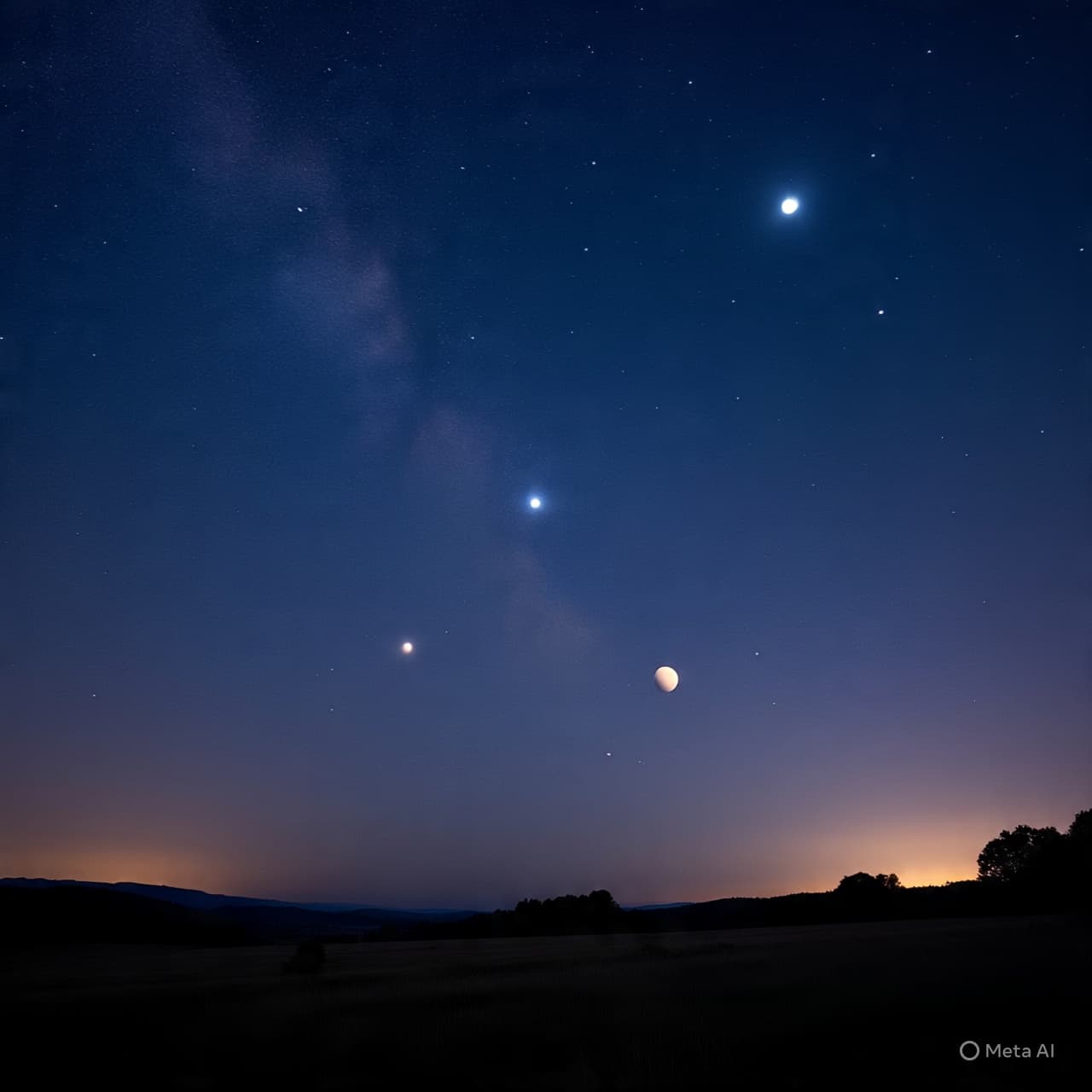
There are evenings when the sky feels less like distance and more like design. The stars settle into their quiet patterns, and for a brief span of nights, several familiar wanderers gather along the same luminous path. Soon, six planets are expected to appear in a rare celestial alignment, offering skywatchers a spectacle that feels both orderly and wondrous — a gentle reminder of the architecture that binds our solar system.
This planetary “parade” does not unfold as a straight line etched across the heavens. Instead, the planets will share the same general arc known as the ecliptic — the path traced by the sun and followed closely by the planetary orbits. When multiple planets occupy this corridor at once, they appear to stand in quiet company, spaced across the twilight like lanterns along a curved horizon.
Among the participants are Mercury, Venus, Mars, Jupiter, Saturn, and Uranus. Several will be visible to the naked eye under clear skies, while others may require binoculars or a small telescope to separate their steady glow from the distant shimmer of stars.
Venus and Jupiter are often the first to command attention, radiating a brightness that outshines most stars. Mars may reveal its faint reddish tint to patient observers, while Saturn glows softly with a golden hue. Mercury, often low on the horizon, can be more elusive in the lingering light of dusk. Uranus, distant and subtle, rewards those who bring optical aid and steady focus.
Such alignments occur because the planets orbit the sun in roughly the same flat plane. From Earth’s vantage point, there are moments when their separate journeys align in perspective, creating the impression of gathering. Though smaller groupings are relatively common, the appearance of six planets at once is less frequent, lending this event a particular distinction.
Astronomers note that visibility will depend on local weather, horizon clarity, and timing. The best viewing windows are typically shortly after sunset or before sunrise, when the sky is dark enough to reveal fainter worlds yet bright enough to guide orientation. Observers are encouraged to consult local sky charts and allow time for their eyes to adjust to darkness.
Beyond the visual appeal, planetary alignments quietly illustrate the precision of celestial motion. Each world continues its own orbit, guided by gravity and time. The parade is not a coordinated performance but a brief alignment of perspectives — a reminder that our viewpoint shapes what we see.
Space agencies and observatories have confirmed the timing and viewing windows for this multi-planet alignment, noting that the event will span several nights. Clear skies will offer the best opportunity to observe the planets as they share the same celestial corridor. For those willing to step outside and look upward, the coming evenings may provide a rare and measured spectacle written across the night.
AI Image Disclaimer Illustrations were produced with AI and serve as conceptual depictions.
Sources NASA Space.com BBC News The Guardian Sky & Telescope
Published by Banx Network. This article is part of the Banx decentralized media programme, powered by the BXE token on the XRP Ledger.