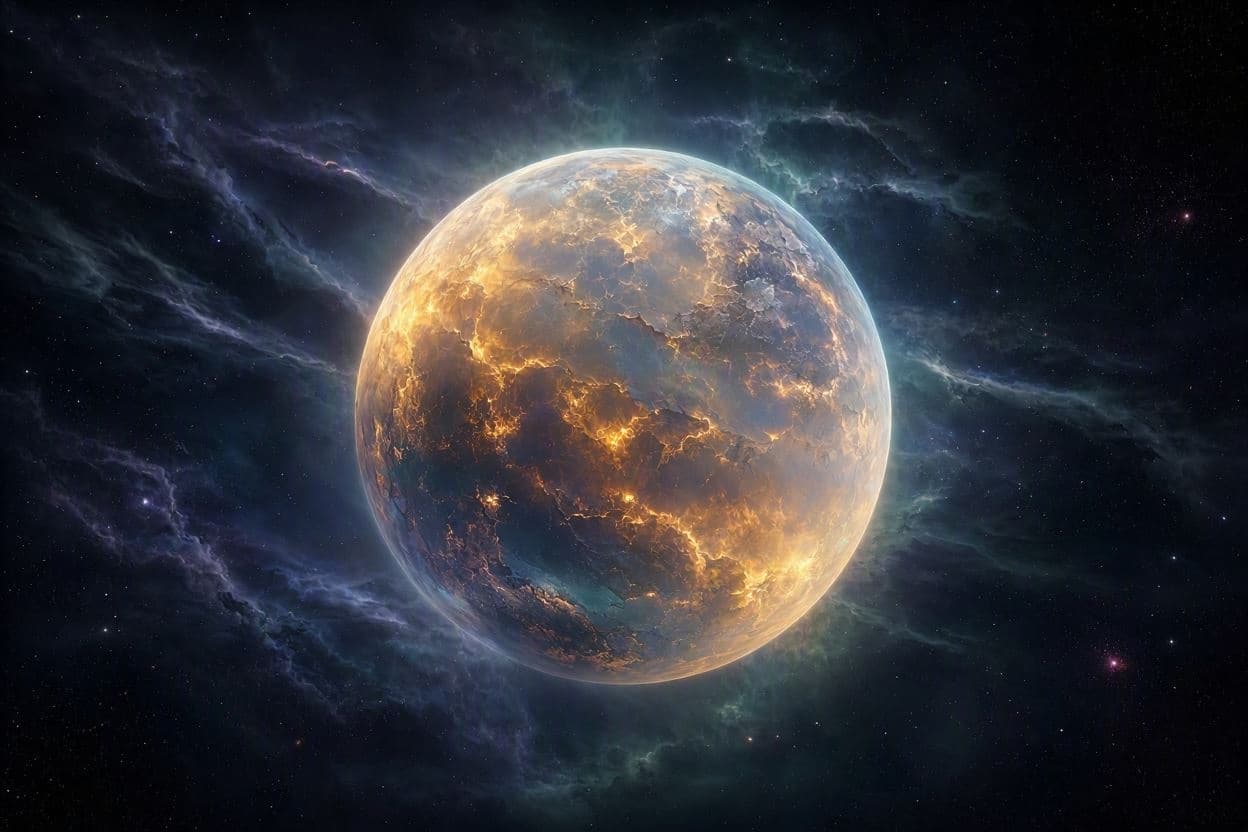
In the deepest reaches of time, just moments after the Big Bang, the universe was a dark and mysterious place. Now, the James Webb Space Telescope (JWST) has peered into this epoch and detected unusual objects that defy conventional explanation. These bright, distant sources, known as "dark stars," may be powered not by nuclear fusion like ordinary stars, but by the annihilation of dark matter particles. If confirmed, this discovery would revolutionize our understanding of the early universe and the nature of dark matter itself.
Dark stars are theoretical objects predicted to have formed in the first few hundred million years of cosmic history. In this era, density fluctuations allowed huge clouds of hydrogen and helium to collapse under gravity. Unlike normal stars, which heat up and ignite fusion, dark stars would have been kept cool and inflated by the energy released from dark matter particles colliding and annihilating each other. This process would allow them to grow to supermassive sizes, shining brightly without the typical spectral signatures of fusion.
Recent observations by JWST have identified several candidates that fit the profile of dark stars. These objects appear unusually bright and large for their age, lacking the heavy elements found in later generations of stars. Their light spectra show characteristics consistent with cool, massive bodies rather than hot, compact fusion engines. While alternative explanations exist, such as clusters of normal Population III stars, the dark star hypothesis offers a coherent model for these anomalies.
The implications for physics are profound. Dark matter, which makes up about 85% of the matter in the universe, has never been directly detected. Its presence is inferred from gravitational effects on galaxies and light. If dark stars exist, they provide a natural laboratory for studying dark matter interactions in extreme conditions. The energy output of these stars depends on the properties of dark matter particles, offering clues about their mass and behavior.
For astronomers, confirming dark stars requires careful analysis of light curves and spectral lines. Future observations with JWST and other telescopes will aim to distinguish between dark stars and other exotic objects. The precision of modern instruments allows scientists to test theoretical predictions with unprecedented accuracy. Each data point brings us closer to understanding the fundamental forces that shaped the cosmos.
The concept of dark stars also challenges our timeline of cosmic evolution. If these objects existed, they may have played a role in reionizing the universe, breaking apart neutral hydrogen atoms and allowing light to travel freely. This period, known as the Epoch of Reionization, is critical for the formation of later galaxies and stars. Dark stars could have been the pioneers of this transformation, lighting up the dark ages.
Public interest in such discoveries highlights the enduring human curiosity about the unknown. The idea that invisible matter powers visible stars captures the imagination, bridging the gap between abstract theory and tangible observation. It reminds us that the universe is far stranger and more wonderful than we often imagine. Science fiction becomes science fact through rigorous inquiry and technological advancement.
In the end, the potential discovery of dark stars is a testament to the power of exploration. JWST continues to push the boundaries of what we can see and understand. Whether these objects are truly powered by dark matter or represent another phenomenon, they invite us to rethink the origins of light and life. The universe reveals its secrets slowly, but with patience and precision, we learn to read its ancient stories.
AI Image Disclaimer: The images accompanying this article are AI-generated artistic interpretations of early universe concepts and telescope imagery, not actual raw data images from the James Webb Space Telescope.
Sources: Phys.org University of Texas at Austin ArXiv
Published by Banx Network. This article is part of the Banx decentralized media programme, powered by the BXE token on the XRP Ledger.