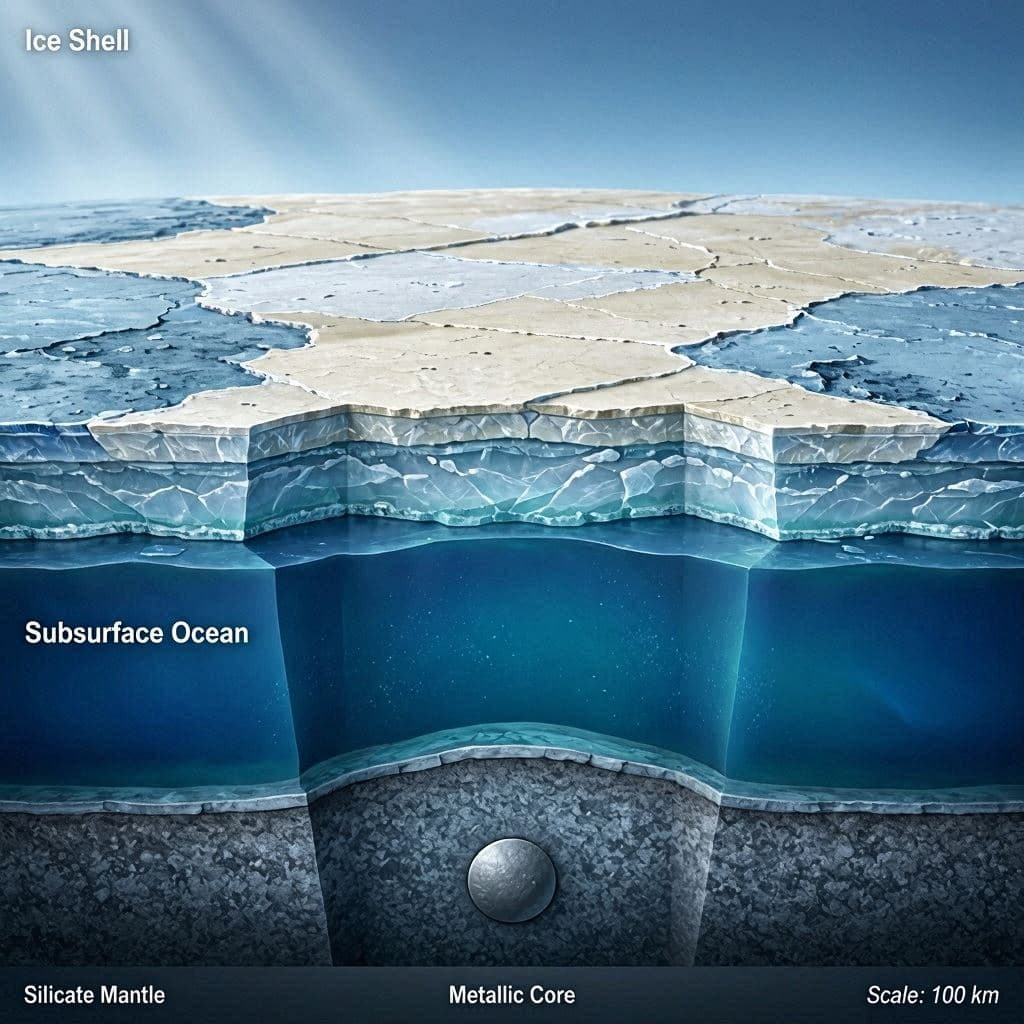
In the cold darkness of the outer solar system, hidden beneath a shell of ice, lies a secret that defies intuition. Europa, one of Jupiter’s moons, is smaller than our own Moon, yet it harbors an ocean containing more liquid water than all of Earth’s seas combined. This vast reservoir is not warmed by the distant sun but by the relentless gravitational pull of Jupiter, which squeezes the moon in a cosmic embrace. This phenomenon, known as tidal heating, keeps the water liquid and makes Europa one of the most promising places to search for life beyond Earth.
The mechanism behind this warmth is fascinating. As Europa orbits Jupiter, the planet’s immense gravity exerts varying forces on the moon, causing it to flex and stretch. This friction generates heat within the moon’s interior, preventing the subsurface ocean from freezing solid. Unlike Earth, where solar energy drives surface temperatures, Europa’s heat source is internal and mechanical, a testament to the dynamic nature of planetary physics.
The ice shell covering the ocean is estimated to be several miles thick, acting as a protective barrier against the harsh radiation of Jupiter’s magnetosphere. Beneath this shield, the ocean may interact with a rocky mantle, creating chemical reactions that could support microbial life. Scientists believe that hydrothermal vents, similar to those on Earth’s ocean floor, might exist on Europa, providing energy and nutrients for potential organisms.
Recent missions, such as NASA’s Galileo spacecraft, have provided indirect evidence of this subsurface ocean through magnetic field measurements and surface features. Plumes of water vapor have also been observed erupting from cracks in the ice, offering a glimpse into the hidden world below. These geysers provide a unique opportunity for future missions to sample the ocean’s contents without drilling through the ice.
The upcoming Europa Clipper mission aims to study the moon in unprecedented detail. Equipped with advanced instruments, it will map the ice shell, analyze the composition of the plumes, and assess the habitability of the ocean. The data collected will help scientists determine if Europa possesses the necessary ingredients for life: water, chemistry, and energy.
Comparing Europa to Earth highlights the diversity of habitable environments in the universe. While Earth relies on sunlight and atmosphere, Europa demonstrates that life could thrive in dark, pressurized depths powered by gravitational forces. This expands our definition of the "habitable zone," suggesting that moons around gas giants could be just as viable as planets around stars.
The search for life on Europa is not just a scientific endeavor but a philosophical one. It challenges our understanding of where life can exist and encourages us to look beyond traditional assumptions. If life is found in Europa’s ocean, it would suggest that the universe is teeming with potential, hidden in the most unexpected places.
Europa’s hidden ocean, warmed by Jupiter’s gravitational grip, remains one of the solar system’s greatest mysteries. As we prepare to explore this icy world, we carry with us the hope of discovering that we are not alone in the cosmos.
AI Image Disclaimer: The images associated with this article are AI-generated illustrations designed to represent the themes of planetary science and astrobiology.
Sources: NASA Science, National Geographic, Space.com, JPL
Published by Banx Network. This article is part of the Banx decentralized media programme, powered by the BXE token on the XRP Ledger.