Among the planets of our solar system, Jupiter has always stood apart. Its immense size, powerful gravity, and complex magnetic environment make it less like a familiar world and more like a miniature planetary system of its own. New research now suggests that this giant planet may be even more extraordinary than previously understood.
Scientists have found evidence that Jupiter can accelerate charged particles to speeds approaching that of light. The discovery highlights the remarkable power of the planet's magnetic field and its ability to influence the surrounding space environment.
Jupiter possesses the strongest planetary magnetic field in the solar system. Generated deep within its interior, this magnetic shield extends millions of kilometers into space, creating a vast region filled with energetic particles.
Researchers studying data from spacecraft observations identified processes capable of accelerating electrons to extremely high energies. These particles move at relativistic speeds, meaning their behavior must be described using principles developed by Albert Einstein's theory of relativity.
The findings provide valuable insight into how planetary magnetic fields interact with charged particles. Similar mechanisms are observed around stars, black holes, and other energetic cosmic environments, making Jupiter an important natural laboratory for astrophysical research.
Understanding these processes also has practical significance. Energetic particle environments can affect spacecraft systems and scientific instruments operating near giant planets. Improved knowledge may help future missions navigate these conditions more effectively.
Jupiter has long fascinated astronomers due to its turbulent atmosphere, powerful storms, and extensive system of moons. The new discovery adds another layer to its scientific importance by revealing previously underestimated capabilities within its magnetosphere.
Researchers emphasize that continued observations will be necessary to determine how widespread and persistent these acceleration mechanisms may be. Future missions could provide more detailed measurements and refine current models.
As exploration continues, Jupiter remains a reminder that even familiar planets can hold unexpected surprises. The giant world that dominates the outer solar system continues to challenge assumptions and expand scientific understanding.
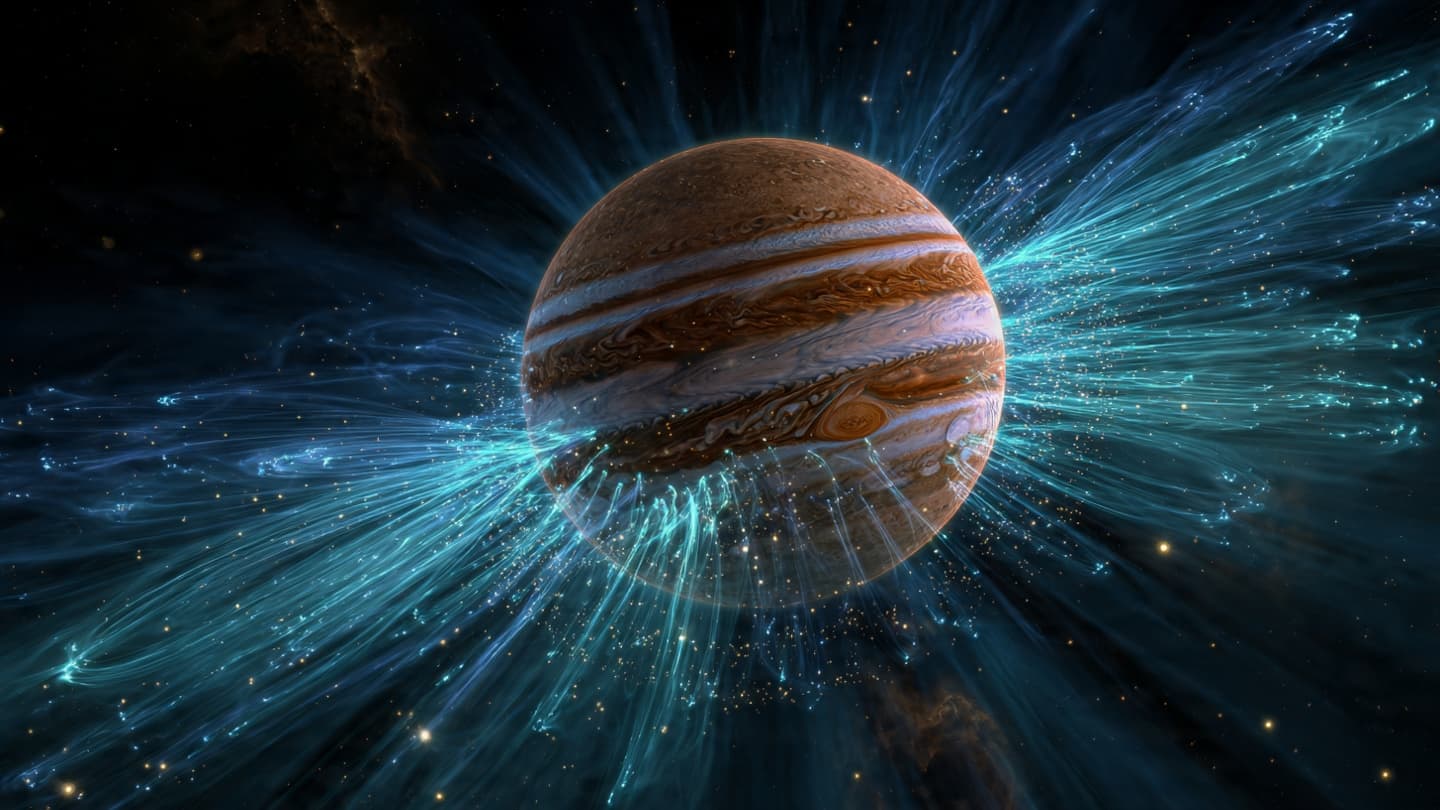
AI Image Disclaimer: Images included with this article are AI-generated scientific visualizations created to illustrate research concepts and are not direct spacecraft photographs.
Source Verification Check: Planetary science researchers, astronomy publications, spacecraft mission data
Published by Banx Network. This article is part of the Banx decentralized media programme, powered by the BXE token on the XRP Ledger.