There is a particular kind of ambition that does not announce itself with fanfare but with the quiet precision of a launch window calculated to the second. Japan has spent years preparing to reach for a moon that is not our own—a small, potato-shaped body orbiting Mars, named for a Greek deity of fear, and never before touched by human machinery with the intention of returning. On Tuesday, that preparation becomes motion.
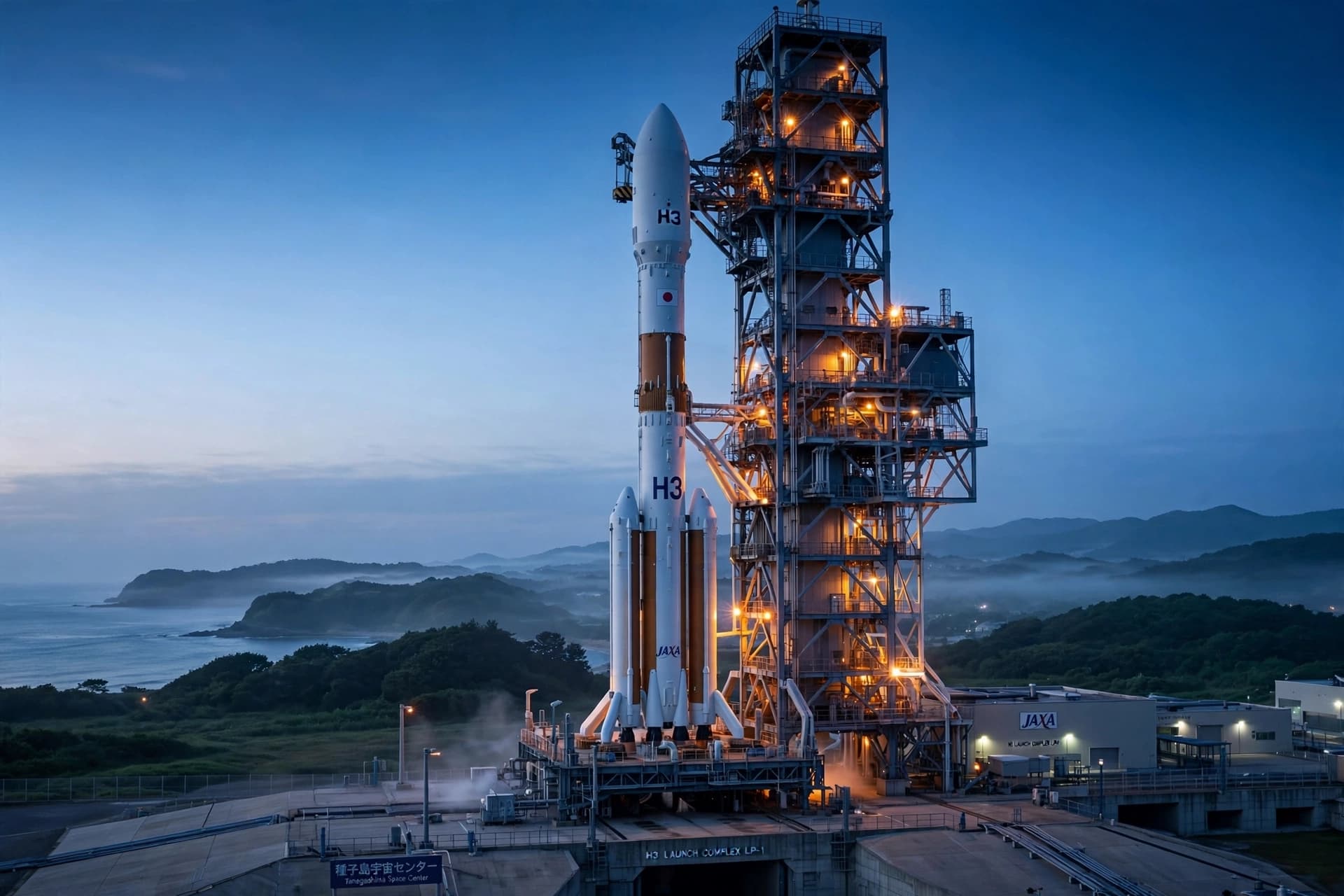
The Japan Aerospace Exploration Agency is set to launch its Martian Moons eXploration mission, known as MMX, aboard an H3 rocket from the Tanegashima Space Center at 4:41 a.m. Japan time on October 20 . The mission aims to become the world's first to land on Phobos, collect samples from its surface, and deliver them to Earth—a round trip to the Martian system that no nation has yet attempted . The total development cost is approximately 55.3 billion yen, or roughly 350 million dollars .
The spacecraft is not a single machine but a composite of three modules: one for propulsion, one for exploration, and one for return . Only the return module will come home, carrying a capsule of material that scientists believe could hold answers to questions as large as the origins of the solar system and as specific as how Mars's two moons came to be. The exploration module carries four landing legs designed for Phobos's almost negligible gravity—about one two-thousandth of Earth's—along with sampling equipment and two super high-vision cameras developed jointly by NHK and JAXA .
The journey is long and the itinerary deliberate. After launch, the spacecraft will arrive near Mars approximately one year later, then spend three years conducting observations in the Martian sphere . A small rover named IDEFIX, developed by France and Germany, will land first to survey the surface and help identify a safe landing site . The MMX lander will then touch down and collect at least 10 grams of material from the surface layer at a depth of two centimeters or more, using both a Japanese coring method and a NASA sampling device that employs pressurized gas . The return module is expected to deliver the samples to Earth during the fiscal year ending in March 2032 .
The scientific stakes are considerable. One theory holds that Phobos and its smaller sibling Deimos formed from debris after a large celestial body collided with Mars; another suggests they are asteroids captured by the planet's gravity . Samples from Phobos, JAXA scientists believe, could almost certainly settle the question . There is also the tantalizing possibility that material from Mars itself—perhaps 0.1 percent of what is collected—could carry traces of past microbial life, offering a window into whether the red planet once harbored conditions suitable for living things .
The mission is also a step toward something further. JAXA has said MMX will explore the possibility of using Phobos as a "natural space station," establishing requirements for a round trip to Mars that would be essential for eventual crewed exploration . The samples and the engineering data alike are meant to serve a future that is still being imagined.
The launch window opens in the early hours of a Tuesday morning, Japan time. The rocket will rise, the spacecraft will separate, and then it will begin the long fall toward Mars. The moon it seeks is small and dark and has never been touched. In a few years, if all goes as planned, a capsule will return with a few grams of it—and with them, perhaps, a clearer view of how the worlds we know came to be.
AI Image Disclaimer: The images accompanying this article were generated by artificial intelligence and are intended for illustrative purposes only.
Sources: NHK World-Japan, European Space Agency, AFP (via BSS), Associated Press (via The Canadian Press), Anadolu Agency, JAXA
Published by Banx Network. This article is part of the Banx decentralized media programme, powered by the BXE token on the XRP Ledger.