The moons of Mars, Phobos and Deimos, have long been enigmatic sentinels orbiting the Red Planet. Small, irregular, and dark, they hold clues to the early solar system’s formation. Now, Japan is poised to unlock their secrets with the Martian Moons eXploration (MMX) mission. Scheduled for launch in 2026, MMX aims to land on Phobos, collect samples, and return them to Earth in 2031, marking a historic first for humanity’s exploration of the Martian system.
Phobos is a challenging target. With gravity roughly 1,700 times weaker than Earth’s, landing requires precise navigation and delicate handling. The spacecraft must touch down gently, avoiding a bounce that could send it drifting into space. Once on the surface, MMX will use a pneumatic sampling mechanism to gather at least 10 grams of regolith. While this amount may seem small, it is sufficient for detailed laboratory analysis that remote sensing cannot match.
The mission’s primary goal is to determine the origin of Mars’s moons. Are they captured asteroids, or did they form from debris ejected by a giant impact on Mars? The answer has profound implications for our understanding of planetary formation and the delivery of water and organic materials to the inner solar system. By analyzing the isotopic composition of the samples, scientists hope to distinguish between these competing theories.
The return journey is equally complex. After collecting samples from Phobos and conducting flybys of Deimos, the spacecraft will release a re-entry capsule destined for Earth. In a coordinated international effort, the capsule is scheduled to land in the Woomera Prohibited Area in South Australia. This location, previously used for other sample return missions, offers a safe and controlled environment for recovery.
Australia’s role in this mission highlights the global nature of space exploration. The partnership between JAXA and Australian authorities ensures that the samples are retrieved efficiently and transported to specialized facilities for analysis. This collaboration underscores the shared scientific interest in understanding our neighbors in the solar system and the benefits of international cooperation in space endeavors.
The timeline for MMX is ambitious but well-planned. Launching in 2026, the spacecraft will arrive at Mars in 2027, spend several months studying the moons, and begin its return journey in 2028. The five-year gap before sample return allows for thorough preparation of reception facilities and analytical protocols. When the capsule lands in 2031, it will bring with it the first physical pieces of the Martian system ever delivered to Earth.
For the scientific community, the anticipation is palpable. Previous missions to Mars have focused on the planet itself, leaving its moons largely unexplored. MMX fills this gap, providing a comprehensive view of the Martian environment. The samples will be studied for signs of past habitability, resource potential, and geological history, informing future human exploration plans.
As MMX prepares for its journey, it represents a leap forward in robotic exploration. It demonstrates the capability to navigate, land, and sample from low-gravity bodies, a skill essential for future missions to asteroids and other small worlds. In 2031, when the capsule touches down in the Australian outback, it will carry not just dust, but the answers to questions we have asked for centuries.
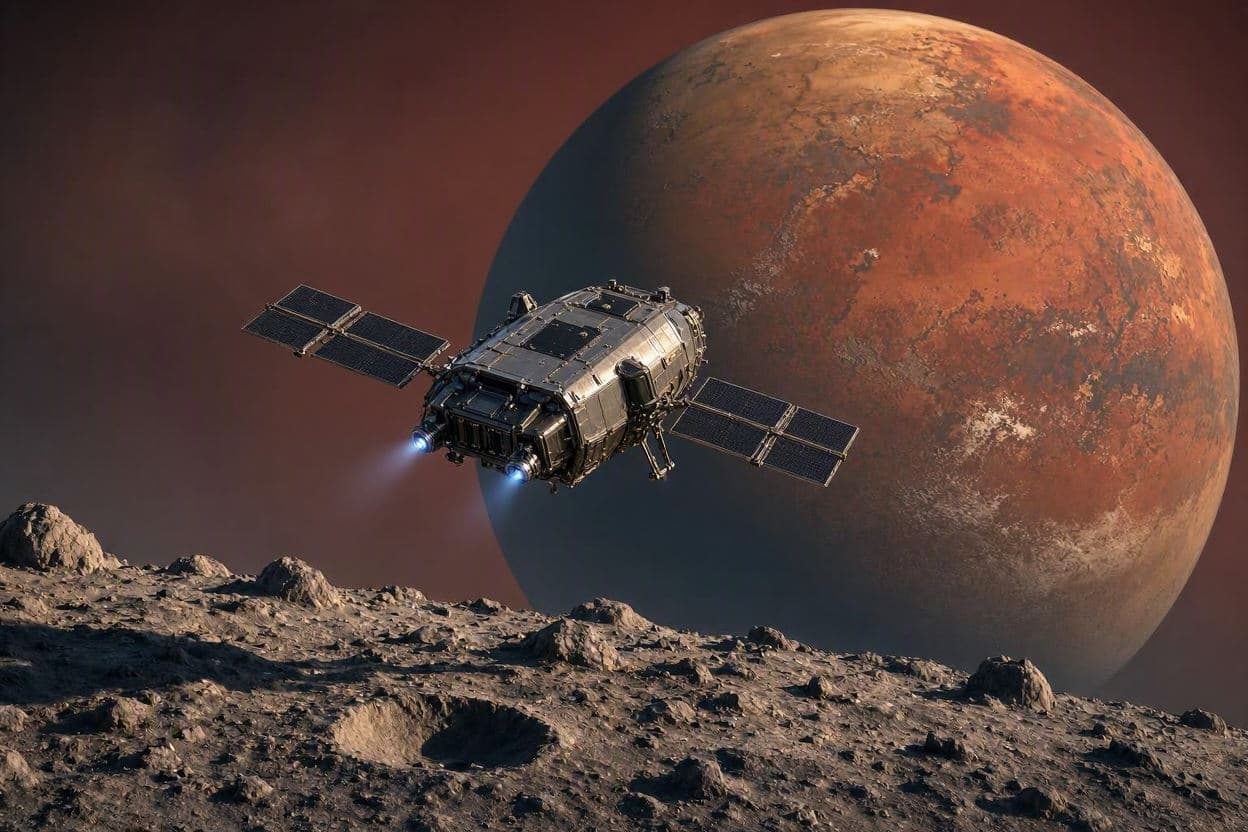
AI Image Disclaimer: Images accompanying this report are AI-generated artistic interpretations of spacecraft operations and Martian moons, intended to visualize the MMX mission concepts without depicting real proprietary engineering designs.
Sources: JAXA, ESA, Planetary Society, SpaceDaily, Wikipedia
Published by Banx Network. This article is part of the Banx decentralized media programme, powered by the BXE token on the XRP Ledger.