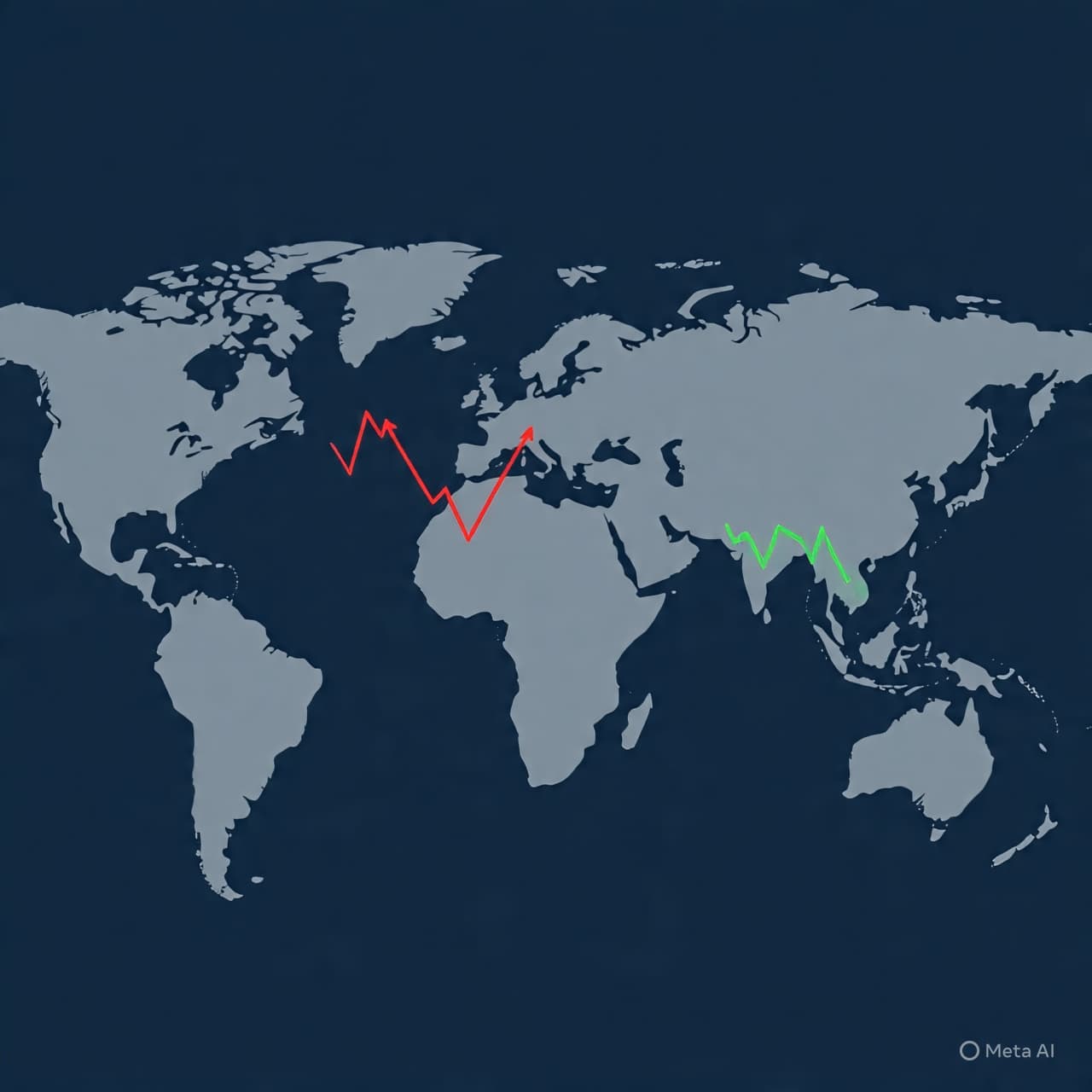
There are moments in global finance when a familiar rhythm — the steady heartbeat of a dominant currency — begins to skip and slow, not in a sudden crash but in the quiet cadence of shifting winds. The US dollar, long the world’s reserve cornerstone, has recently experienced such a moment: slipping to its weakest in four years, a gentle tilt that speaks less of abrupt crisis and more of evolving sentiment among investors and policymakers alike.
In the soft light of early trading sessions this year, the US dollar’s slide felt almost whispered at first, a gradual descent noted by careful watchers of foreign exchange. Over the past months, a blend of signals — from political uncertainty to expectations about future interest-rate paths — drew investors’ attention away from the greenback and toward other assets. As the dollar traded lower against major currencies, analysts began to speak of structural themes at play, rather than a transient blip in market behavior.
At the heart of this shift lies a tapestry of interwoven factors. Traders and fund managers observe a backdrop where anticipated monetary policy developments, such as potential rate cuts by the Federal Reserve, contrast with robust foreign economic signals abroad. A strong yen and rising euro reflect growing confidence in other economies’ prospects, nudging the dollar’s exchange rates lower. This environment — one where monetary policies may diverge and economic leadership feels in flux — often encourages capital to redistribute across global markets rather than settle in a single dominant currency.
Political posture, too, plays its part. Recent public comments from U.S. leadership suggesting a tolerance, even comfort, with a weaker dollar have rippled through currency markets. Some investors interpreted these remarks as a sign that policy priorities might favor export competitiveness over exchange-rate strength — a nuanced stance that can, in turn, influence foreign exchange valuations. Expectations of political friction over central bank independence and fiscal direction likewise contribute to a subtler recalibration of market confidence.
Meanwhile, broader economic currents have shaped community sentiment. Growing interest in commodities and non-dollar assets — from precious metals to emerging market equities — underscores an appetite for diversification, born not of panic but of thoughtful reassessment. Indeed, this shift toward tangible and globally diversified holdings suggests that capital is responding to changing risk and return profiles, and not merely reacting to fleeting headlines.
As the dollar moved toward its recent lows, some market voices have noted that nothing is ever truly static in global finance. A currency’s value is not merely a statement of domestic strength, but a reflection of international confidence, policy nuance, and comparative advantage. In this context, the dollar’s moderation is less an abrupt fall than a gentle adjustment to the complex interplay of global economic forces.
In straight economic terms: the U.S. dollar recently dipped to its lowest valuations against a basket of major currencies in four years. This weak point has been attributed to a combination of shifting investor expectations on interest rates, political rhetoric around currency strength, concerns about fiscal and monetary policy direction, and competitive exchange-rate movements in other economies. Continued volatility in currency markets is expected, with analysts pointing to multiple economic and policy drivers that could influence the dollar’s path in the coming months.
AI Image Disclaimer Illustrations were produced with AI and serve as conceptual depictions.
Sources News used in this article: Reuters, Financial Times, Bloomberg, The Guardian, MarketWatch.
Published by Banx Network. This article is part of the Banx decentralized media programme, powered by the BXE token on the XRP Ledger.