Key Highlights
- Renewed military tensions between Iran and the U.S. escalate with drone attacks.
- The USS Theodore Roosevelt arrives, increasing U.S. naval presence in the region.
- The Strait of Hormuz remains a critical chokepoint for global oil exports.
Renewed Military Tensions Between Washington and Tehran
The confrontation between Iran and the United States has entered another period of heightened tension, following months of military activity, economic pressure, and unsuccessful diplomatic efforts. On November 17, 2026, Iran's Islamic Revolutionary Guard Corps (IRGC) claimed responsibility for launching drones targeting a U.S. military radar system at Sheikh Isa Air Base in Bahrain. This facility is strategically important as it hosts the headquarters of the U.S. Navy's Fifth Fleet.
Bahrain's air-defense systems successfully intercepted the incoming aerial attacks, prompting an alert for residents to take shelter. Fortunately, there were no immediate reports of casualties or damage. This incident follows a series of attacks and attempted attacks against American military targets in Bahrain, coinciding with a renewed expansion of U.S. naval forces in the region.
The United States has maintained a significant military presence around the Persian Gulf throughout the ongoing conflict. The arrival of another aircraft carrier, alongside continuing maritime operations, underscores Washington's commitment to maintaining substantial military capabilities in the region. For both governments, the situation presents a difficult challenge. Iran is attempting to exert pressure against the U.S. and its regional partners, while Washington is focused on protecting its military personnel, commercial shipping, and strategic interests.
The immediate concern is whether further attacks will trigger another cycle of retaliation, potentially drawing additional countries into the confrontation.
The USS Theodore Roosevelt Arrives as America Reinforces Its Presence
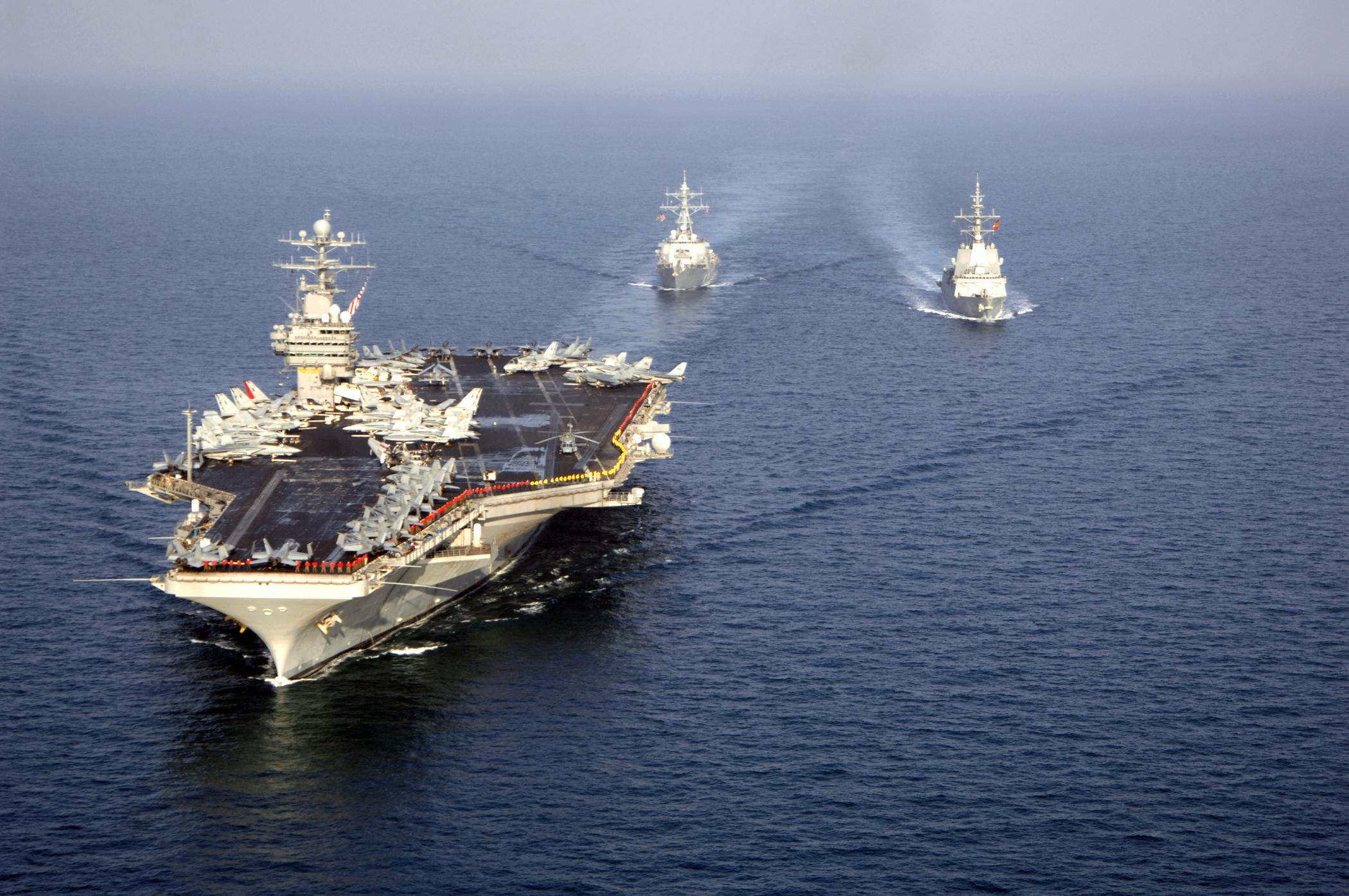
One of the most significant developments in this ongoing situation is the arrival of the USS Theodore Roosevelt carrier strike group in the U.S. Central Command area of responsibility. This deployment brings the number of American aircraft carrier strike groups operating in the wider Middle East region to three, alongside the USS George H.W. Bush and USS George Washington.
An aircraft carrier serves as a mobile military airbase, capable of supporting fighter aircraft, surveillance operations, and other military missions without relying entirely on land-based facilities. Its accompanying strike group can include guided-missile destroyers, support vessels, and other naval assets, providing Washington with additional military flexibility.
According to USNI News, the Theodore Roosevelt entered the Fifth Fleet's area of operations on November 16 as part of a scheduled deployment. Its arrival comes amid elevated tensions with Iran, as American naval forces continue operating around the Gulf. However, a larger military presence does not necessarily indicate that another major offensive is imminent. Aircraft carriers can support maritime security, surveillance, deterrence, and defensive operations, as well as offensive military action.
Nevertheless, the concentration of naval forces increases the military capabilities available to Washington should the confrontation escalate. For Tehran, the deployment is another indication of the scale of American military power positioned around its maritime approaches.
The Strait of Hormuz: The World's Energy Chokepoint
The Strait of Hormuz is arguably the most economically significant geographical feature in the current confrontation. Located between Iran and Oman, this narrow waterway connects the Persian Gulf with the Gulf of Oman and the Arabian Sea. It provides a maritime passage for energy exports from several major oil and gas-producing countries, including Saudi Arabia, Iraq, Kuwait, Qatar, the United Arab Emirates, and Iran.
Its importance cannot be overstated. According to the International Energy Agency (IEA), approximately 20 million barrels of crude oil and petroleum products passed through the Strait of Hormuz each day in 2025, representing around one-quarter of global seaborne oil trade. The waterway also carries substantial volumes of liquefied natural gas, particularly exports from Qatar. As tensions continue to rise, the Strait of Hormuz remains a focal point for both military strategy and global energy security.
Published by Banx Network. This article is part of the Banx decentralized media programme, powered by the BXE token on the XRP Ledger.