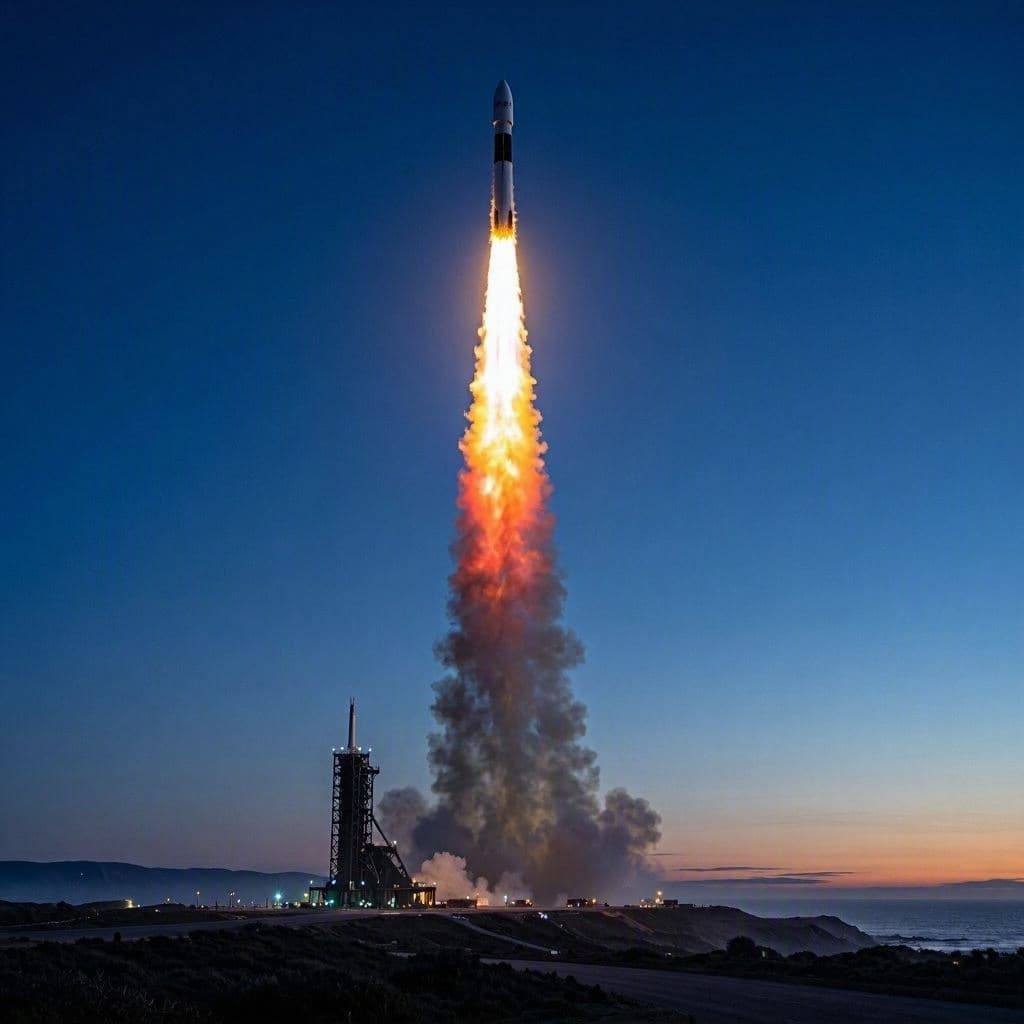
In the pre-dawn darkness of the California coast, a pillar of fire pierced the sky, carrying secrets into the orbit above. The launch, conducted by SpaceX from Vandenberg Space Force Base, was another step in the increasingly intricate dance between private enterprise and national security. As the Falcon 9 rocket ascended, it carried a classified payload for the U.S. Space Force, a reminder that the frontier of space is not just a place of scientific discovery, but also of strategic importance.
The mission, designated USSF-153, underscores the growing reliance of the military on commercial launch providers. SpaceX has become a key partner in this endeavor, offering reliability and frequency that traditional government programs often struggle to match. This partnership reflects a broader shift in how nations approach space defense, leveraging innovation from the private sector to maintain superiority in an increasingly crowded domain.
While the details of the payload remain hidden, the launch itself was a spectacle of precision and power. The roar of the engines echoed across the coastal hills, a sound that has become familiar to residents near Vandenberg. Yet, each launch carries a unique weight, knowing that it contributes to the complex web of satellites that monitor, communicate, and protect national interests from above.
The successful deployment of the payload and the subsequent landing of the rocket’s first stage on a drone ship in the Pacific Ocean demonstrated the maturity of reusable launch technology. This efficiency is crucial for maintaining a robust presence in space, allowing for more frequent and cost-effective missions. It is a testament to the engineering prowess that has come to define the modern space age.
For the U.S. Space Force, such launches are essential for maintaining situational awareness and ensuring the resilience of its orbital assets. In a world where space is increasingly contested, the ability to rapidly deploy and replace satellites is a critical capability. The partnership with SpaceX provides this agility, allowing the military to adapt to emerging threats and technological changes.
The secrecy surrounding the mission highlights the sensitive nature of modern space operations. Unlike scientific missions that share data openly, national security launches operate in the shadows, their purposes known only to a select few. This opacity is necessary for protecting strategic advantages, but it also raises questions about transparency and accountability in the militarization of space.
As the rocket’s trail faded into the morning sky, the mission joined the countless other objects orbiting Earth, silent guardians in the void. The launch from California was not just a technical achievement but a statement of intent, reaffirming the commitment to securing the high ground of space for years to come.
The images accompanying this report are AI-generated visualizations created to illustrate the narrative context.
Sources: Space.com, Spaceflight Now, C-SPAN, Yahoo News, UNN.ua
Published by Banx Network. This article is part of the Banx decentralized media programme, powered by the BXE token on the XRP Ledger.