There is a particular kind of silence that attends the unveiling of a machine designed to operate where no human can comfortably go, a silence that is part engineering and part strategy. In a factory in Sydney, Australian defense officials and engineers have spent years developing a vehicle that looks, from the outside, like a dark and elongated torpedo, but is in fact something else entirely: an extra-large uncrewed underwater vehicle called Ghost Shark, designed to roam the seafloor and the water column for missions that navies have historically asked sailors to perform. This week, for the first time, the public saw inside its payload bay.
The photographs were taken during a visit by Pat Conroy, Australia's Minister for Defense Industry, to the Anduril Australia factory in New South Wales. They emerged alongside an announcement of new details about the payloads Ghost Shark will carry: up to twelve sea mines deployable in a single mission, the ability to leave supply caches on the seabed for later retrieval, and the capacity to launch Anduril's ALTIUS aerial drones for reconnaissance or strike missions . "Ghost Shark now has teeth," Conroy said, "and will have the ability to inflict damage on any potential adversary" .
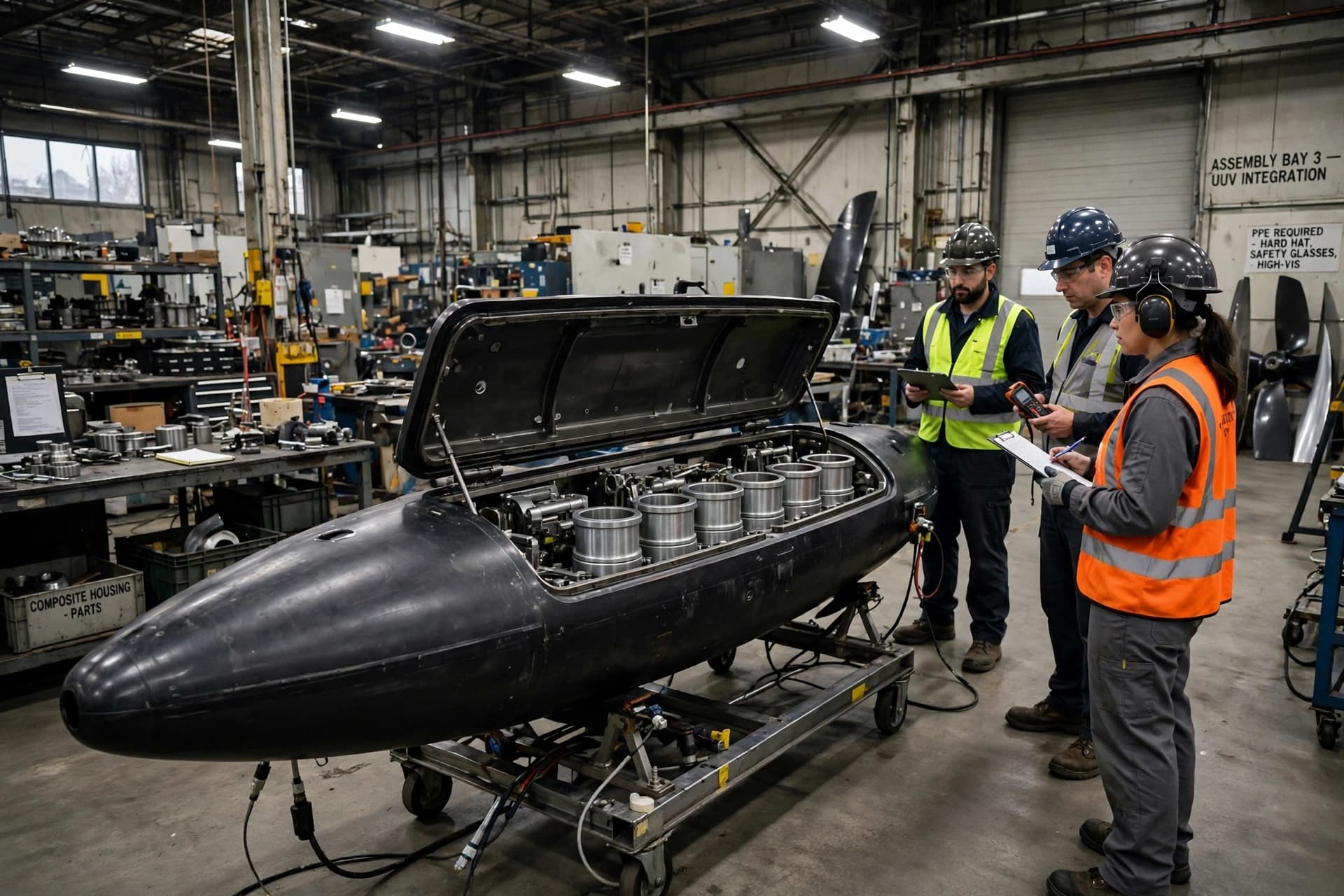
The payload bay itself, now visible for the first time, reveals the modular logic at the heart of the design. The vehicle's nose, tail, and midsection can be reconfigured with different-sized hull sections to accommodate different mission systems. Inside the bay of one of the Ghost Sharks on display, cylindrical spacers formed in segments were visible, likely ballast or mockup components rather than operational stores . The image is significant not for what it shows in detail but for what it confirms: this is a platform built to be changed, to adapt as missions evolve and threats shift.
The ability to deploy aerial drones from an underwater vehicle is particularly notable. An uncrewed submarine capable of releasing ALTIUS drones could extend a naval force's intelligence, surveillance, and reconnaissance reach beyond the vehicle's own sensors, delivering effects at a distance without putting personnel in harm's way . The ALTIUS-600 family, which the Ghost Shark will deploy, includes variants for ISR and strike, with a maximum range of around 275 miles and the ability to remain airborne for at least four hours . The drones can be launched in swarms, extending the battlespace from undersea into the air.
The context for this capability is Australia's strategic environment. The government is investing up to 5.8 billion dollars over the decade for autonomous and uncrewed undersea warfare capabilities, including 1.7 billion for a fleet of Australian-designed and built Ghost Sharks for the Royal Australian Navy . The first prototypes were delivered a year ahead of schedule, and the first Ghost Shark was handed to the Navy three months after the contract was signed . Conroy noted that potential adversaries would now have to consider that any shipping container near a wharf in Australia could contain a Ghost Shark, and that those Ghost Sharks "now have teeth—teeth with the ability to strike through mines, teeth with the ability to undertake strike to hit targets thousands of nautical miles away" .
There is a broader alliance dimension. The Ghost Shark program is part of the AUKUS partnership, under which Australia, the United Kingdom, and the United States have committed to developing interchangeable payloads for uncrewed undersea systems. The work is also being tested with AUKUS partners at Exercise Maritime Big Play, which has been held over the past three years . The technology is not merely an Australian project but a shared one, a sign of how undersea warfare is being reimagined collectively by nations that share concerns about the Pacific.
What remains unknown is how the Ghost Shark will perform in the contested environments it is designed for. The payload bay photographs show a vehicle in development, with mockups and spacers rather than operational mines or drones. The real test will come when these systems are deployed, when the modularity is tested under pressure, and when the adversary has a vote. For now, the glimpse inside the bay is a statement of intent, a quiet revelation of what Australia and its partners believe the future of undersea warfare will look like.
---
AI Image Disclaimer: The images in this article are AI-generated and are intended for illustrative purposes only.
Sources: The War Zone, Defence Connect, Australian Defence Ministers, Central News Agency (CNA)
Published by Banx Network. This article is part of the Banx decentralized media programme, powered by the BXE token on the XRP Ledger.