For years, artificial intelligence has largely lived behind screens. It has analyzed information, generated text and helped researchers work through enormous collections of data. Now, some of the newest AI systems are beginning to move closer to the physical world.
Anthropic has established a wet laboratory in the San Francisco Bay Area as the company expands its work in biology and life sciences, Reuters reported on September 18. The company’s head of life sciences, Eric Kauderer-Abrams, confirmed the existence of the laboratory.
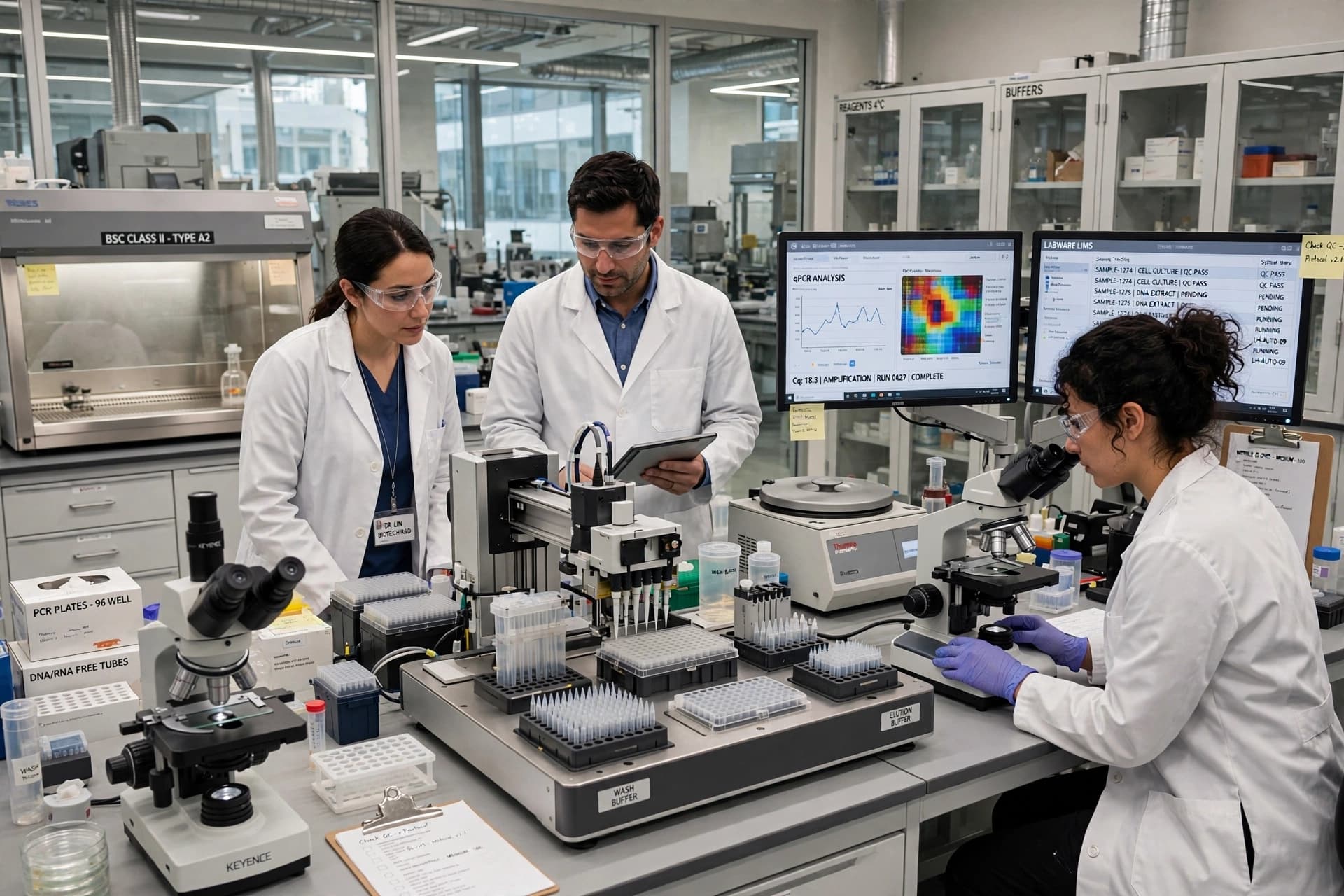
The laboratory allows Anthropic to conduct physical biological experiments rather than relying entirely on computer-based simulations. The company has said that real laboratory work remains an essential part of biology research even as computational AI capabilities improve.
Anthropic has indicated that its life-sciences work is focused partly on diseases that may receive less attention from conventional pharmaceutical development. The company has discussed preclinical research and possible applications of AI to complex biological problems.
Automation is also part of the effort. Reuters reported that Anthropic is exploring ways for its Claude AI systems to interact with robotic laboratory equipment, potentially allowing software to direct portions of experimental workflows while maintaining human involvement.
The approach represents a shift from AI as a purely analytical tool toward AI-assisted physical experimentation. Instead of simply suggesting what researchers might test, AI systems can potentially help organize experiments, process results and interact with laboratory equipment.
Anthropic has also expanded its broader life-sciences activity. The company launched Claude Science, acquired biotechnology startup Coefficient Bio and added Novartis CEO Vas Narasimhan to its board, according to Reuters.
The road from a laboratory experiment to an approved medicine, however, remains long. Identifying a promising biological pathway or molecule is only one stage of pharmaceutical development. Safety testing, efficacy studies and clinical trials can take years, and Anthropic is not currently running clinical trials itself.
The company says human oversight remains important as it develops automated laboratory processes. That distinction matters because biological research involves physical systems that cannot always be fully represented by computer models alone.
For now, Anthropic’s laboratory marks an early stage in an expanding relationship between artificial intelligence and biological research. The machines may calculate at extraordinary speed, but inside the laboratory, progress still depends on experiments, measurements and the slow accumulation of evidence.
AI Image Disclaimer
These visuals were created using AI tools and are conceptual representations of Anthropic’s reported laboratory and life-sciences research activities.
Sources
Reuters The Star Anthropic
Published by Banx Network. This article is part of the Banx decentralized media programme, powered by the BXE token on the XRP Ledger.