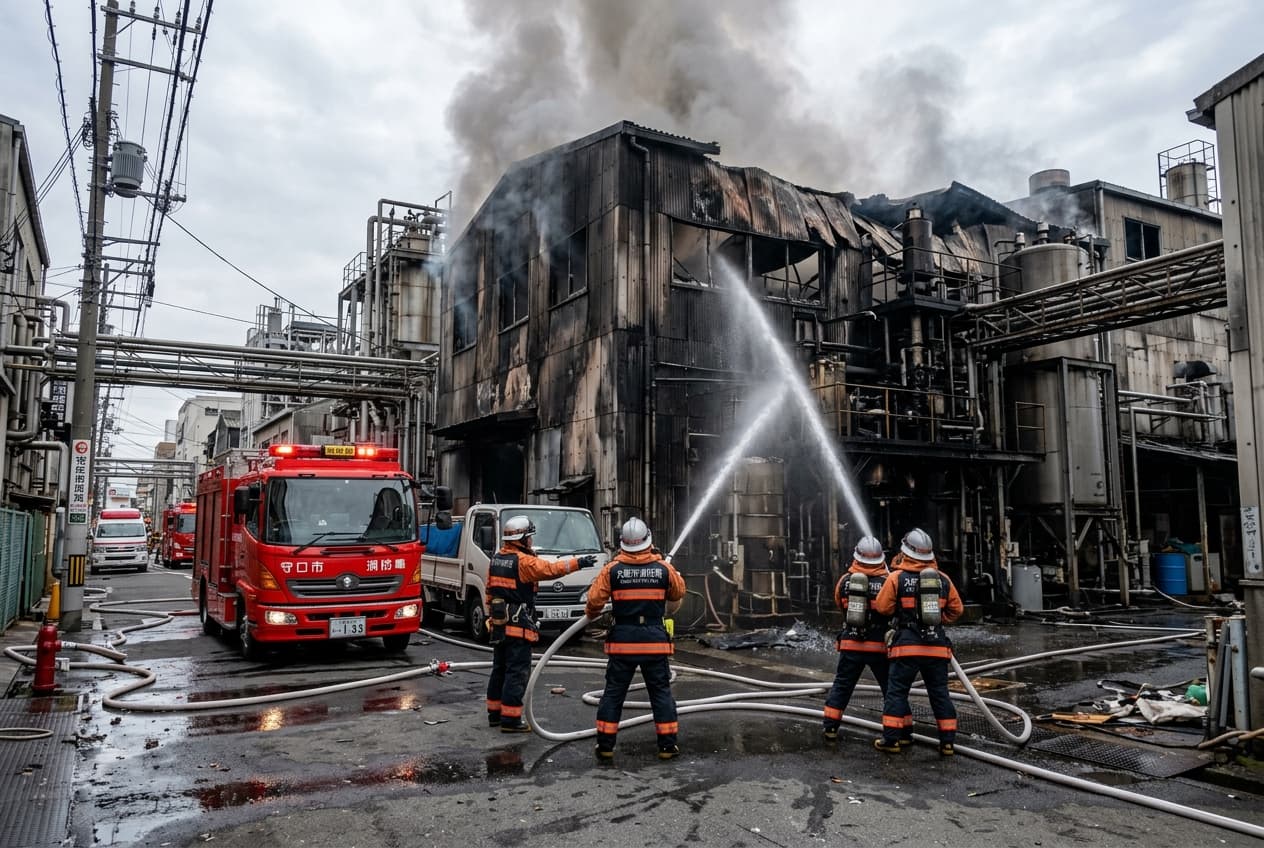
Tokyo, Japan—Emergency responders rushed to an industrial manufacturing plant on the outskirts of Tokyo at 09:15 local time on September 3, 2026, following reports of a heavy explosion and subsequent fire. Shockwaves from the blast shattered reinforced windows across the facility and sent plumes of dense black smoke into surrounding neighborhoods. First responders confirmed multiple worker fatalities at the scene as search teams comb through unstable rubble.
Hazardous material units established a perimeter around the complex to contain potential chemical runoff. Surrounding roads were closed to civilian traffic as dozens of fire engines battled secondary blazes within the main processing hall. Paramedics treated several survivors for severe burn injuries and smoke inhalation before transporting them to regional trauma centers.
Initial accounts indicate the blast originated near high-pressure chemical storage tanks during scheduled morning maintenance operations. Plant workers reported a sudden pressure spike seconds before the primary structure collapsed. Structural engineers evaluated adjacent buildings to ensure no immediate threat of secondary collapses existed.
Corporate executives released a brief statement confirming that facility operations were halted indefinitely. Management stated that all site personnel were being accounted for as roster checks continued alongside police recovery efforts. The company pledged full cooperation with municipal authorities and safety inspectors.
Prefectural police and industrial safety inspectors launched a joint forensic inquiry to determine the exact mechanical or chemical catalyst behind the ignition. Investigators gathered digital telemetry from off-site monitoring servers to track system pressures prior to the detonation. Technical teams collected residue samples from the core impact zone for lab analysis.
Labor union representatives expressed immediate concern over reported safety protocol lapses at the site. Union officials noted that maintenance delays had been raised during previous quarterly safety reviews. Local community leaders demanded transparent updates regarding potential environmental contamination in nearby residential areas.
Municipal environmental agencies deployed mobile monitoring units to test air quality levels around the perimeter. Preliminary sensor sweeps indicated no toxic gas releases above dangerous thresholds, though authorities advised nearby residents to keep windows closed as a precaution. Emergency shelters opened in neighboring civic centers for displaced workers and nearby residents.
Rescue operations transitioned toward structural containment as heavy machinery moved in to clear damaged steel framing. Forensic investigators remained on site to map debris field patterns through the night.
Published by Banx Network. This article is part of the Banx decentralized media programme, powered by the BXE token on the XRP Ledger.