There is a particular ingenuity in the way evolution repurposes what already exists—the way structures that evolved for one purpose can be co-opted for another, the way the same basic building blocks can appear in creatures as different as a squid and a human. Deep inside the human ear, thousands of tiny hair cells convert sound vibrations into electrical signals that the brain interprets as speech, music, and the world around us. When those cells are damaged, hearing is lost, often permanently. And now, scientists have discovered that squid have hair cells remarkably similar to our own—not just on their heads and arms, where they were known to exist, but across their entire bodies .
The discovery, published in Current Biology, represents the first full-body mapping of lateral lines on squid—the sensory systems made up of arrays of hair cells . Researchers at Case Western Reserve University used light sheet microscopy, a technique that illuminates one plane of tissue at a time with a laser, to build detailed 3D images of hatchling squid without damaging them . What they found was a population of hair cells far more extensive than anyone had described: hundreds of cells lining the fins, the mantle, and the siphon, arranged in patterns that had not been seen before in any squid or fish .
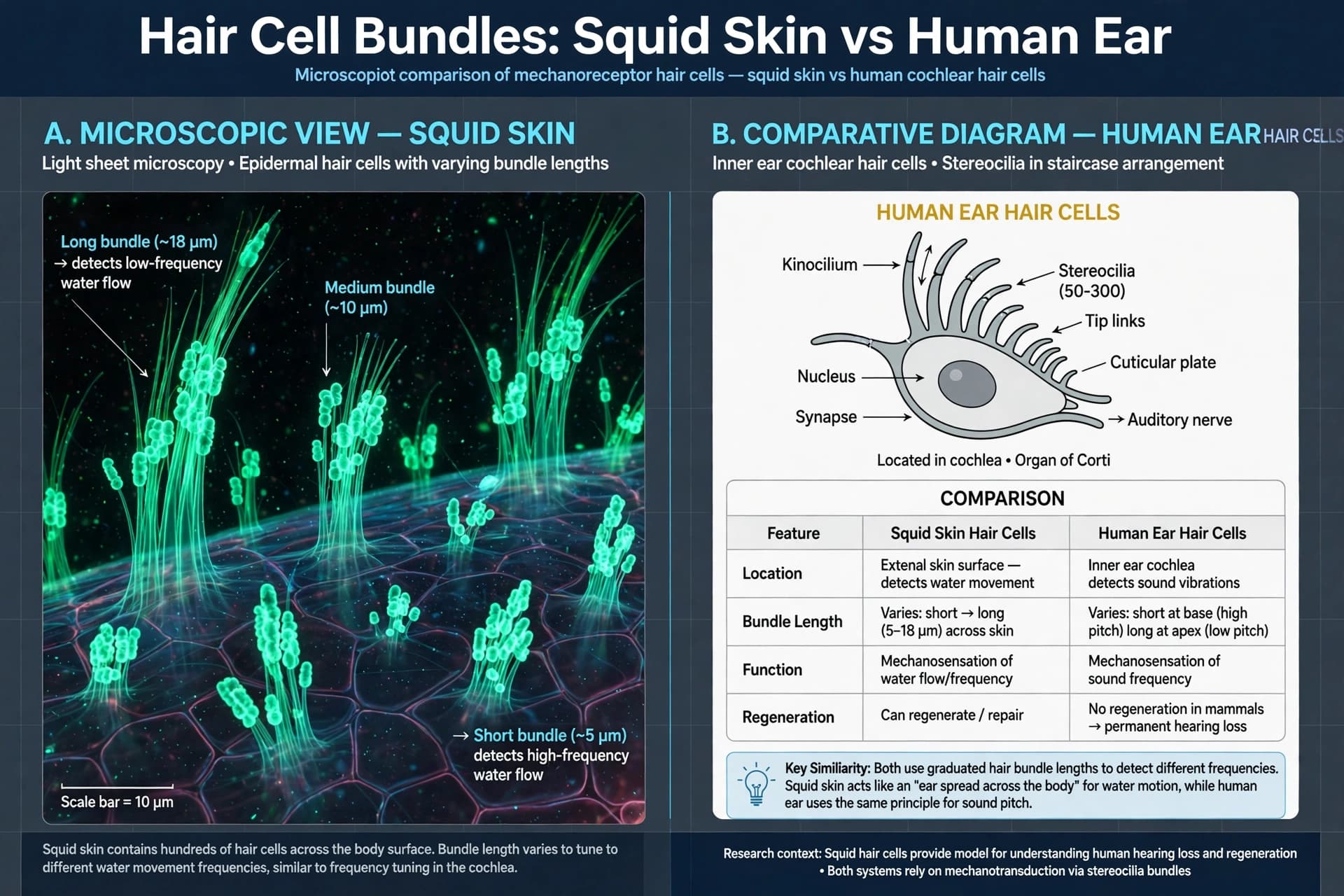
The significance lies in the structure of these cells. In the human ear, hair cells are tuned to different frequencies based partly on the height of their bundles—the tiny, hair-like projections that bend in response to sound or movement. Taller bundles detect lower pitches; shorter ones detect higher pitches . Fish lateral lines do not vary in this way. But the squid bundles do. On the front edge of the mantle, bundles were about one-fifth as long as those on the head . This suggests that squid, like humans, use bundle length to tune their cells to different frequencies of movement—a parallel that makes them a promising model for studying how hearing works and how it fails .
The researchers also noted a practical detail that speaks to the elegance of evolutionary design: almost none of the hair cells sit under the head where the siphon expels water. This placement likely prevents the squid's own jets from drowning out its sensors, allowing it to detect the movements of prey, predators, and currents without interference from its own propulsion .
The likeness between squid and human hair cells has limits. Human bundles are built on the protein actin; squid bundles are built on microtubules, tiny tubes inside cells . They do related jobs with different materials. But the functional similarity—the tuning of sensitivity through bundle length—makes squid a useful stand-in for studying the basic mechanisms of hearing. As Brian McDermott, who led the research, put it: "Often, when a child is born deaf or a hearing person loses their hearing, it is the hair bundle that has been damaged. So, studying the squid's hair bundle holds promise for understanding how hearing loss occurs" .
The research is early-stage, an animal model with no immediate clinical application . But it opens a window into the cellular machinery that underlies hearing across species, and perhaps, eventually, into ways of protecting or restoring it. The squid, it turns out, has been listening to the water all along—with cells that echo our own.
AI Image Disclaimer: The images accompanying this article were generated by artificial intelligence and are for illustrative purposes only.
Sources: Current Biology, Case Western Reserve University, Discover Magazine, Phys.org, Hearing Tracker
Published by Banx Network. This article is part of the Banx decentralized media programme, powered by the BXE token on the XRP Ledger.