In the vastness of the sky, there are moments when Earth’s everyday light dims not with sorrow, but with a poetic pause. Like a silvered leaf caught briefly in shadow, the Moon will glide between us and the Sun in February 2026, casting a quiet enchantment that reminds us how delicate the balance of celestial motion truly is. Though distant and unseen from many corners of our shared world, this dance of light and shadow connects observers across continents, oceans, and time zones — a universal thread woven through human curiosity.
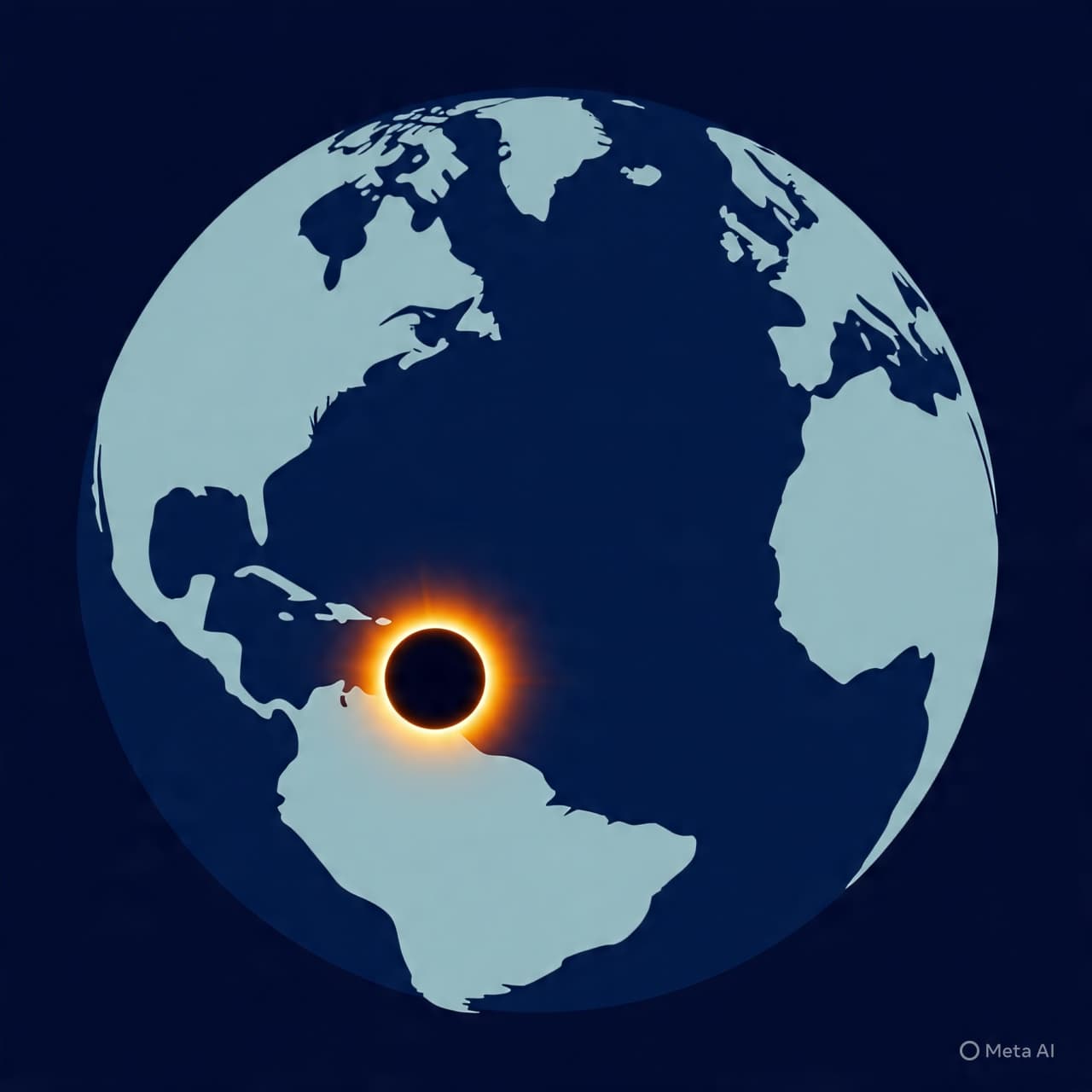
On February 17, 2026, Earth will host the first of its solar eclipses for the year: an annular eclipse, often called a “ring of fire.” In this event, our Moon, slightly farther from Earth than usual, will silhouette itself against the blazing disk of the Sun, leaving only a brilliant ring of sunlight shining around its edges. This luminous halo — neither fully day nor fully night — serves as a poetic reminder of both presence and absence in the sky.
This particular eclipse is exceptional not only for its beauty but for its quiet exclusivity. The path where the full annular effect — the glowing ring — will be visible lies primarily across remote regions of Antarctica and nearby oceanic waters, places few people will witness in person. For a fleeting couple of minutes, if skies are clear, the thin ring of fire may be observed from research stations deep on the icy continent, near some ocean crossings, and perhaps from specialized observation vessels charting the path of totality.
Beyond this narrow corridor, skywatchers in parts of southern Africa, South America, and surrounding seas may see a partial eclipse, where the Moon obscures only a portion of the Sun’s disk. Though not a full ring of fire, even this partial covering softens sunlight in a way that invites reflective wonder — an invitation to look up with awe rather than alarm.
For those of us in Indonesia, the sky will hold its usual glow on that mid‑February day. The annular eclipse’s path does not sweep across the archipelago, nor will the subtle partial phases be visible here. That does not diminish the connection; it simply reminds us that the cosmos unfolds at its own rhythm, sometimes near and sometimes distant, yet always gracious in its logic.
Astronomers and enthusiasts alike will share this moment through live streams and scientific coverage, offering each one of us a chance to witness, through screens and telescopes, the quiet elegance of our Moon’s passage. In observing this event — whether in person or through a broadcast — we participate in the age‑old story of humanity’s gaze toward the heavens.
In gentle news: The annular solar eclipse on February 17, 2026 will occur as scheduled, with peak annularity lasting around two minutes and twenty seconds along its remote path. Proper eye protection remains essential for safely observing any solar eclipse.
AI Image Disclaimer: “Illustrations were produced with AI and serve as conceptual depictions.”
Source Check — credible mainstream/niche sources on the 2026 annular solar eclipse:
1. Times of India 2. Time and Date 3. Space.com 4. Detik (Indonesian news) 5. Moneycontrol (science section)
Published by Banx Network. This article is part of the Banx decentralized media programme, powered by the BXE token on the XRP Ledger.