
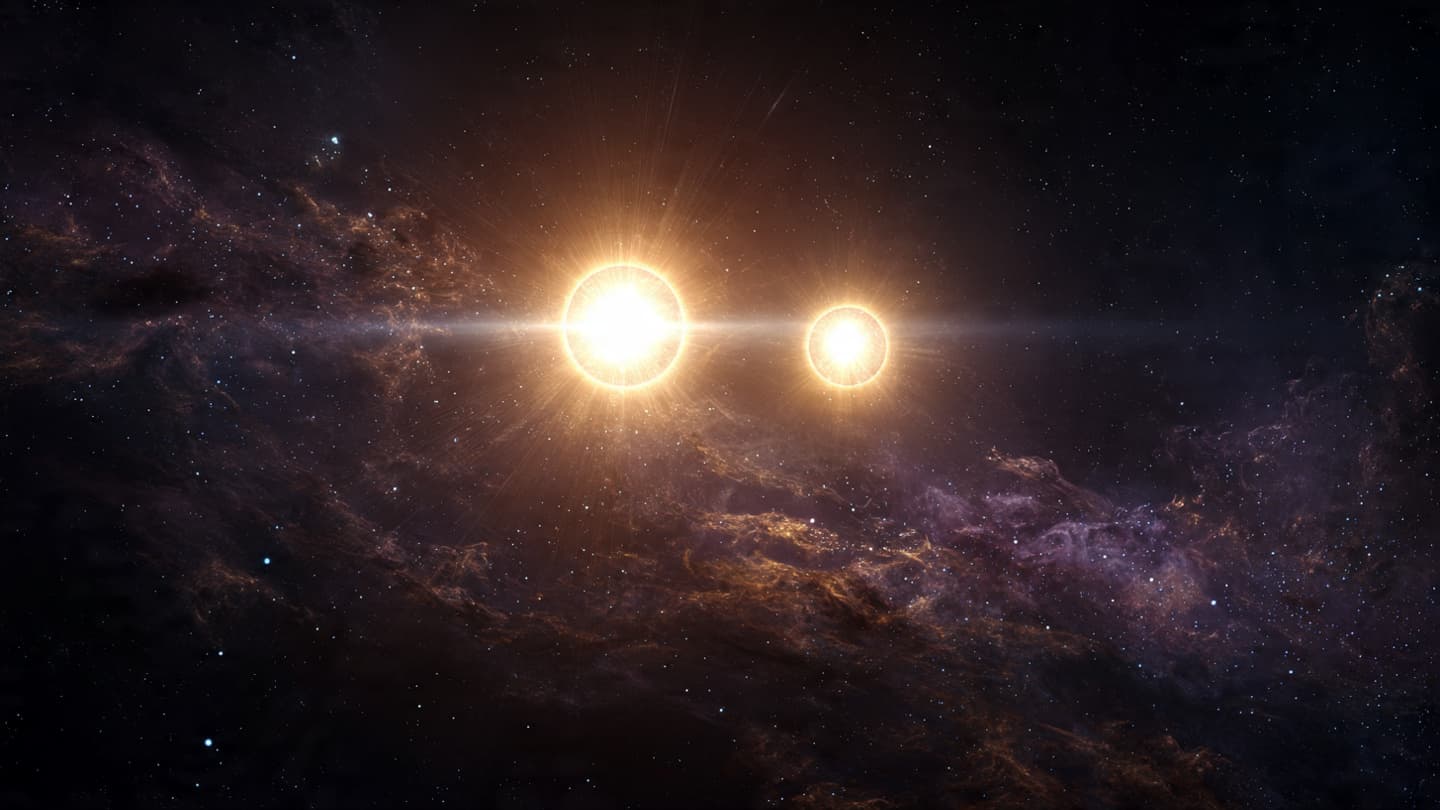
In the vast openness of space, stars often seem solitary, each one a distant point of light. Yet closer observation reveals a quieter truth: many of these lights are not alone, but formed in pairs, moving together through the galaxy like companions sharing a common beginning.
New research suggests that most close pairs of stars, known as binary systems, originate as “cosmic twins.” This means they are formed simultaneously from the same collapsing cloud of gas and dust, rather than coming together later through gravitational capture.
Astronomers have long studied binary stars to understand stellar evolution, as their interactions provide valuable data about mass, gravity, and orbital dynamics. The latest findings strengthen the idea that these systems are fundamentally linked from birth.
Using advanced simulations and observational data, researchers analyzed how star-forming regions behave under different conditions. The results showed that fragmentation within dense molecular clouds can lead to the formation of two nearly equal-mass stars in close proximity.
This twin formation process helps explain why many binary systems exhibit similar characteristics, including comparable size and composition. It also sheds light on how stars influence each other’s development over time, from early formation to later stages.
Binary systems are not rare; in fact, a significant portion of stars in the galaxy are part of such pairings. Understanding their origins contributes to a broader picture of how galaxies evolve and how stellar populations are distributed.
The study also has implications for the search for planets. Planets forming around binary stars may experience different conditions compared to those orbiting single stars, affecting their stability and potential habitability.
Despite these insights, researchers continue to refine their models. Observations from new telescopes are expected to provide further clarity, particularly in regions where stars are actively forming.
The idea that many stars begin their lives as twins offers a quiet reminder that even in the vastness of space, companionship may be more common than once thought.
AI Image Disclaimer: Some images are AI-generated representations designed to illustrate binary star systems and star formation processes.
Sources: Nature Astronomy, NASA, European Space Agency (ESA), Scientific American, Space.com
Published by Banx Network. This article is part of the Banx decentralized media programme, powered by the BXE token on the XRP Ledger.



