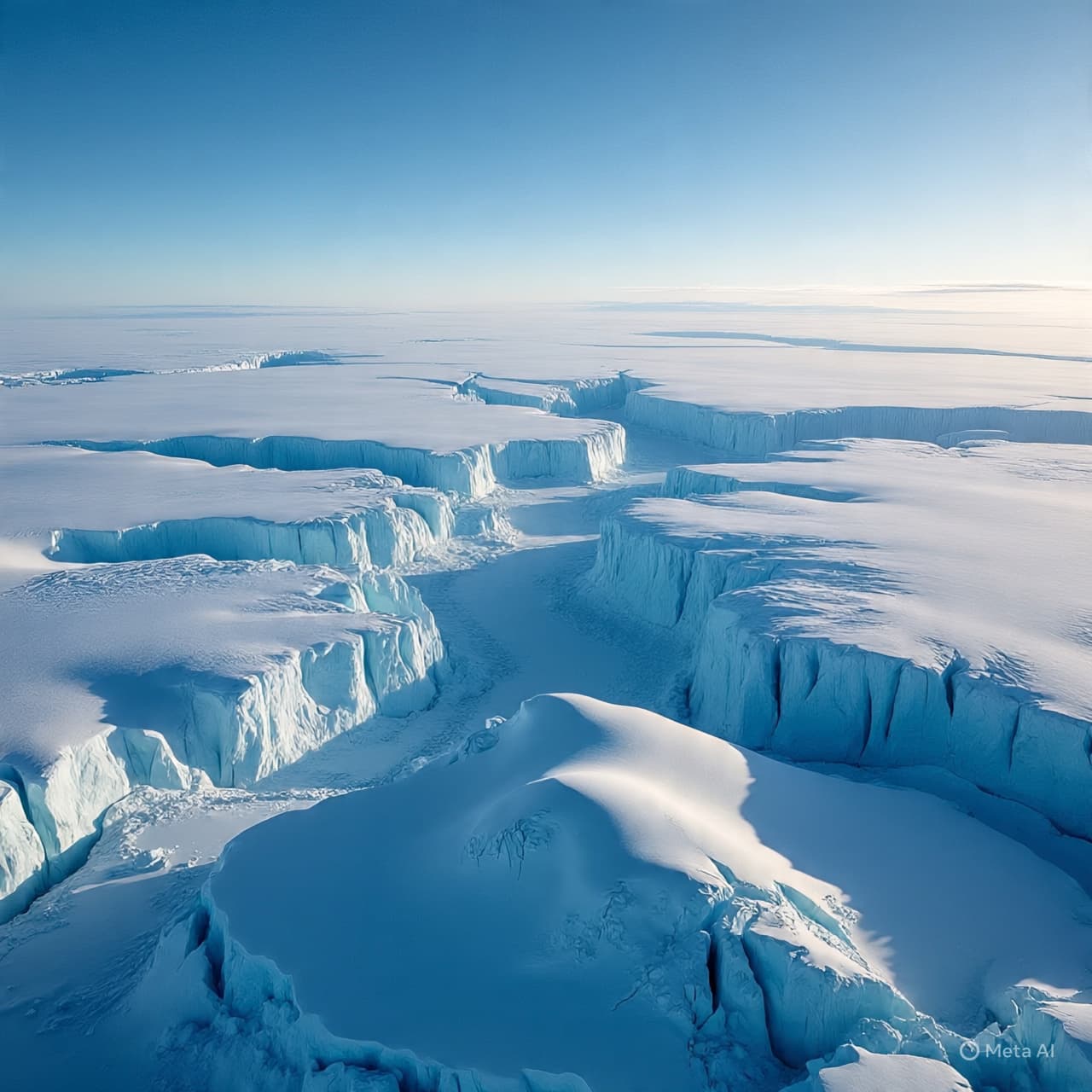
In Antarctica, silence is not empty. It is layered — wind across ice, snow settling over ancient rock, the slow migration of glaciers that move almost imperceptibly to the human eye. Beneath that vast white expanse, forces unseen continue their patient work, shaping the planet in ways that satellites, circling far above, are only now beginning to understand more clearly.
Scientists monitoring Earth’s gravitational field have found that a long-observed anomaly over Antarctica — often described as a “gravity hole” — is growing stronger. The term does not refer to a literal void, but to a region where Earth’s gravitational pull is slightly weaker than average, caused by variations in mass distribution beneath the surface. Recent satellite measurements suggest that this gravitational dip is intensifying.
The anomaly is linked in part to the complex geology hidden beneath the Antarctic ice sheet and to ongoing changes in the ice itself. As glaciers thin and mass is lost to the ocean, the redistribution of weight alters the planet’s gravitational balance. Instruments aboard gravity-measuring satellites detect these subtle shifts with extraordinary precision, tracking changes measured in fractions of millimeters.
The strengthening of the gravity anomaly reflects the interplay between deep Earth processes and surface climate dynamics. In some regions of Antarctica, ice loss has accelerated in recent decades, particularly along parts of West Antarctica. When ice mass decreases, the reduced weight can cause the underlying bedrock to rebound slowly upward — a process known as isostatic adjustment. At the same time, the loss of mass contributes to measurable changes in gravitational pull.
The Antarctic gravity anomaly has been studied for years, originally linked to ancient tectonic events and large-scale geological structures buried beneath kilometers of ice. Now, contemporary climate-driven ice loss appears to be adding a new layer to that story. The strengthening signal suggests that the balance between ice, rock, and ocean water is shifting.
For scientists, such findings are not abstract curiosities. Gravity measurements help refine models of sea-level rise, ice sheet stability, and Earth’s internal structure. By understanding how mass is redistributed — whether through melting glaciers or tectonic movement — researchers can improve projections of how coastlines and ecosystems may change over time.
The language of gravity is quiet and mathematical, far removed from the dramatic imagery often associated with Antarctica. Yet the implications extend well beyond the continent. Changes in mass at the poles influence global sea levels and, over longer timescales, Earth’s rotation and shape.
No single measurement tells the whole story. Instead, data accumulates across years of observation, revealing trends that become visible only through persistence. The growing strength of Antarctica’s gravity anomaly is one such signal — subtle, but significant.
Far above the frozen plateau, satellites continue their steady orbit, tracing invisible contours around a continent defined by extremes. Below, ice shifts, rock responds, and the planet recalibrates its balance. The gravity hole is not a rupture, nor a sudden collapse. It is a quiet adjustment in Earth’s vast system — a reminder that even in the most remote and seemingly immutable places, change is ongoing, measured not in headlines but in the patient language of physics.
Published by Banx Network. This article is part of the Banx decentralized media programme, powered by the BXE token on the XRP Ledger.