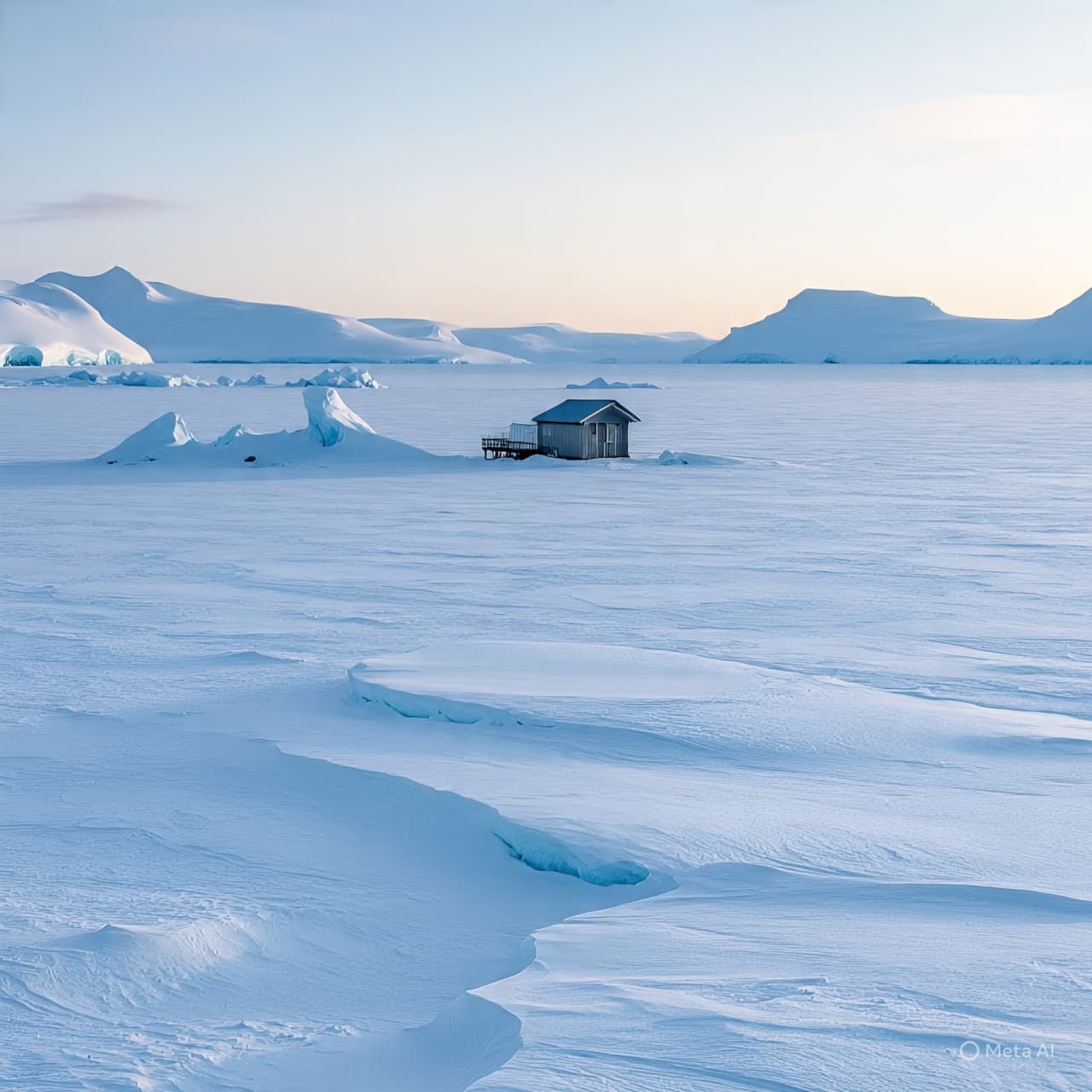
There are places on Earth where silence feels ancient. In Antarctica, the wind moves across a white expanse that seems untouched by time, as if the planet itself were pausing to listen. Beneath that vast, frozen stillness, far below the crunch of boots and the hum of research stations, something invisible is passing through the ice — particles so small and elusive that billions move through our bodies every second without notice.
Deep in the Antarctic ice, scientists have built an instrument not to disturb this quiet, but to listen to it. Buried within the frozen layers lies the , a vast detector designed to capture fleeting traces of neutrinos — particles born in the heart of stars, in exploding supernovae, and in the most extreme environments of the universe.
Neutrinos are often called “ghost particles.” They carry no electric charge and have almost no mass. They rarely interact with matter, which makes them both extraordinarily difficult to detect and uniquely valuable. Because they pass through galaxies, stars, and entire planets almost undisturbed, they preserve a pristine record of the cosmic events that created them.
IceCube works by embedding thousands of light sensors deep within the Antarctic ice. When a neutrino does collide with an atom in the ice — a rare but precious event — it produces a faint flash of blue light known as Cherenkov radiation. That brief shimmer, lasting only a fraction of a second, becomes a message from across the universe.
Through these signals, researchers have begun tracing neutrinos back to their cosmic origins. Some have been linked to active galactic nuclei — supermassive black holes at the centers of distant galaxies that emit powerful jets of energy. Others may originate from cataclysmic stellar explosions. Each detection is less like a photograph and more like a whisper, suggesting where to look and what questions to ask next.
The work unfolding beneath Antarctica’s ice also touches on deeper mysteries. Neutrinos challenge aspects of the Standard Model of particle physics. Their tiny mass, once thought to be zero, hints at physics beyond what scientists currently understand. By studying how neutrinos oscillate — changing “flavors” as they travel — researchers explore why the universe contains more matter than antimatter, and why anything exists at all.
In this way, Antarctica becomes more than a remote frontier. It becomes a listening post for the cosmos. The ice, ancient and transparent, serves as both shield and lens, protecting the detectors from background noise while amplifying rare cosmic signals. What appears to be emptiness reveals itself as a medium of discovery.
The answers are unlikely to arrive all at once. Science often advances not through thunderclaps but through patient accumulation — data point by data point, winter after winter. Yet with each neutrino captured in the dark, a small piece of the universe’s story becomes clearer.
For now, the ice continues to hold its vigil. Beneath its frozen layers, instruments wait quietly for the next flash of blue light — a reminder that even in the coldest silence, the universe is still speaking.
AI Image Disclaimer Visuals are created with AI tools and are not real photographs.
SOURCE CHECK
Credible mainstream and scientific sources covering this topic include:
The New York Times BBC News Nature Scientific American NASA
Published by Banx Network. This article is part of the Banx decentralized media programme, powered by the BXE token on the XRP Ledger.