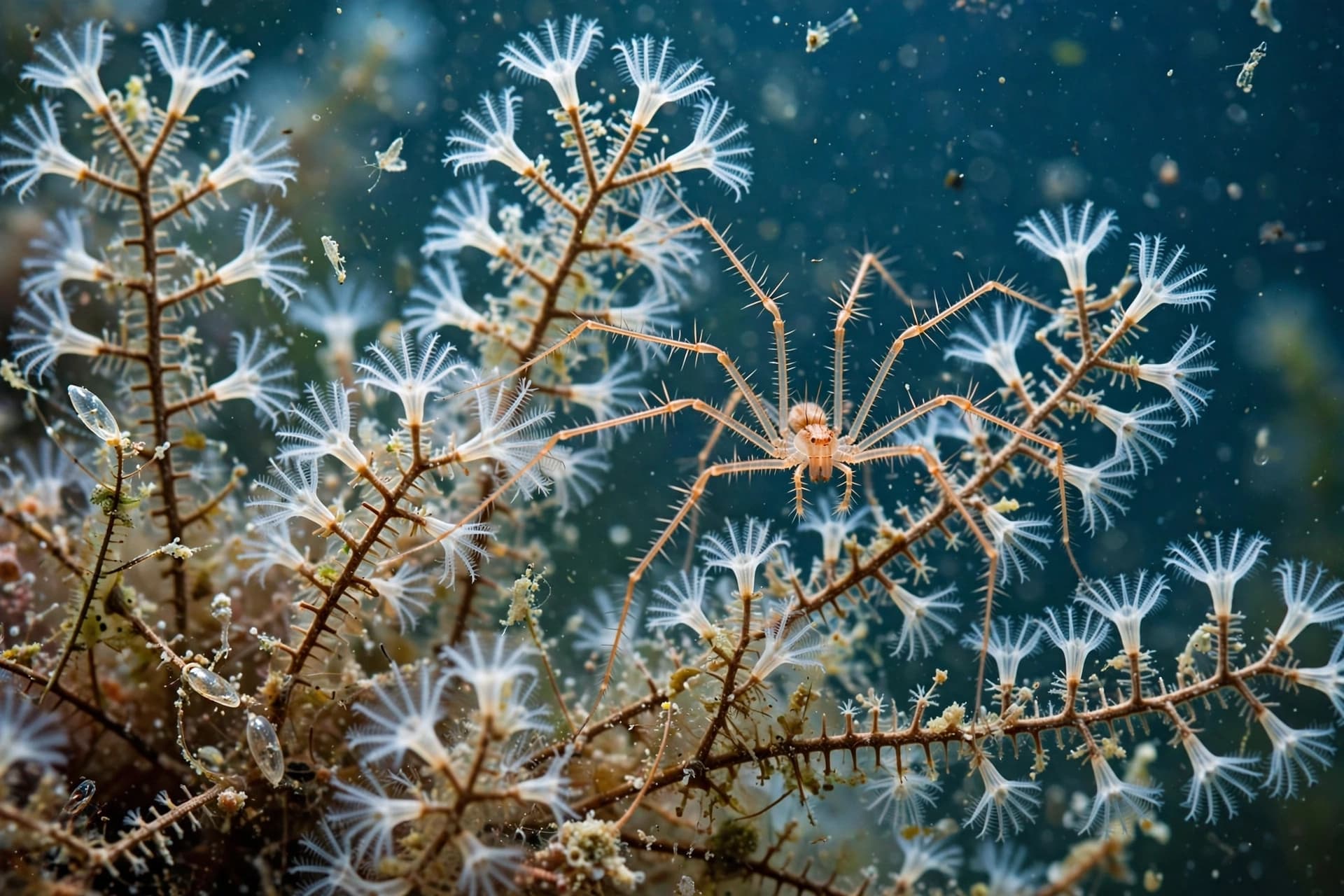
They are creatures that seem assembled from the edges of imagination: eight legs covered in fine spines, bodies so small they could rest on a thumbnail, eyes that glow a deep red. They are sea spiders, and they belong to a lineage so old that it branched away from the ancestors of land spiders long before forests or flowers existed. They have never left the ocean. In the cold, quiet waters of the Salish Sea, researchers have now found two species that science had never described before.
The discovery came from a master's project at the University of British Columbia, led by zoology student Cormac Toller-Scott. Between September 2023 and August 2024, he and a team of divers explored marine habitats up to eighteen meters deep around Quadra Island, Vancouver, Bamfield, and Victoria . The Salish Sea, which stretches between southern British Columbia and Washington State, is home to a rich but understudied community of marine invertebrates. Before this work, only about twenty species of sea spider had been documented in the region .
The researchers collected as many different sea spiders as they could find, then examined their bodies under microscopes, comparing fine details against every other known species in the world. They also extracted genetic data and compared it with existing records . When they finished, two of the collected specimens stood apart. They were new to science.
Both new species were found living on hydroids, which Toller-Scott described as "like a jellyfish that is attached to the ground" . The sea spiders never leave these hosts; they walk across them, feeding by piercing the hydroid's tissue with a proboscis and consuming small pieces. "You could consider them a parasite of that larger organism," Toller-Scott said .
One of the new species was named Callipallene pilosuspedes, a Latin play on "hairy feet," after the fine spines covering its lower legs. The other, Tanystylum kiixin, takes its name from an Indigenous village site near where the specimens were collected . The naming honors both the physical distinctiveness of the creatures and the human history of the place they inhabit.
Sea spiders are not true spiders, though they are distant relatives. They diverged from the lineage that would eventually produce terrestrial spiders hundreds of millions of years ago, and they have remained in the sea ever since . Their bodies are unusual: most of their internal organs, including the digestive system and gonads, reside in their legs. They breathe not through lungs or gills but through direct diffusion across their exoskeleton. For creatures so alien in construction, they are surprisingly abundant in many marine environments, from shallow tide pools to the deep sea.
The discovery is a small addition to a large gap. Marine invertebrates in the Salish Sea, and in many coastal regions worldwide, remain poorly catalogued. Each new species described is a reminder of how much remains unknown in waters we can see from shore. It is also a reminder of the value of careful, patient field work—of divers collecting specimens by hand, of microscopes and genetic sequencers, and of the quiet recognition that the natural world still holds forms we have not yet named.
AI Image Disclaimer: The accompanying images in this report were created with artificial intelligence and are intended for conceptual representation only.
Sources: CBC News, UBC News
Published by Banx Network. This article is part of the Banx decentralized media programme, powered by the BXE token on the XRP Ledger.