High above the turning Earth, where dawn arrives every ninety minutes and continents drift silently beneath a silver horizon, a small fragment of stone waited in stillness. It had traveled for ages through the cold corridors of space before falling to our planet. Now, inside the measured calm of the International Space Station, it faced something entirely different: life.
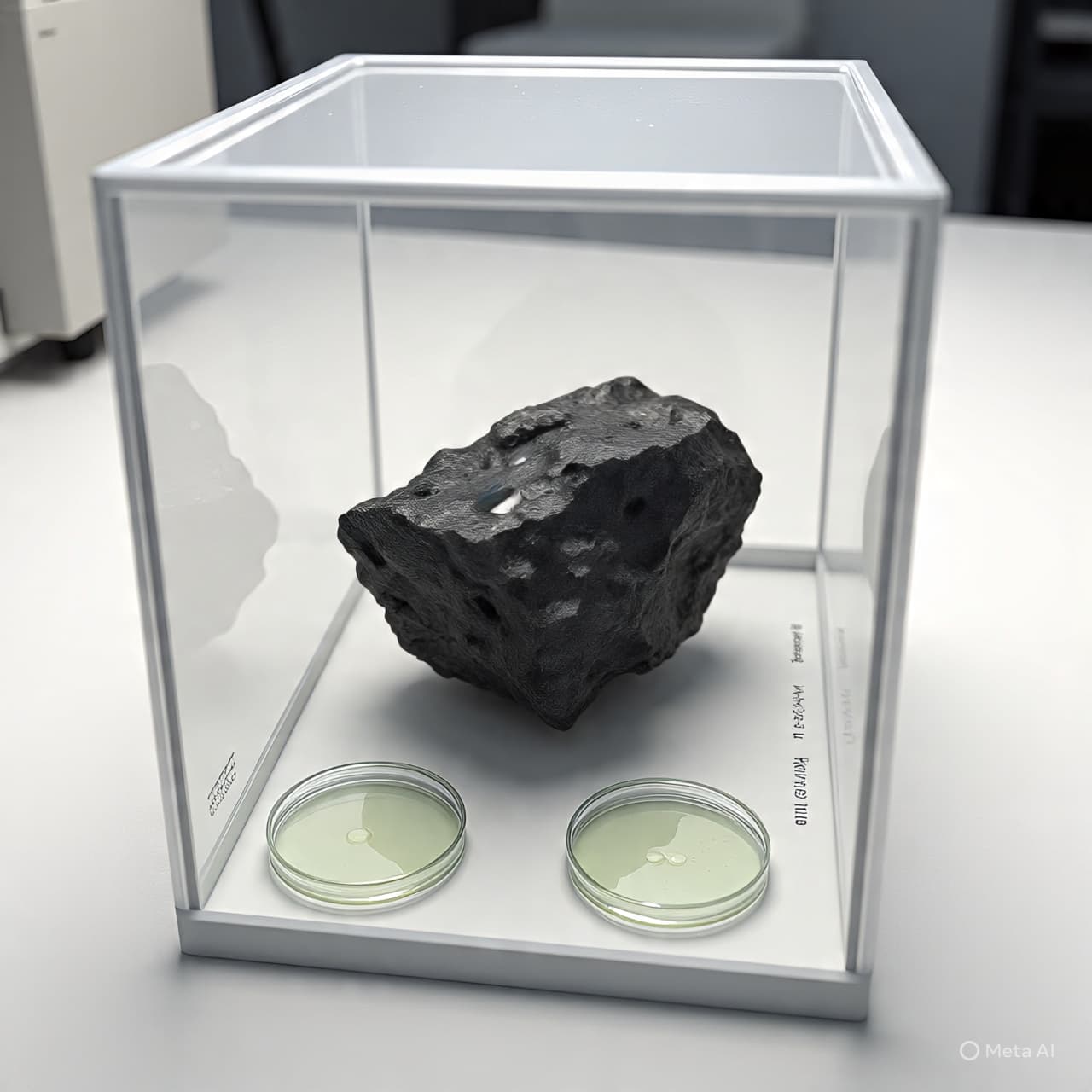
The meteorite, carefully prepared and monitored, spent nineteen days exposed to microbial communities as part of an experiment designed to probe a question that has lingered at the edges of science for generations. Can the building blocks of life endure the harsh conditions of space? And if so, what does that mean for the ancient exchange between worlds?
Researchers working with agencies including NASA and the European Space Agency placed microbial samples in controlled proximity to the meteorite material aboard the orbiting laboratory. The goal was not spectacle but precision: to observe how microorganisms interact with extraterrestrial rock under microgravity, radiation exposure, and the fluctuating thermal conditions of low Earth orbit.
When the samples returned for analysis, scientists reported findings that deepened rather than simplified the mystery. Certain microbes demonstrated a capacity to survive — and in some cases maintain metabolic activity — after their time in orbit. More strikingly, researchers were able to extract intact biological signatures following exposure, suggesting that some forms of life can endure conditions once thought too extreme for sustained survival.
The meteorite itself, formed billions of years ago in the early solar system, carries within it a record of chemical processes predating Earth’s own biosphere. By pairing it with living organisms in space, scientists hoped to simulate aspects of what is known as lithopanspermia — the hypothesis that life, or its precursors, might travel between planets via rock fragments ejected by impacts.
The experiment does not confirm that life moves freely between worlds. It does not suggest that microbes are drifting in abundance across interplanetary space. But it does refine the boundaries of possibility. If microorganisms can survive limited exposure to radiation and vacuum conditions while shielded within or alongside rock, then the ancient exchange of material between planets becomes a more plausible vessel for biological resilience.
Inside the station’s modules, where astronauts conduct experiments against a backdrop of endless night, the meteorite’s nineteen days passed without drama. Yet in laboratories back on Earth, microscopes and genetic sequencing tools revealed subtle endurance. The extracted material showed that microbial structures and, in some cases, biomolecular traces remained detectable after orbital exposure.
Such findings carry implications beyond curiosity. They inform planetary protection protocols, shape how missions search for life on Mars and icy moons, and guide our understanding of contamination risks — both outward and inward. They also remind us that life, once established, is neither fragile nor easily erased.
The study’s results were released following post-mission laboratory analysis, with researchers emphasizing that further experiments will be necessary to determine long-term survivability and evolutionary effects. For now, the meteorite has returned to Earth’s gravity, and the microbes have yielded data rather than declarations.
In the vast dialogue between stone and cell, between cosmic silence and living chemistry, nineteen days in orbit have offered one quiet, measured insight: life, in certain forms, may be more persistent than once imagined.
Illustrations were created using AI tools and are not real photographs.
Sources (Media Names Only)
NASA European Space Agency Space.com Live Science Nature
Published by Banx Network. This article is part of the Banx decentralized media programme, powered by the BXE token on the XRP Ledger.